The Role of Music in Early Childhood Education
Exploring the Transformative Role of Music in Supporting Holistic Development and Learning Throughout Early Childhood Years.

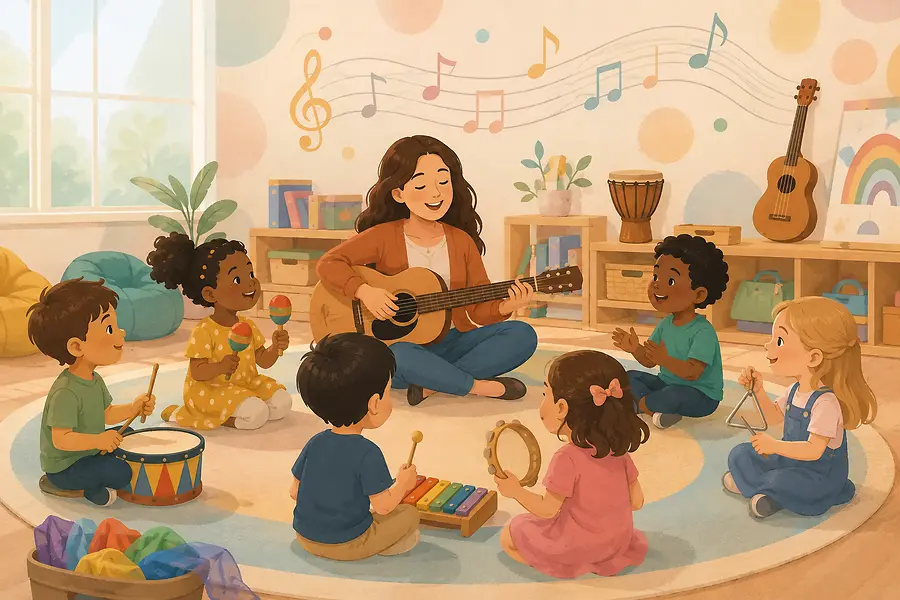
Music is a fundamental component of early childhood education that supports children's cognitive, linguistic, physical, social-emotional, and creative development. Far beyond entertainment, music functions as a powerful developmental tool that promotes neural organization, language acquisition, executive functioning, emotional regulation, and cultural understanding during the early years of life. Young children naturally engage with rhythm, melody, movement, and vocal expression long before they develop advanced verbal communication skills, making music one of the earliest forms of learning and self-expression. Contemporary research in developmental psychology, neuroscience, and early childhood education consistently demonstrates that intentional music experiences contribute to school readiness while fostering curiosity, collaboration, and lifelong appreciation for artistic expression.
High-quality early childhood programs therefore incorporate music as an integrated element of daily instruction rather than treating it as an isolated enrichment activity. Effective educators intentionally design music-rich environments that encourage exploration, experimentation, creativity, and meaningful participation while remaining responsive to children's developmental stages, interests, cultural backgrounds, and individual learning needs. This paper examines the developmental stages of music, music development, planning and preparing supportive learning environments, characteristics of effective music environments, integrating music play throughout the curriculum, major types of music experiences, and the educational significance of songs and singing within early childhood education.
Children's musical abilities emerge progressively throughout infancy, toddlerhood, preschool, and the early elementary years. Musical development follows predictable developmental patterns while also reflecting individual differences in temperament, experience, neurological maturation, and environmental exposure. During infancy (birth to approximately 12 months), children respond instinctively to rhythm, pitch, tempo, and the emotional qualities of music. Infants demonstrate preferences for familiar voices, recognize recurring melodies, and often calm in response to soothing lullabies. Research suggests that musical experiences during infancy strengthen auditory discrimination, attention, memory formation, and caregiver attachment while stimulating neural pathways associated with language development.
Toddlers (ages one to three years) begin actively participating in musical experiences through spontaneous movement, imitation, rhythmic exploration, and vocal experimentation. At this stage, children clap, sway, bounce, dance, and attempt to reproduce simple melodies. Children often mimic well-known tunes and take pleasure in recurring musical activities, which helps strengthen their memory and provides predictability. Music also enhances gross motor coordination and encourages emerging social interactions through shared participation.
Preschool-aged children (three to five years) demonstrate increasingly sophisticated musical understanding. They begin to match pitch more accurately, maintain rhythmic patterns, distinguish musical contrasts, and participate in group performances. Preschoolers often create original songs, experiment with instruments, invent movements to accompany music, and use musical expression during imaginative play. Their growing symbolic thinking allows them to connect music with stories, emotions, dramatic play, and cultural experiences.
As children approach kindergarten and the primary grades, musical development expands into greater rhythmic precision, melodic awareness, instrument exploration, and an understanding of musical structures. These developmental milestones reinforce literacy, mathematical reasoning, executive functioning, and collaborative learning while strengthening children's confidence and creative identity.
Music development encompasses the gradual acquisition of musical knowledge, skills, attitudes, and appreciation through meaningful experiences. Rather than emphasizing formal performance, developmentally appropriate music education prioritizes exploration, creativity, active participation, and joyful engagement. Neurological research demonstrates that music activates multiple regions of the brain simultaneously, including those associated with language processing, executive functioning, motor coordination, emotional regulation, memory, and attention. This broad neurological activation explains why music contributes to learning across developmental domains.
Cognitively, musical experiences strengthen sequencing, pattern recognition, auditory discrimination, problem-solving, and working memory. Children learn to recognize repeated rhythms, anticipate musical changes, and organize information through structured musical experiences. Language development is equally enhanced through music. Songs expose children to new vocabulary, sentence structures, phonological awareness, rhyming patterns, and expressive language. Repeated singing improves articulation while supporting early literacy skills such as syllable segmentation, sound discrimination, and oral language fluency.
Music also promotes physical development. Dancing, clapping, marching, instrument play, and coordinated movement strengthen both gross and fine motor skills while improving bilateral coordination, balance, timing, and body awareness. Social-emotional development benefits significantly from shared musical experiences. Group singing encourages cooperation, empathy, turn-taking, emotional expression, and a sense of belonging. Music additionally provides a healthy outlet for emotional regulation by helping children recognize, communicate, and manage feelings through creative expression.
Planning is essential for creating meaningful music experiences that support children's learning and development. Educators should thoughtfully organize physical spaces, instructional materials, daily routines, and learning opportunities that encourage active musical exploration. A developmentally appropriate music environment provides easy access to diverse instruments, listening materials, scarves, ribbons, rhythm sticks, movement props, puppets, and culturally representative musical resources. Materials should be organized on accessible shelves that encourage independence while promoting responsibility for classroom resources.
Planning should incorporate Universal Design for Learning (UDL) principles to ensure accessibility for all learners, including children with disabilities. Adaptive instruments, visual schedules, picture communication supports, noise-reducing headphones, alternative seating, and multiple methods of participation allow every child to engage meaningfully in musical experiences regardless of physical, sensory, cognitive, or communication differences. Teachers should also intentionally schedule music throughout the daily routine rather than limiting it to isolated music periods. Transition songs, clean-up songs, greeting songs, movement breaks, and calming music naturally integrate learning while supporting classroom management and predictable routines.
Observation and assessment remain essential components of planning. Educators continuously observe children's interests, developmental progress, and emerging abilities to design increasingly meaningful musical experiences that reflect children's individual strengths and learning needs.
An effective music environment encourages creativity, exploration, experimentation, and joyful participation. Rather than emphasizing performance or perfection, high-quality music environments invite children to investigate sounds, rhythms, movement, and self-expression in psychologically safe and developmentally appropriate ways.
The physical environment should include designated areas where children can independently explore instruments without disrupting other learning experiences. Musical materials should represent diverse cultures, languages, traditions, and family experiences to promote inclusion, cultural responsiveness, and global awareness.
Environmental design should also address sensory considerations. Some children thrive in energetic musical settings, whereas others require quieter spaces or opportunities to participate gradually. Flexible participation options respect children's individual sensory profiles while promoting positive engagement. Visual supports, musical notation symbols, photographs of instruments, movement cards, and multicultural displays further enrich the learning environment by connecting music with literacy, culture, and visual learning.
Educators contribute significantly to the music environment through responsive interactions that encourage curiosity, experimentation, and confidence. Open-ended questions such as "How could you change this rhythm?" or "What feeling does this music express?" promote higher-order thinking rather than simply evaluating performance accuracy.
Music serves as a highly effective interdisciplinary teaching strategy that enhances learning across all curriculum areas. Integrating music throughout the curriculum allows children to construct knowledge through meaningful, engaging, and developmentally appropriate experiences.
Language and literacy development are strengthened through nursery rhymes, storytelling songs, alphabet songs, phonemic awareness activities, and rhythmic poetry. Singing supports vocabulary acquisition, oral language development, listening comprehension, and early reading readiness.
Mathematics naturally connects with music through counting songs, rhythmic patterns, sequencing, measurement, fractions, tempo comparisons, and pattern recognition. Musical experiences allow children to experience mathematical concepts in concrete, meaningful ways.
Science education benefits from songs about weather, animals, life cycles, seasons, and environmental exploration. Children deepen scientific understanding by combining observation with movement, rhythm, and musical storytelling.
Social studies instruction incorporates music representing diverse cultures, historical traditions, community celebrations, and global perspectives. Exposure to multicultural music promotes respect for diversity while helping children appreciate cultural similarities and differences.
Music also enriches visual arts, dramatic play, physical education, and social-emotional learning by encouraging creativity, collaboration, self-expression, and imaginative exploration across multiple learning contexts.
Early childhood classrooms should expose children to a wide variety of musical styles that reflect cultural diversity, artistic expression, and different emotional experiences. Diverse musical exposure broadens children's appreciation while supporting inclusive educational practices. Children benefit from listening to classical music, folk music, multicultural music, jazz, blues, country, gospel, Indigenous music, world music, children's songs, contemporary educational music, instrumental compositions, and nature-inspired soundscapes. Each genre offers unique opportunities to explore rhythm, melody, harmony, tempo, instrumentation, and cultural traditions.
Educators should intentionally select music that reflects the backgrounds of the children and families represented within the classroom while also introducing unfamiliar musical traditions that expand cultural awareness. Authentic multicultural music encourages children to appreciate global diversity and recognize music as a universal form of human communication.
Live music experiences, including classroom performances, family participation, community musicians, and instrument demonstrations, provide meaningful opportunities for authentic musical engagement beyond recorded media. Singing represents one of the most accessible and developmentally appropriate musical experiences available in early childhood education. Unlike many instructional resources, singing requires minimal materials while producing substantial developmental benefits across multiple domains.
Regular singing strengthens language development by increasing vocabulary, improving pronunciation, reinforcing syntax, and promoting phonological awareness. Through rhythm, rhyme, and predictable language patterns, repetitive songs enhance memory retention and support emergent literacy. Singing also promotes emotional regulation, building confidence, self-expression, and a sense of belonging to a group. Additionally, group singing fosters community while encouraging active listening, cooperation, and shared participation. During group singing activities, children who might otherwise feel reluctant to speak on their own often join in comfortably.
Educational songs also support classroom routines by providing predictable cues for transitions, clean-up, greetings, attendance, and calming activities. These musical routines reduce behavioral challenges while increasing independence and classroom organization. Educators should encourage enthusiastic participation rather than technical perfection. Every child's voice deserves validation regardless of pitch accuracy or musical ability. Inclusive singing experiences strengthen children's confidence, creativity, and willingness to participate in future learning opportunities.
Music is an indispensable element of high-quality early childhood education because it supports holistic child development while fostering creativity, communication, collaboration, and lifelong learning. Understanding children's developmental stages enables educators to provide developmentally appropriate musical experiences that promote cognitive, linguistic, physical, social-emotional, and creative growth. Purposefully planned music environments, inclusive classroom design, and intentional curriculum integration ensure that all children can participate meaningfully regardless of developmental ability or learning differences.
Furthermore, exposing children to diverse musical experiences and encouraging regular singing strengthens cultural competence, language development, executive functioning, and emotional well-being. Children experience joyful, engaging, developmentally meaningful, and culturally responsive learning when educators purposefully integrate music into the daily curriculum instead of treating it as an isolated enrichment activity. As research continues to demonstrate the far-reaching benefits of music during early childhood, its integration remains an essential component of effective, inclusive, and evidence-based educational practice.


