THE SILENT GUARDIAN: A STORY OF CATHODIC PROTECTION

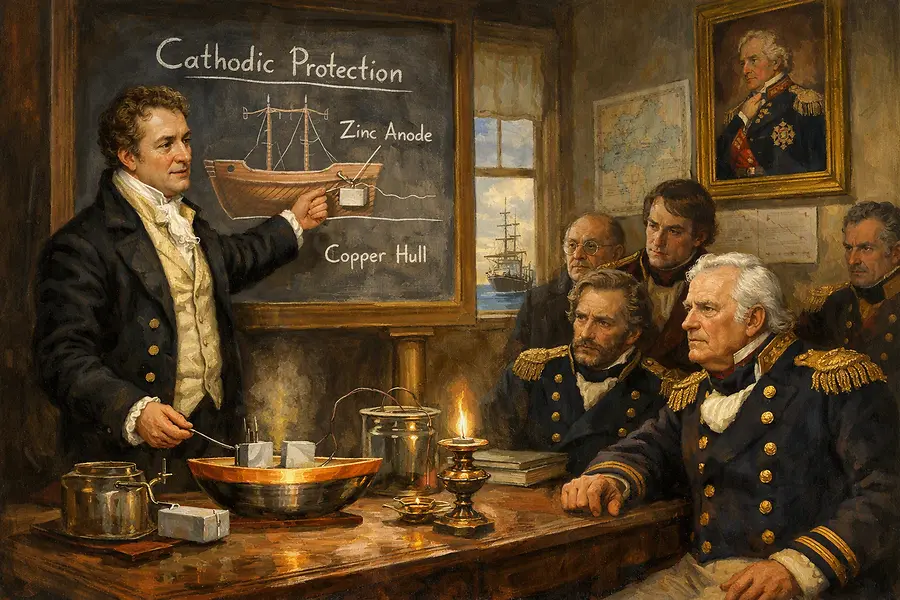
The Dockyards of Portsmouth, 1824
The salty air clung to the copper hulls of Britain's proud naval fleet. Shipwrights shook their heads as they scraped away the green corrosion that seemed to bloom overnight.
"Another voyage, another fortune lost to the sea," muttered Captain Harwood, running his hand over the pitted copper. "If this continues, the Empire's ships will rot before they sail."
Enter Sir Humphry Davy, chemist, inventor, and a man with a reputation for daring ideas. He stood before the Admiralty, chalk in hand, sketching strange diagrams of currents and metals.
"What if," Davy began, his voice steady, "we could make copper immune to the sea's bite? Not by covering it, but by changing its very nature by forcing it to behave as a cathode."
The room fell silent. Admirals exchanged sceptical glances. "You mean… protect copper by sacrificing another metal?" one asked.
Davy nodded. "Zinc. Iron. They will corrode in place of copper. The ship will live, though the anodes will die."

The Experiment
Weeks later, sailors bolted blocks of zinc to the hull of HMS Samarang. As the ship cut through the waves, the crew watched anxiously.
Months passed. When the vessel returned, the copper gleamed as if untouched. The Admiralty was astonished.
Captain Harwood clasped Davy's hand. "You've done it, sir. You've given our fleet a shield no cannon can breach."
But Davy's triumph was short-lived. The zinc slowed the ships, fouling their hulls with marine growth. Admirals grumbled, and the experiment was abandoned. Yet the seed was planted; the principle of cathodic protection had been born.

The Legacy
Years later, Michael Faraday, Davy's protégé, refined electrochemistry. Engineers began applying cathodic protection to pipelines, tanks, and bridges.
Fast-forward to Ghana's oilfields, where engineers in reflective vests kneel beside buried pipelines. They connect wires, measure currents, and adjust power supplies.
"Check the potential," says Sika, a corrosion engineer. The voltmeter hums. "Perfect. The steel is safe. The anodes will take the damage."
Her colleague smiles. "It's like having a bodyguard for the pipeline—one that throws itself in harm's way."


The Modern Breakthrough
For decades, scientists debated the exact mechanism. Was CP simply shifting electrons, or was something deeper at play?
In 2024, researchers at ETH Zurich finally cracked the mystery. They proved that CP pushes steel into an "immune state," halting corrosion altogether. The discovery unified standards worldwide.

The Silent Guardian
From copper-clad warships to buried pipelines in Accra, cathodic protection remains a silent guardian. It sacrifices so that steel may endure, protecting economies, environments, and lives.
As Sika closes her inspection log, she looks at the pipeline stretching across the horizon. "Funny," she says, "two hundred years ago, Davy saved ships. Today, he saves nations."


