The Silent Weight of Failure in Higher Education
How institutional systems and psychological factors shape whether failure becomes a source of growth or shame in higher education.

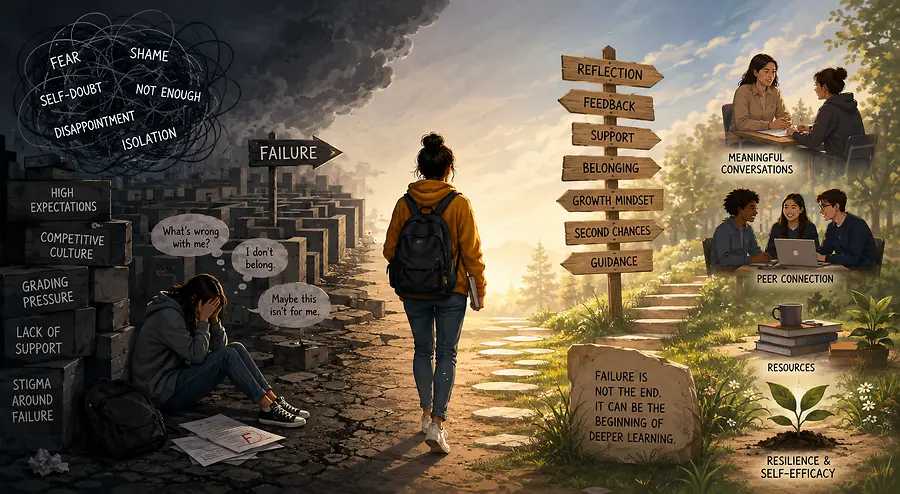
Failure in Higher Education: Understanding the Psychology Behind Academic Setbacks
Failure in higher education is often treated as a final outcome: A low grade, a failed course, a delayed graduation, or an academic warning.
But psychologically, failure is rarely just about performance.
It is often connected to fear, identity, belonging, expectations, confidence, and the silent pressure students carry when they believe they must succeed without struggle. In many higher education spaces, students are taught how to pass, but they are not always taught how to understand failure. They are expected to be resilient, but they are not always provided with the emotional, academic, and institutional support needed to rebuild after disappointment.
This is where the conversation around failure in higher education needs to shift.
Failure should not be understood only as a student's weakness. Sometimes, failure reveals a gap in preparation. Sometimes, it reveals a lack of support. Sometimes, it reveals misalignment between teaching methods, student needs, and institutional expectations.
In this sense, failure becomes not only a student experience but also an institutional mirror. Paul Feigenbaum (2021) captures this contradiction clearly in his article, Telling Students It's O.K. to Fail, but Showing Them It Isn't. He explains that higher education often promotes positive language around failure, while its structures continue to make failure feel dangerous. As he writes, institutions may speak about generative failure, but they often operate through stigmatized failure.
Generative failure is "learner-centered and process-driven," while stigmatized failure is "institution-centered and grades-driven". This distinction matters deeply. When failure is generative, it becomes part of learning. It provides students with feedback, encourages reflection, and creates opportunities to try again. Feigenbaum describes generative failure as a process where mistakes and setbacks are "temporary, healthy, and integral components of any learning process" (Feigenbaum, 2021).
But when failure is stigmatized, it becomes a judgment. It tells students that they are behind, unprepared, incapable, or not good enough. It can cause students to question their intelligence, their place in the classroom, and even their future.
This is why failure in higher education is never only academic.
It is emotional. It is social. It is psychological.
Rawle, Laliberté, and Guadagnolo (2026) explain that failure is central to learning, yet it is often surrounded by stigma and anxiety. Their interdisciplinary review reminds us that failure "permeates higher education," but it is not always discussed as a formative part of teaching and learning. They also emphasize that failure is not experienced equally by all students. Access, opportunity, power, privilege, time, and support determine whether a student can learn from failure or be harmed by it.
This point is especially important because higher education often celebrates resilience without asking who is given the conditions necessary to be resilient.
Some students have financial stability, family support, academic confidence, flexible schedules, and familiarity with university systems. Others are navigating employment, caregiving responsibilities, health concerns, disabilities, language barriers, immigration challenges, or first-generation responsibilities. For these students, failure may not feel like a temporary academic moment. It may feel like confirmation that they do not belong.
Rawle and colleagues argue that failure is connected to power and privilege because marginalized learners may have fewer resources or less time to recover from academic setbacks. They state clearly that failure is "intractable from power and ought to be studied as such" (Rawle et al., 2026). This challenges the common idea that students simply need more grit.
Sometimes, the issue is not a lack of grit. Sometimes, the issue is a lack of safety nets. Sometimes, the issue is a system that asks students to recover without giving them the space, guidance, or dignity to do so.
Ajjawiet et al., (2020) add another important layer by focusing on students who failed but continued their studies. Their findings show that academic failure is not caused by one simple factor. Instead, students explained failure through a combination of dispositional, situational, and institutional factors. The authors argue that this perspective "shifts the blame away from individuals who are framed as part of a deficit model"
This is powerful because higher education often speaks about persistence as if it is only an individual trait. However, persistence is not only about personal motivation. It is also shaped by advising, belonging, curriculum design, feedback, faculty response, institutional policies, and whether students feel safe enough to ask for help.
Ajjawi and colleagues also found that students who fail often carry a significant emotional burden. Students described feelings of shame, embarrassment, disappointment, anger toward themselves, and feeling "stupid." These emotions can damage confidence and self-efficacy and may prevent students from seeking support when they need it most.
This brings us back to the deeper question. The question is not only: Why did this student fail? The deeper question is: What kind of system allows failure to become a source of silence, isolation, and self-doubt instead of growth, guidance, and transformation?
Fear of failure also shapes how students engage in learning. Nakhla's study on fear of failure, academic motivation, and student engagement found that fear of failure is associated with motivation and engagement in complex ways. Students with high fear of failure and low motivation demonstrated overall disengagement, while students with low fear of failure and high motivation demonstrated stronger engagement across skills, emotions, participation, and performance (Nakhla, 2019).
This reminds us that fear is not a small emotion in education. It can shape whether students participate, take risks, ask questions, seek feedback, or quietly withdraw from the learning process.
When we understand the psychology of failure, We begin to see students more fully. Not as numbers. Not as outcomes. Not as problems to be corrected. But as human beings learning how to navigate pressure, Uncertainty, disappointment, and the difficult process of becoming.
Failure should not be romanticized. It should not be used as a motivational slogan without structural support. It should not be presented as beautiful while students are left alone in shame. Failure should be understood, guided, and supported.
A more humane higher education system would treat failure as information, not identity.
It would help students understand what happened, what support is available, what can be changed, and how they can continue. It would create learning environments where feedback comes before final judgment, where struggle is discussed openly, and where recovery is part of the curriculum rather than an individual burden. Because sometimes the most important learning does not begin with success. It begins with the moment a student is given the chance to rise again with support, dignity, and a deeper understanding of themselves.


