The Strategic Rise of Instructional Design: Building a Workforce That Performs, Not Just Learns
How instructional design has evolved from a support function into a strategic business capability that drives organizational performance and competitive advantage.

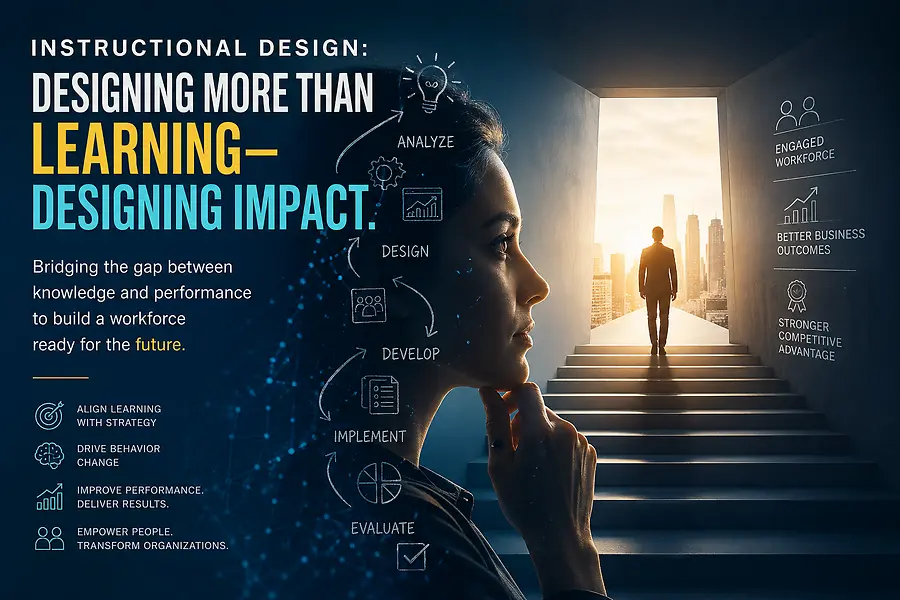
The Strategic Rise of Instructional Design: Why It Matters Now More Than Ever
Instructional design is no longer a support function—it is a core business capability.
As organizations navigate rapid digital transformation, workforce disruption, and escalating performance expectations, the ability to design learning that directly drives outcomes has become a competitive differentiator.
The modern instructional designer is not simply a content creator; they are a performance architect operating at the intersection of business strategy, human behavior, and systems thinking.
From Content Delivery to Performance Engineering
Historically, training functions focused on content dissemination—courses, manuals, and workshops designed primarily to transfer knowledge.
This model is increasingly obsolete.
Today’s organizations require measurable behavior change, operational efficiency, and accelerated capability building.
Instructional designers address this gap by diagnosing performance problems, identifying root causes, and designing targeted interventions aligned with business KPIs.
This shift reframes instructional design as a discipline grounded in applied science.
It leverages principles from cognitive psychology, behavioral economics, and organizational development to ensure that learning translates into execution.
Frameworks such as ADDIE and Agile are not rigid processes; they are decision-making systems that guide designers in building scalable, adaptive learning ecosystems.
Why the Workforce Needs Instructional Designers
The global workforce is facing a readiness crisis.
Employees are often equipped with information but lack the ability to apply it effectively in dynamic, high-stakes environments.
Instructional designers close this gap by ensuring that learning is relevant, contextualized, and immediately actionable.
At the individual level, they enable employees to perform with confidence and competence.
At the team level, they standardize performance and reduce variability.
At the organizational level, they align learning initiatives with strategic priorities, ensuring that every training investment contributes to measurable outcomes such as:
- Revenue growth
- Cost reduction
- Risk mitigation
- Customer satisfaction
Without instructional design, organizations default to fragmented learning experiences that fail to scale and rarely produce sustained impact.
With it, learning becomes an integrated system that drives continuous improvement and competitive advantage.
The Economic Impact of Instructional Design
Instructional design does not merely influence learning—it influences economic performance.
When employees are trained effectively, productivity increases, errors decrease, and innovation accelerates.
These improvements compound across teams and functions, ultimately affecting organizational profitability and market positioning.
At a macro level, a workforce equipped with applied skills and adaptive thinking contributes to stronger industries and more resilient economies.
Instructional designers play a critical role in this ecosystem by ensuring that talent development keeps pace with technological advancement and market shifts.
Why Individuals Should Become Instructional Designers
Pursuing a career in instructional design offers a unique opportunity to operate at the nexus of strategy and impact.
It is one of the few professions where you can directly influence how organizations think, perform, and grow.
The field demands a blend of analytical rigor and creative execution.
Designers must be able to:
- Assess business needs
- Translate those needs into learning strategies
- Build experiences that drive behavior change
This requires not only technical proficiency with tools and platforms but also strong business acumen and stakeholder management skills.
As demand for performance-driven learning continues to rise, instructional designers are increasingly positioned as strategic partners rather than support staff.
They are consulted on:
- Organizational change initiatives
- Digital transformation efforts
- Leadership development programs
These are the very areas shaping the future of work.
The Future of Instructional Design
The integration of artificial intelligence, data analytics, and immersive technologies is redefining what instructional design can achieve.
Designers can now create highly personalized learning experiences, predict performance outcomes, and continuously optimize interventions based on real-time data.
However, technology does not replace the instructional designer—it amplifies their role.
The ability to ask the right questions, design for human behavior, and align solutions with business objectives remains uniquely human.
As tools evolve, the strategic importance of instructional design will only increase.
Conclusion
Instructional design is no longer optional—it is essential.
Organizations that invest in this capability will be better equipped to navigate complexity, drive performance, and sustain growth.
For individuals, it represents a career path defined by relevance, impact, and opportunity.
In a world where the gap between knowing and doing continues to widen, instructional designers are the professionals who close it.
They do not just build courses—they build capability, performance, and the future of the workforce.