The CEO Who Does Everything - Is The CEO Who Can't Grow
How Trusting the Right Executive Virtual Assistant Transforms Your Business from Overwhelmed to Scaled

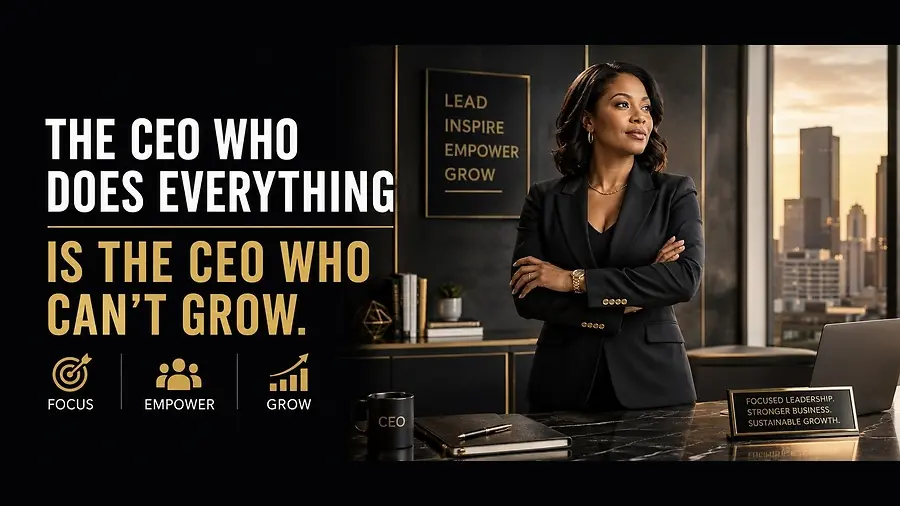
There is a particular kind of exhaustion that only founders and CEOs recognize in each other. It isn't the exhaustion of working hard—most of us signed up for that. It's the exhaustion of working hard on the wrong things. Of ending a sixty-hour week having moved the business forward by inches, because the hours went to inbox triage, calendar Tetris, formatting a proposal, and chasing down a vendor invoice instead of the strategy, the relationships, and the decisions that actually grow the company.
The research backs up what most of us already feel in our bodies by Friday. A Harvard Business School study that tracked 60,000 hours across 27 CEOs found they work an average of 62.5 hours a week, with the workday stretching across weekends and vacation days as well. Small business owners report something similar from a different angle: 70% say time management is one of their biggest challenges, and nearly half admit they're personally handling administrative work that could be delegated or automated entirely.
The math is simple. The decision to act on it rarely is.
The Real Reason We Don't Delegate
If the case for delegating were purely about time and money, every founder would already have an executive assistant. The benefits are well documented—businesses that bring in virtual support report saving on operating costs compared to a full in-house hire, and the majority of small business owners who do delegate say it frees them up to focus on growing the business instead of running it. So why do so many capable, intelligent business owners keep doing it all themselves?
Because it was never really a time problem. It's a trust problem.
Industry research on delegation resistance points to the same root cause repeatedly: business owners hesitate not because they doubt a virtual assistant could learn the tasks, but because they doubt anyone else could be trusted with their reputation, their client relationships, and the parts of the business that live only in their own head. When you've built something from nothing, handing it to someone you haven't met in person—someone who works from a screen instead of a desk down the hall—can feel less like delegating and more like exposure.
That fear is not irrational. It's earned. Many founders have a story—a bad hire, a missed deadline, a contractor who disappeared mid-project—that taught them caution the hard way. The problem isn't that the hesitation exists. The problem is what it costs to let it run the show indefinitely.
What Staying Stuck Actually Costs
Every hour a CEO spends formatting a deck, responding to routine emails, or untangling a scheduling conflict is an hour not spent with a customer, not spent shaping strategy, not spent building the next stage of the business. Harvard's research on CEO time allocation found that the best-performing leaders spend roughly a quarter of their time on people and culture, and about a fifth on strategy—and that the gap between leaders who protect that time and those who don't shows up directly in company performance.
For small business owners specifically, the data is even more pointed: more than half of entrepreneurs say they regularly spend significant portions of their day on tasks that don't move their core business forward. That's not a productivity hack away from being solved. It's a delegation problem, full stop.
And the cost compounds. Burnout among founders is well documented, with roughly a third reporting significant burnout tied directly to long hours and the inability to switch off. A business that depends entirely on its founder doing everything isn't actually a scalable business—it's a job with extra liability. Every week spent buried in tasks that someone else could be trusted to handle is a week the company didn't grow the way it could have.
Trust Isn't Given. It's Built—On Purpose.
This is where I think the conversation about executive virtual assistance usually goes wrong. Too many agencies treat trust as something that simply accumulates over time, like rapport. I don't. At Robert Lee and Associates, I built our vetting process around a different idea entirely: trust has to be engineered before day one, not earned after the fact.
When I evaluate a candidate to become one of our Executive Virtual Assistants, I'm not only reviewing a resume or testing software fluency. I'm holding that candidate to the exact standard my own clients hold me to. Every expectation a CEO has of me when they hire Robert Lee and Associates—discretion, follow-through, sound judgment under ambiguity, and the ability to represent a brand as if it were their own—is the same expectation I require of the EVA I place with them. I don't ask my clients to trust a stranger. I ask them to trust someone who has already been measured against the standard their business deserves.
That distinction matters, because it's exactly where the freelance marketplace model tends to fail business owners. A platform can verify a skill. It cannot verify judgment. It cannot tell you whether the person managing your inbox will know when something needs your immediate attention versus when it can wait until Monday. That kind of discernment is what separates an assistant from a true executive partner—and it's the entire reason a structured agency model, with real vetting and real accountability behind it, exists.
Built in America, for the Businesses Building America
I'm also deliberate about something else: Robert Lee and Associates is U.S.-based—owned, operated, and staffed by professionals working right here on American soil. That matters for trust, too. Time zone alignment, shared communication norms, and accountability under U.S. business standards remove an entire category of uncertainty that keeps founders up at night when they're deciding whether to hand someone the keys.
Made in America. Built by Americans. That's not a marketing line for us—it's an operating principle, and it's part of how we close the trust gap before it ever has a chance to open.
What Becomes Possible on the Other Side of Trust
I've watched it happen enough times to know the pattern. A founder hires their first Executive Virtual Assistant white-knuckled, half-expecting to regret it. Within weeks, the inbox stops being a source of dread. The calendar stops being a battlefield. Client follow-ups happen on time without reminders. And slowly, the founder starts doing the thing they started the business to do in the first place—leading it, rather than just running it.
That shift is available to far more CEOs, founders, and small business owners than currently believe it is. The barrier was never capability. It was never even budget, in most cases. It was the unanswered question of whether anyone outside their own head could be trusted to carry a piece of the business responsibly.
Given the right partner, an Executive Virtual Assistant isn't a risk to the business you built. They're how it keeps growing.
If you're a CEO, founder, or business owner who recognizes yourself in this—buried in the day-to-day, telling yourself you'll delegate once things calm down—I would offer the same thing I tell every client I sit down with: things rarely calm down on their own. The businesses that scale are the ones where the founder decides to trust, deliberately and on purpose, before they're forced to.
- Angela Cain is the Founder and CEO of Robert Lee and Associates, a U.S.-based Executive Virtual Assistant agency matching CEOs, founders, and small business owners with dedicated Executive Virtual Assistants. Learn more at www.robertleeassoc.com.