The U.S. Turns 250 Climate Change at a Crossroads
Confronting the climate crisis and reimagining America's energy future as the nation marks its 250th anniversary.

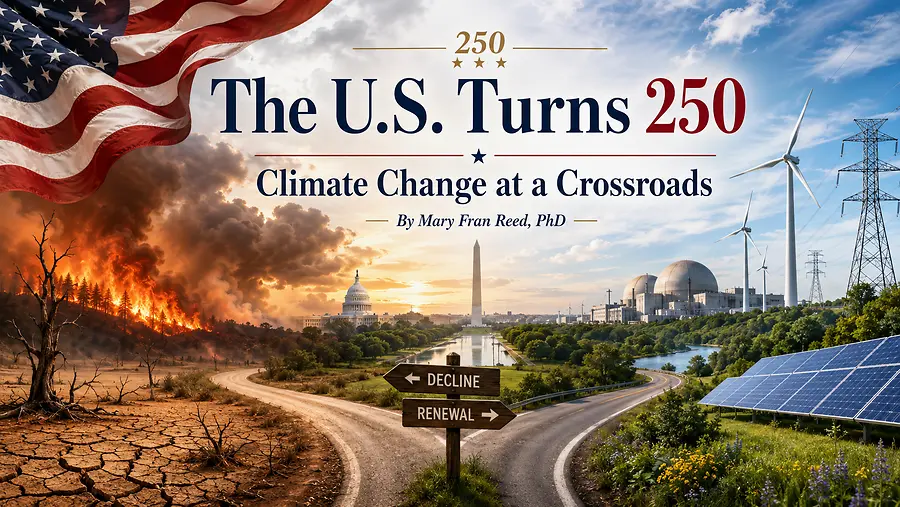
America at 250: Climate Change, Energy, and the Choices That Will Shape Our Future
As the United States celebrates its 250th anniversary, we find ourselves at a moment of profound reckoning. Two and a half centuries after the nation's founding, the forces shaping our future are no longer only political or economic-they are planetary.
The climate crisis is no longer a distant threat approaching on the horizon; it is here, reshaping our weather patterns, infrastructure, ecosystems, and daily lives with accelerating intensity.
For nearly fifty years, Earth has not experienced a single year cooler than the 20th-century average. That fact alone should give us pause. But the deeper story is far more unsettling: global warming is rewriting the rules of weather itself. Heat waves, deep freezes, megafires, atmospheric rivers, stalled jet streams, and catastrophic floods are no longer rare anomalies. They are becoming part of the new rhythm of a destabilized planet.
And as America celebrates its semi quincentennial, we must confront a sobering truth:
The next 250 years depend on what we choose to do right now.
Climate Whiplash: A Nation Pulled Between Fire and Ice
The United States has become a vivid example of what scientists describe as climate whiplash-rapid and extreme swings between weather conditions caused by a warming climate.
In recent years, Americans have experienced:
- Record-breaking heat waves across the South and Midwest
- Billion-dollar wildfires from California to Hawaii
- Catastrophic flooding across the Northeast and Appalachia
- Deadly cold outbreaks influenced by disruptions in the polar vortex
- Hurricanes strengthened by warmer ocean temperatures
- Droughts that threaten agriculture and strain water resources
These events are not isolated incidents. They are interconnected symptoms of a climate system being pushed beyond historical patterns of stability.
As the Arctic warms two to four times faster than the global average, the jet stream weakens and becomes more variable. The polar vortex can become disrupted, allowing frigid air to move farther south. At the same time, warmer oceans provide additional energy for stronger storms and heavier rainfall. Drought conditions dry vegetation into fuel, allowing a single spark to become a devastating megafire.
This is the emerging reality of the American climate: volatile, unpredictable, and increasingly dangerous.
A Nation at 250: What's at Stake
If the Founders could see the country today, they would likely marvel at our technological achievements, scientific advancements, and global influence. But they would also be confronted with environmental challenges unimaginable in their time.
Unchecked climate change threatens:
- Lives - through heat-related illness, respiratory disease, extreme cold exposure, and natural disasters
- Economies - through infrastructure damage, crop losses, insurance challenges, and rising energy costs
- Security - as water scarcity, migration pressures, and resource instability increase
- Ecosystems - from coral reefs and forests to coastal wetlands
- National identity - as treasured landscapes and communities face irreversible transformation
The United States cannot celebrate its 250th birthday without acknowledging the vulnerability of the next century-and the responsibility we carry to protect it.
The Energy Reality: Demand Is Exploding
America's energy demands are increasing rapidly. Artificial intelligence, data centers, electrified transportation, advanced manufacturing, and digital infrastructure all require enormous amounts of electricity.
Much of that electricity still comes from fossil fuels.
If we continue along this path without significant changes, emissions will continue rising, temperatures will increase, and extreme weather events will intensify.
Renewable energy sources such as solar and wind are essential components of the future energy system, but they cannot independently provide consistent 24/7 power without additional support. Because their output varies depending on weather conditions and time of day, reliable backup and storage solutions remain necessary.
Today, much of that reliability is still provided by fossil fuels.
This is where the conversation must evolve.
A Turning Point: Nuclear Energy as a Climate Solution
As I wrote in my short eBook, Fire & ICE: Cooling Our Planet with the Power of the Atom, nuclear energy is not a relic of the past-it is a critical component of our future.
Modern nuclear technologies are safer, cleaner, and more efficient than previous generations of reactors. They offer:
- Massive clean energy output
- Reliable power generation during heat waves, cold snaps, storms, and droughts
- Minimal land requirements compared with large-scale solar and wind installations
- Small waste volumes-all U.S. spent nuclear fuel could fit within a relatively small area
- Advanced safety systems designed to prevent failures associated with older reactor designs
- Small modular reactors that may offer greater flexibility and scalability
Nuclear energy is one of the few carbon-free energy sources capable of delivering large-scale, consistent electricity needed to support America's growing energy demands.
If the United States wants to maintain global leadership-scientifically, economically, and technologically-nuclear energy must be part of the conversation.
The 1.5°C Threshold: A Warning We Cannot Ignore
The world has now experienced a year in which global temperatures exceeded the critical 1.5°C warming threshold. This is not merely a statistic in a scientific report-it is a warning that requires immediate attention.
Crossing this threshold increases the risks of:
- Accelerated ice loss
- Rising sea levels
- More intense storms
- Ecosystem disruption
- Agricultural instability
- Dangerous heat conditions
At 250 years old, the United States stands at a defining crossroads: continue with business as usual or pursue bold, transformative action.
A Call to Action for America's Next Century
The Founders could not have anticipated climate change. However, they did envision a nation capable of innovation, courage, and collective action.
To honor that legacy, we must:
- Invest in nuclear energy as a central component of America's clean-energy strategy
- Expand renewable energy while pairing it with reliable, carbon-free power sources
- Modernize the electrical grid to meet rising demand
- Strengthen climate resilience in every community
- Support science-based policies at local, state, and federal levels
- Educate the public by addressing misinformation and promoting solutions grounded in evidence
America's 250th birthday is not only a celebration-it is a checkpoint.
It is a moment to decide what kind of nation we want to be when we reach 300, 400, or even 500 years.
The choices we make today will echo across generations.
The Path Forward
We are not powerless.
We are not too late.
But the window for meaningful action is narrowing.
Nuclear energy, combined with renewable energy, storage technologies, and efficiency improvements, offers one pathway toward stabilizing our climate, protecting communities, and securing America's future.
The United States reaches its 250th anniversary during a period of unprecedented challenge. Yet with bold action, scientific leadership, and a commitment to truth over fear, we can ensure that the next 250 years are defined not by crisis, but by resilience, innovation, and hope.