The VALUE Framework:
How a career in education transformed my approach to customer success and the VALUE Framework that builds lasting relationships.

Trust First: What Teaching Taught Me About Customer Onboarding
During more than twenty years in education—as a kindergarten and first-grade teacher and later as an instructional technology facilitator—I learned that meaningful learning always begins with trust.
The first days of school are exciting, but they can also be filled with uncertainty. For many children, it's their first experience away from home, and for parents, it's the beginning of a new chapter as well. Before any real learning could begin, they needed to know they were heard, supported, and cared for.
Of course, there were plenty of bumps along the way. Some lessons went beautifully, while others required me to completely rethink my approach. Every student learned differently. Every family had a different story.
Later, as I worked with teachers integrating technology into their classrooms, I discovered the same thing to be true. Success wasn't about having the perfect lesson plan or the perfect technology—it was about listening, adapting, encouraging, and building relationships along the way.
When I transitioned into SaaS implementation, I expected my work to be completely different. Instead, I discovered something surprising: the same principles still applied.
The software was different.
The conversations were different.
The goals were different.
But people were still people.
Just as every child learns differently, every customer adopts technology differently. Some are eager to dive in, while others need more reassurance, encouragement, and time. My role was never simply to implement software—it was to meet people where they were, guide them through change, and help them move forward with confidence.
Just like in education, success wasn't about simply following a project plan. It was about building trust, listening carefully, adapting when needed, and celebrating progress together.
That's when I had one of those aha moments that changes the way you see your work.
I realized I wasn't just teaching reading, writing, or technology anymore—I was still helping people navigate change.
People don't embrace change because they receive information. They embrace change because they trust the person guiding them through it.
As I reflected on what made implementations successful, I realized I naturally followed the same pattern every time. I wanted a simple way to capture those lessons—not only to guide the implementation process but also to remind myself that successful onboarding is built on trust throughout the customer journey.
Using ChatGPT as a thought partner, I organized those ideas into what became the VALUE Framework.
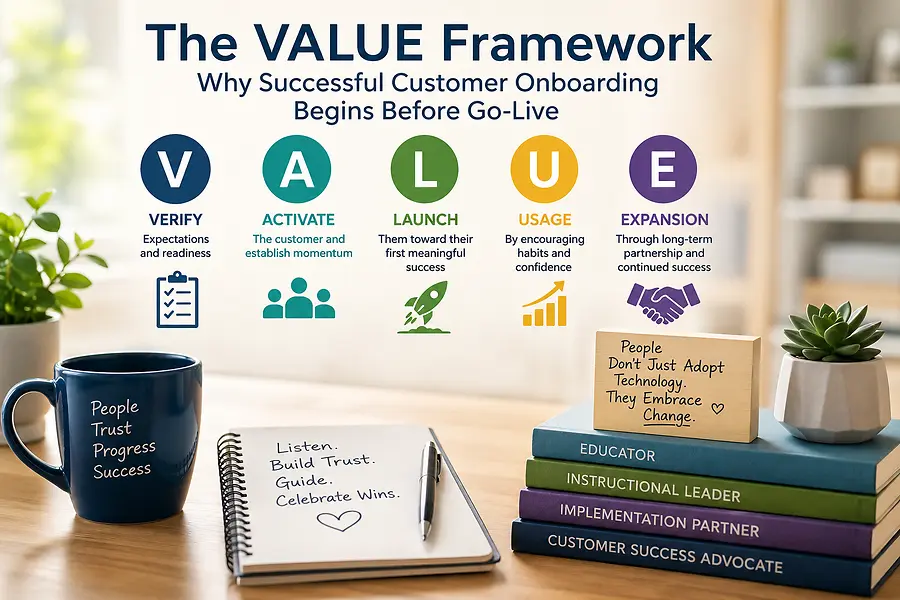
The framework is built around five simple principles that have guided every successful implementation I've led:
- V – Verify expectations and readiness.
- A – Activate the customer and establish momentum.
- L – Launch customers toward their first meaningful success.
- U – Encourage usage by building habits and confidence.
- E – Expand through long-term partnership and continued success.
V — Verify
Every successful implementation begins with a conversation. Before discussing timelines, configurations, or training, I want customers to know who I am, understand how I'm going to help them succeed, and feel comfortable sharing their goals.
Listening early builds trust, uncovers expectations, and prevents confusion later in the project.
A — Activate
Once expectations are aligned, it's time to build momentum.
Activation is more than turning on a platform. It's helping people build the confidence to begin using it successfully. Training, encouragement, and early wins create momentum while helping customers recognize the platform's value from the very beginning.
L — Launch
Go-live isn't the finish line.
Too often, organizations view go-live as the end of implementation.
I see it as the beginning of the customer relationship.
Some of the most important conversations happen during those first few days and weeks after launch. Staying connected, checking in proactively, and celebrating early successes help customers build confidence while reinforcing that they have a trusted partner beside them.
U — Usage
This is where implementation becomes adoption.
Regular follow-up allows customers to ask questions, discover additional features, and share real-world feedback that can improve both their experience and the product itself.
These conversations often become the most valuable conversations for both the customer and the implementation team.
E — Expansion
Expansion isn't simply about adding more products or services.
It's about continuing the relationship.
As customers become more successful, new opportunities for growth naturally emerge. Those conversations are built on trust, shared goals, and a genuine desire to help customers continue succeeding.
I remember one implementation in particular where the customer wasn't just learning a new platform—they were managing change across their entire organization. There were questions, concerns, and a few unexpected obstacles along the way.
We adjusted our plan, stayed in close communication, and celebrated each milestone together.
Looking back, what they remembered most wasn't every training session or configuration step.
They remembered having someone they trusted to guide them through the process.
That experience reinforced something I had learned years earlier in the classroom:
Relationships create confidence.
Confidence creates success.
Today, AI can answer questions faster than ever before. It can automate tasks, provide information instantly, and improve efficiency.
But my experience has taught me that successful onboarding is still built on something technology cannot replace: human connection.
Whether I'm working with a young student, a classroom teacher, or a new SaaS customer, my goal has never really changed.
I want people to feel confident, supported, and successful.
Technology will continue to evolve, and AI will undoubtedly transform the way we work. But after years in both education and SaaS, I've learned that people don't remember every training session or every implementation milestone.
They remember how you made them feel.
They remember whether you listened, encouraged, and helped them succeed.
That's why I believe successful customer onboarding begins long before go-live.
It begins with trust.


