They Weren't Failing. They Were Standing in the Wrong Soil.
When someone struggles at work, the problem might not be them—it might be the ground they're standing in.

By Lynn Cirillo
Most of us have watched it happen at least once. A capable, thoughtful person starts to struggle. Their confidence drops. They stop offering ideas. They get quieter in meetings, slower on deadlines, and more careful about everything. And the organization responds the way organizations usually do: a development plan, some coaching, maybe a hard conversation about "performance."
Sometimes that's exactly what's needed. But over my years in corporate America, I came to believe something else was happening far more often than we admitted. In my book That's Not a Detour, That's the Point, I describe the realization that sometimes a person "was not failing at all. They were simply standing in the wrong soil."
That idea has stayed with me because, once you see it, you can't unsee how often we get it backwards. We treat the person as the problem to solve when the more useful question is about the ground they're standing in.
This piece is for anyone who has ever been that person, anyone who works alongside one, and anyone who has a say, formally or not, in where people get planted.
First, Some Validation
If you've ever felt like a lesser version of yourself in a particular job, team, or culture, that experience deserves validation. You are not imagining the difference. Many people know exactly what it feels like to be sharp, funny, and generous in one setting and guarded, hesitant, and tired in another.
That doesn't mean you lost your talent. It may mean you've been spending a huge amount of energy just getting through the day in conditions that don't fit you. One of the questions in the book stops me every time: "What have they convinced themselves they are bad at because they have spent too much time in an environment that does not fit them?"
If something in you recognized itself in that sentence, please hear this: a long stretch in the wrong environment can make you doubt things about yourself that were never true.
Potential Gets the Attention. Environment Deserves More.
Workplaces love to talk about potential. We rate it, map it, and build programs around it. But as I wrote, "People talk a great deal about potential. I think environment deserves more attention."
Here's why that matters. When we focus only on the individual, we can "spend years trying to correct someone who might flourish almost immediately somewhere else."
When I was trying to understand why a team was struggling, I rarely wanted to stop at the obvious answer. A missed deadline was rarely just a missed deadline. One question I kept coming back to was this: "Was the system asking people to succeed despite it instead of because of it?" Over time, as I put it in the book, "I learned to look at systems instead of immediately blaming individuals."
That isn't about excusing anyone. It's about looking in the right place first.
We Describe People With Nouns
Part of the problem is language. We describe people by their roles: manager, analyst, coordinator, assistant, director. Those labels shape almost every people decision we make.
But as I wrote, "Roles are useful. They are also incomplete. A role tells us where something is expressed. It does not always tell us what is being expressed."
Underneath every noun is a verb. Someone isn't just "the project coordinator." They're the person who untangles things, who notices who's been left out, who calms a room, who asks the question nobody else will. Those verbs travel with people from job to job. As the book puts it, "Maybe identity is not found in the labels we accumulate. Maybe it is found in the patterns underneath them."
When an organization only sees the noun, it misses the verb. It can put someone with a gift for connection into a role that isolates them and then wonder why they've gone quiet.
What This Looks Like Inside Organizations
None of these patterns requires bad leaders. They just require habits nobody has questioned.
Correction comes before curiosity. When someone struggles, the first tool we reach for is usually a fix for the person. Rarely do we start by asking what the role, the team, the workload, or the culture is asking of them.
Sameness is mistaken for strength. Many workplaces quietly reward people who think, communicate, and work the same way. I was never particularly interested in creating identical employees. Uniformity makes a team easier to manage, but rarely better.
Fit is treated as a hiring question only. We talk about fit once, at the interview, and then assume it holds forever. But people change, roles change, and teams change. Soil that worked five years ago may not work now.
Adaptation hides the cost. Capable people adjust. They work around whatever doesn't fit until the workaround becomes invisible, even to them. In the book, I note how "survival can become identity." From the outside, it looks like someone is doing fine. Inside, they're spending energy that could have gone into their best work.
The Soil Check
Here's a simple framework I use, built from the questions in Chapter 4. It's four questions you can ask about yourself, about someone you work with, or about a whole team. Each one shifts attention from "What's wrong with this person?" to "What does this person's ground look like?"
1. Light: Where do they come alive? Watch for the moment someone starts talking about something they care about and their energy changes. What were they doing? Who were they with? What kind of problem were they solving? That's information about the conditions they need.
2. Drain: What's fighting against their nature? The book asks it plainly: "What are we asking them to do that fights against who they naturally are?" When the core of a role runs against someone's wiring every day, more coaching won't fix it.
3. Roots: What verbs have followed them everywhere? Look past titles. Ask, "Which characteristics have followed you through every version of your work, regardless of the title?" Those consistent patterns are a far better guide to where someone will thrive than their last job description.
4. Return: What do people seek them out for? Another question from the book: "What do people consistently seek you out for, regardless of your title?" The informal reputation often tells the truth the org chart misses.
If someone is struggling and you can't answer these four questions about them, you don't yet know whether you're looking at a performance problem or a soil problem.
Practices You Can Start This Week
Lead with curiosity before conclusion. "Excavation requires curiosity before conclusion," I wrote, and the same holds at work. Before deciding what someone's struggle means, ask what changed, what's in the way, and what they'd need.
Write a verb list. For yourself or for each person on your team, write down five verbs that describe what they do best, not what their title says. Compare that list to how their days are actually spent.
Add a soil question to one-on-ones. Try, "When have you felt most like yourself at work lately, and when have you felt least like yourself?" Then listen without fixing.
Run a small experiment before a big judgment. Before a performance plan, try a different responsibility, a different partner, or a different structure for a few weeks. Change the conditions and see what happens.
Look at your own soil, too. If you're the one struggling, ask yourself the four questions. A struggle doesn't have to be a verdict on you. Sometimes it's simply information about where you are.
If You Lead, Coordinate, or Influence Anyone
You don't need a title to change someone's soil. Anyone who assigns work, builds a team, recommends a colleague, or decides who gets asked to help is shaping the ground other people stand in.
Notice who used to light up and doesn't anymore. Ask what changed around them before asking what changed in them. And when someone does flourish after a move, resist the urge to take credit for transforming them. In my experience, the truth was simpler: "Not because we transformed them. Because the conditions finally allowed more of them to emerge."
When people are in the right soil, as the book describes, "They stop spending so much energy protecting themselves." That energy goes into ideas, risks worth taking, and the work itself.
You Are Still in There
Here's the hope I want to leave you with. If you've spent a long season feeling smaller than you are, that version of you is not the whole story. The person who came alive in the right conditions hasn't disappeared. Your verbs came with you. They're waiting for ground that lets them grow.
And if you're the one who shapes other people's ground, you have more power than you think. Sometimes the most effective development plan isn't a plan to change the person at all.
So, a final question to sit with, straight from the book: "Beneath everything you learned to become, are you still in there?"
I believe you are.
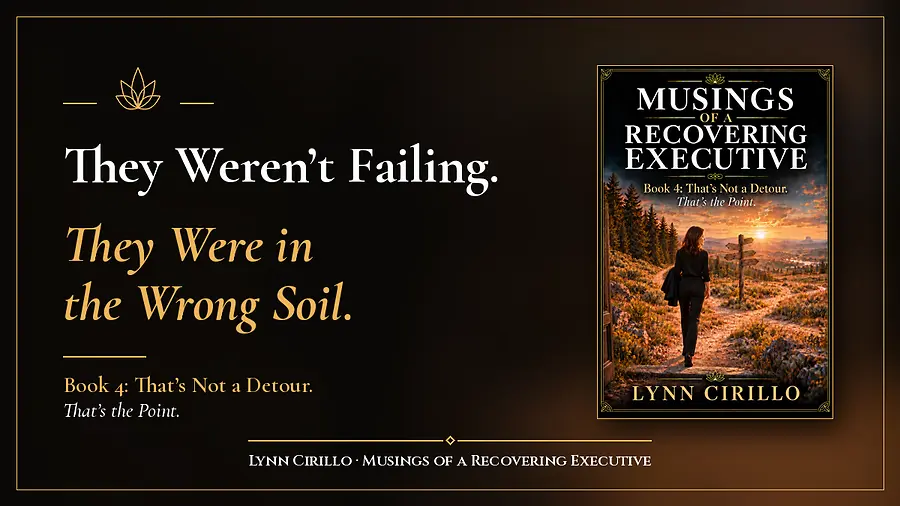
That's Not a Detour, That's the Point is the fourth book in my Musings of a Recovering Executive series. It's about curiosity, identity, and the patterns that follow us through every version of our lives, with Excavation questions in every chapter. You can learn more at https://MusingsOfaRecoveringExecutive.com/books/thats-not-a-detour-thats-the-point/.
About the Author
Lynn Cirillo is an author, leadership mentor, and founder of Grounded Leadership LLC, based in Cheyenne, Wyoming. She lives with ADHD, OCD, and dyslexia and writes the six-book Musings of a Recovering Executive series about leadership, identity, boundaries, reinvention, neurodiversity, and reclaiming confidence after difficult workplaces. Learn more at https://MusingsOfaRecoveringExecutive.com/.

Lynn Cirillo is an author, leadership mentor, and Founder and Principal of Grounded Leadership, LLC in Cheyenne, Wyoming. She brings nearly 40 years of professional experience across commercial real estate, corporate operations, research, and technology. Her six-book nonfiction series, Musings of a Recovering Executive, explores the journey from burnout and reinvention to boundaries, identity, neurodiversity, and…