Trump vs. Iran—The War That Did Not Have to Happen
How the JCPOA Constrained Iran's Nuclear Program: What the Evidence Showed Before the U.S. Withdrawal

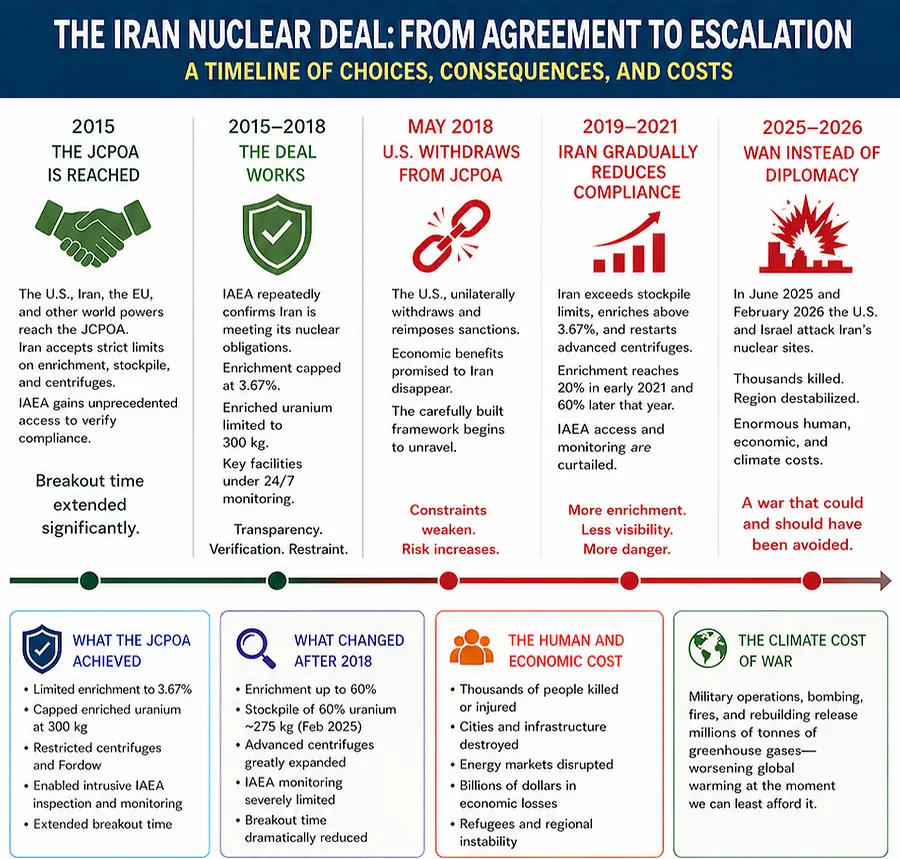
The Joint Comprehensive Plan of Action (JCPOA) was negotiated in 2015 under Barack Obama by the United States, Iran, the United Kingdom, France, Germany, Russia, China, and the European Union. It emerged after years of tension, sanctions, and painstaking diplomacy, with one central purpose: to place verifiable, enforceable limits on Iran’s nuclear program in exchange for sanctions relief.
It was not built on trust or goodwill. It was built on the sober recognition that the safest way to prevent Iran from moving toward a nuclear weapon was to constrain its program under strict international inspection and monitoring.
Iran Under the JCPOA: What the Evidence Showed Just Before Trump Withdrew
When Donald Trump withdrew the United States from the JCPOA on May 8, 2018, the central technical question was not whether Iran had once pursued nuclear weapons—that had already been established.
The real question was whether the JCPOA had succeeded in constraining Iran’s enrichment program, lengthening its path to weapons-grade material, and empowering the International Atomic Energy Agency (IAEA) with an unusually intrusive verification system.
On that narrower—but critical—question, the evidence available at the time was strong: the IAEA continued to report that Iran was complying with the agreement’s core nuclear limits.
The JCPOA never claimed that Iran had innocent nuclear intentions in the past. Within the agreement, Iran reaffirmed that “under no circumstances will Iran ever seek, develop or acquire any nuclear weapons,” while the deal’s purpose was to ensure the “exclusively peaceful nature” of its nuclear program through strict limits, transparency, and monitoring.
The agreement also:
- Established a Joint Commission to oversee implementation
- Tied sanctions relief directly to IAEA verification
- Embedded the framework in U.N. Security Council Resolution 2231
What Iran’s Enrichment Program Looked Like in Spring 2018
The clearest snapshot comes from the IAEA’s May 24, 2018 quarterly report, issued shortly after the U.S. withdrawal announcement.
At that time:
- Iran operated no more than 5,060 IR-1 centrifuges at Natanz
- Uranium enrichment remained capped at 3.67% U-235
- The total enriched uranium stockpile remained below the 300 kg limit
As of May 14, 2018, Iran’s stockpile stood at 123.9 kilograms—well within the cap.
At Fordow:
- No more than 1,044 IR-1 centrifuges were maintained
- The facility was not operating as an enrichment site in violation of the agreement
Heavy water levels also remained within limits, at 120.3 metric tons.
These figures mattered because the JCPOA was designed to restrict both the scale and speed of any potential “breakout” attempt. In practical terms, Iran’s fissile material pathway was tightly constrained and continuously monitored.
What the JCPOA Prohibited Beyond Enrichment
The agreement extended well beyond enrichment limits.
For 15 years, Iran was barred from:
- Producing or acquiring highly enriched uranium
- Separating plutonium
- Producing uranium metal outside tightly controlled conditions
It also:
- Prohibited reprocessing activities
- Restricted facilities capable of plutonium separation
- Banned work related to nuclear explosive device design
This included activities such as:
- Advanced computer modeling of nuclear explosions
- Development of multi-point detonation systems
Unless explicitly approved for non-nuclear purposes and monitored, these activities were forbidden.
What We Knew About Iran’s Earlier Weapons Work
The IAEA’s December 2015 Final Assessment concluded that Iran had conducted “a range of activities relevant to the development of a nuclear explosive device” prior to 2003 as part of a coordinated effort.
Some activities continued afterward, but not as part of a structured weapons program. The agency found:
- No credible indications of weapons-related activities after 2009
- No evidence of diversion of nuclear material
However, later findings complicated this picture.
A 2019 study from the Belfer Center for Science and International Affairs concluded that Iran’s pre-2003 program (Project AMAD) was more advanced than previously assessed and included plans for multiple nuclear weapons.
Importantly, the same study emphasized that the archive did not provide evidence of ongoing weapons development in 2018.
How Intrusive Was the Verification Regime?
The JCPOA established one of the most comprehensive verification regimes ever implemented.
Under the agreement, Iran:
- Provisionally applied the Additional Protocol
- Implemented modified Code 3.1
- Allowed expanded inspector access and monitoring
The IAEA gained:
- Continuous monitoring of key facilities
- Daily access (on request) to Natanz
- Regular access to Fordow
- Long-term monitoring of centrifuge production (20 years)
- Oversight of uranium supply chains (25 years)
Iran also expanded the number of authorized inspectors to approximately 130–150.
The 24-Day Access Debate
The much-debated access provision for undeclared sites was not “anytime, anywhere,” but it was far from ineffective.
If concerns arose:
- The IAEA could request clarification
- If unresolved, the issue moved to the Joint Commission
- A maximum of 24 days was allowed for access to be granted
Critics argued this delay was too long. Supporters countered that nuclear traces are difficult to conceal entirely and that this mechanism was far stronger than pre-JCPOA safeguards.
Was the Verification System Working in 2018?
On the narrow technical question: yes.
The IAEA issued consistent reports through 2017 and 2018 confirming Iranian compliance. Independent organizations such as the Arms Control Association echoed this conclusion.
A later 2023 IAEA retrospective further reinforced this point, stating that from 2016 to early 2021, the agency successfully verified and monitored Iran’s commitments in an “impartial and objective manner.”
Crucially, once the agreement began to unravel and monitoring tools were reduced, the IAEA lost continuity of knowledge—making oversight significantly more difficult.
Important Limitations
“Success” should not be overstated.
The IAEA had not yet reached its “broader conclusion” that all nuclear material in Iran remained exclusively in peaceful use. Instead:
- Declared facilities were effectively monitored
- Evaluation of undeclared activities remained ongoing
This reflects the complexity of nuclear verification—not a failure of the JCPOA, but the longer timeline required for full assurance.
What Trump Withdrew From
The May 8, 2018 withdrawal did not hinge on a finding that Iran was violating the agreement’s core nuclear limits.
Instead, the rationale focused on:
- The temporary nature of restrictions
- Iran’s regional activities
- Past weapons-related work
- Concerns about future capability
These were policy objections—not new technical findings of noncompliance.
That distinction is historically significant: the United States exited the agreement while the IAEA continued to report Iranian compliance with its primary nuclear restrictions.
The Bottom Line
The most responsible conclusion is this:
Iran had a documented history of organized nuclear weapons-related work, and later evidence suggests that its earlier program may have been more advanced than initially assessed.
However, the best contemporaneous evidence from 2018 shows that the JCPOA was functioning as intended:
- It reduced Iran’s enrichment capacity
- Kept uranium stockpiles far below pre-deal levels
- Restricted sensitive nuclear activities
- Provided the IAEA with unprecedented access and monitoring tools
- The inspection regime was not perfect—but it was real, highly intrusive, and demonstrably more effective in 2018 than the far more limited oversight that followed its unraveling.