Understanding Airlines, part II!
Exploring Standard and Luxury Airlines: Beyond Low-Cost Carriers and Flag Carriers

In this article, we will continue our exploration of airlines with the final two types. Previously, we covered Low-Cost Carriers and Ultra-Low-Cost Carriers (LCCs and ULCCs), as well as Flag and Legacy Carriers.
First, a final note on the myth of "low cost."
It is just that-a myth. These airlines are called "Low-Cost Carriers" and "Ultra-Low-Cost Carriers" based on their operating costs, not necessarily on passenger value. Passengers are often an afterthought. The cost savings are eventually passed on as a marketing gimmick disguised as a cheap seat. Travelers are then "nickel-and-dimed" for every add-on, whether it's a bag of pretzels, a can of soda, a carry-on bag, a personal item, or an upfront seat.
One example is Spirit Airlines' Big Front Seat option, which includes the first three rows of seats offering extra legroom, a soft plush leather armchair, and a snack-and-drink combination. It's not terrible for what essentially amounts to first-class on a Greyhound bus with wings.
European LCCs, by contrast, don't try to scam you-you know exactly what you're buying and exactly how little you're getting: just a seat. For a forty-five-minute trip from London to Mallorca, Birmingham to Frankfurt, or Madrid to London, it's not a bad deal, especially when the seat costs only ten to fifteen euros-the equivalent of two lattes at a Starbucks in the United States.
Now, let's move on.
Standard carriers
Standard carriers often do not officially represent their country of origin. Examples include Virgin Atlantic, based in the United Kingdom; Condor Airlines, based in Germany; several other carriers around the world; and JetBlue in the United States.
These airlines do not have the luxury or legacy prestige of their "older siblings," such as British Airways, Lufthansa, and United, respectively. (While JetBlue is not officially tied to United, it does have a dynamic partnership with United that binds them closely together.) These airlines are often seen as youthful, hip, and dynamic, which enables them to corner the leisure-travel market globally.
Virgin Atlantic, created by Sir Richard Branson, was specifically designed to mock British Airways, its cross-town rival. Branson famously described British Airways as "old, stuffy, snobby, and uptight." Virgin Atlantic evolved from a leisure carrier into a true rival of the UK flag carrier, competing directly with British Airways.
Condor, by contrast, was founded to capture the leisure boutique passenger market in and around Germany. JetBlue followed a similar model in the United States, targeting the national market and ferrying passengers to and from the Caribbean through its hubs at Boston Logan International Airport and New York-JFK International Airport, among others.
Luxury carriers
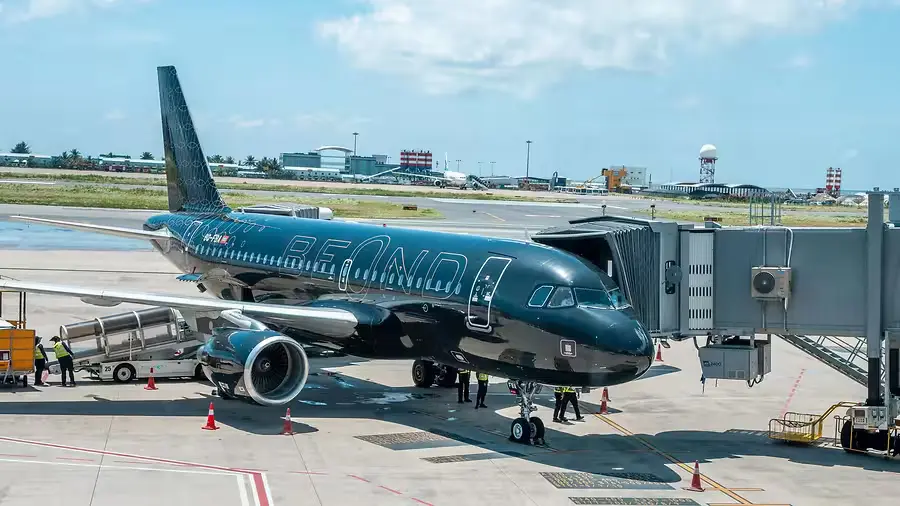
Luxury carriers are a newer phenomenon. Examples include BeOnd Air and La Compagnie. BeOnd (stylized as "BeOnd") is based in Malé, the capital of the Maldives-an added signal of its luxury-while La Compagnie is based just outside Paris in the French countryside, adding a distinct touch of class.
These airlines have managed to turn a net profit by offering exclusively lie-flat business-class seating, with no economy class seats whatsoever. The United States could learn a thing or two from European airline business models.
Next, we will cover the fall of American Airlines-how the American titan brought itself down.
Subscribe to Brooke In The Air Travel at brookeintheairtravel.net to learn more.
Photo credit: Simple Flying