
Unwanted Bias: Is It Affecting Our Industry More Than We Realise?
Understanding Systemic Bias and Creating Fair Opportunities for All

Most people like to believe they are fair.
We want to think that we judge others based on their abilities, their character, and their contributions. We want to think that opportunities are awarded solely on merit. We want to think that if people work hard enough, success will follow.
Yet despite these good intentions, patterns continue to emerge across industries, leadership teams, boardrooms, educational institutions, and workplaces.
Some groups remain underrepresented.
Some voices remain unheard.
Some individuals seem to encounter barriers that others never have to think about.
This raises an important question: Are we dealing with individual shortcomings, or are there unseen forces shaping opportunities and outcomes?
This is where conversations about bias become important. Not because people are inherently bad. Not because organisations are inherently unfair. But because human beings are influenced by systems, experiences, assumptions, and structures that often operate beneath the surface.
Bias Is Not Always Intentional
When people hear the word "bias," they often become uncomfortable. Many immediately associate it with discrimination or prejudice. Yet bias is often far more subtle.
Bias can show up in whom we choose to mentor, whom we see as leadership material, whose ideas we listen to, whom we believe is "ready" for promotion, who receives the benefit of the doubt, and who gets invited into informal networks.
Most of the time, these decisions are not made maliciously. They are influenced by familiarity, exposure, assumptions, and unconscious patterns. That is what makes unwanted bias so difficult to identify. The person demonstrating it may not even be aware that it exists.
The Difference Between Equality and Experience
A workplace may offer the same opportunities to everyone on paper. Yet people do not always experience those opportunities in the same way.
Consider two professionals entering the same organisation. Both are talented. Both are ambitious. Both work hard.
Yet one arrives with access to informal networks, role models who look like them, mentors who understand their journey, and confidence gained from seeing others succeed in similar circumstances. The other arrives without those advantages. The opportunity may be identical. The experience may not be.
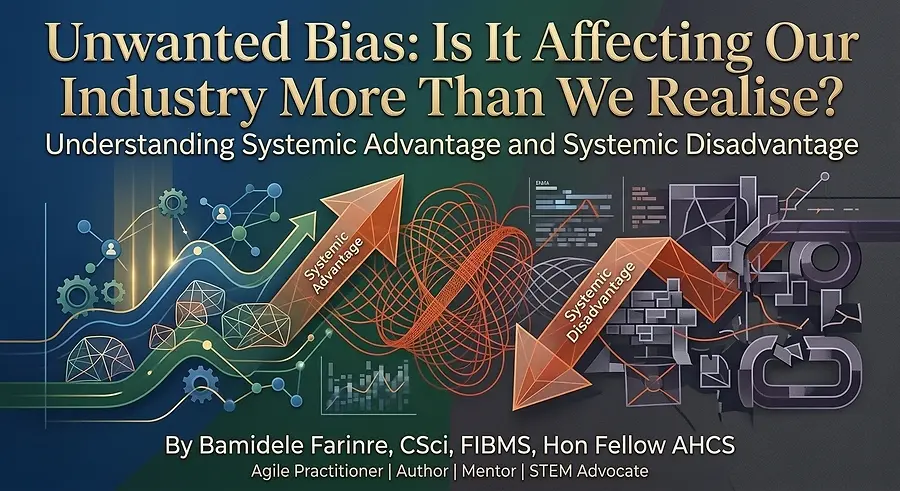
This is where systemic advantage and systemic disadvantage enter the conversation.
What Is Systemic Advantage?
Systemic advantage does not mean someone's achievements are not earned. This is one of the biggest misconceptions surrounding the topic. People with systemic advantages still work hard. They still make sacrifices. They still face obstacles.
However, systemic advantage means certain barriers are less likely to exist. It often appears in ways that are easy to overlook. Perhaps someone sees many examples of people who look like them in leadership positions. Perhaps they have access to networks that naturally create opportunities. Perhaps they benefit from assumptions that position them as capable before they have to prove themselves. Perhaps they rarely have to wonder whether they belong.
Many advantages are invisible to those who possess them because they simply feel normal.
What Is Systemic Disadvantage?
Systemic disadvantage is not the absence of talent. Nor is it an excuse for failure. Rather, it describes situations in which additional obstacles exist that others may never encounter. For some, this might involve race. For others, gender.
For others, it might involve disability, social background, socioeconomic status, or being the first person in their family to attend university.
I often think about first-generation professionals. Imagine entering spaces where no one in your immediate family has been before. The challenge is not intelligence. The challenge is navigation. You are learning the rules while simultaneously trying to succeed within them. That is a very different experience.
STEM as an Example
As a Black woman in STEM, I have spent much of my career navigating spaces where representation was limited. There were times when I was the only person who looked like me in the room. There were times when I questioned whether my voice carried the same weight as others. There were times when I found myself explaining perspectives that many around me had never considered.
These experiences taught me something important. Bias does not always announce itself. Sometimes it is deeply embedded within systems, expectations, traditions, and assumptions. And because it is subtle, people often struggle to recognise its impact.
Why This Matters for Leaders
The goal of understanding systemic advantage and disadvantage is not to create division. It is to create awareness. Good leaders recognise that fairness is not always achieved by treating everyone identically. Sometimes fairness requires understanding context. It requires recognising that different people begin from different starting points. It requires creating environments where talent can thrive regardless of background. It requires questioning assumptions rather than simply accepting them.
Most importantly, it requires leaders to ask:
- Who is not in the room?
- Whose voice is not being heard?
- Who is being overlooked?
- What barriers might exist that I cannot see?
These questions are not signs of weakness. They are signs of thoughtful leadership.
The Cost of Ignoring Bias
Organisations that fail to examine bias often miss opportunities. They overlook talent. They lose diverse perspectives. They limit innovation. They create cultures where some people feel they must work twice as hard simply to be seen as equally capable.
Over time, the cost extends beyond individuals. It affects organisations, industries, and society as a whole because innovation thrives when diverse experiences and perspectives are allowed to contribute.
Moving Beyond Awareness
Awareness is important.
But awareness alone is not enough. Progress requires action. It requires leaders willing to sponsor talent. It requires organisations willing to examine systems. It requires individuals willing to challenge their own assumptions. It requires all of us to remain curious rather than defensive.
The most effective leaders are not those who claim to be free of bias. They are those who recognise that they are human enough to have biases and humble enough to question them.
A Final Reflection
Perhaps the goal is not to create a world where bias never exists. Human beings will always have perspectives shaped by experience. The goal is to ensure those biases do not become barriers.
Because talent is everywhere. Opportunity is not.
The responsibility of leaders, organisations, and communities is not simply to identify potential.
It is to ensure that potential is not overlooked because of assumptions, stereotypes, or systems that were never designed with everyone in mind.
The question is not whether bias exists.
The question is whether we are willing to see it.
And once we see it, whether we are willing to do something about it.

I am a Chartered Biomedical Scientist and Agile Project Manager with over 18 years of experience in the STEM field. My journey began in Nigeria, where I was inspired to pursue healthcare, and continued in the UK where I developed my passion for microbiology. Despite early setbacks including failing my A-levels, I persevered to earn my biomedical science degree and have since become a multi-award-winning STEM leader.…





