War Against Iran, War Against the Climate
How military conflicts drive massive greenhouse gas emissions and threaten global climate goals.

The Hidden Climate Cost of War
War is often measured in human lives lost, cities destroyed, and geopolitical consequences. Yet modern conflicts carry another enormous—and largely overlooked—cost: their impact on the Earth’s climate.
Military operations are extraordinarily energy-intensive. Jet fighters, aircraft carriers, tanks, transport aircraft, and supply convoys all rely on massive amounts of petroleum. When nations go to war, fossil-fuel consumption spikes dramatically.
The ongoing tensions between the United States and Iran—in the oil-rich Persian Gulf—are already generating significant greenhouse gas emissions, both directly through military activity and indirectly through disruptions in global energy systems. In a world striving to limit warming to 1.5–2°C, these emissions are far from trivial.
Militaries: Among the World’s Largest Emitters
Analyses suggest that armed forces globally account for roughly 5–6% of greenhouse gas emissions. If militaries were a country, they would rank among the largest emitters on Earth.
- The U.S. military alone emits tens of millions of tons of CO₂ annually, with numbers rising sharply during wartime.
- Fighter jets burn thousands of gallons of fuel per hour.
- Aircraft carriers and armored vehicles consume vast amounts of energy.
- Supply chains for war efforts add even more emissions.
Yet military emissions are rarely included in international climate agreements, leaving one of the largest sources of fossil-fuel consumption unreported in climate policy discussions.
Lessons from Past Conflicts
Historical conflicts offer sobering benchmarks:
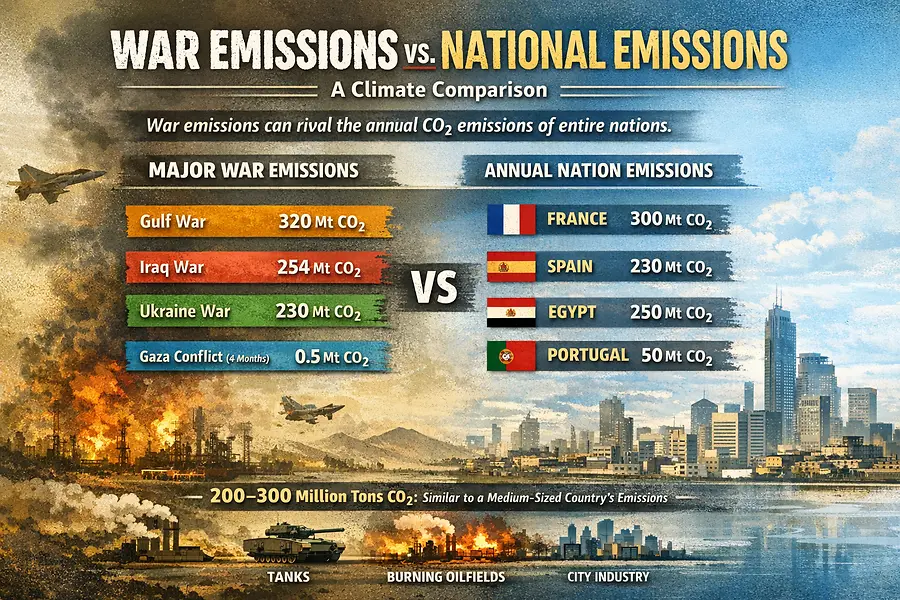
- 1991 Gulf War: ~320 million tons of CO₂
- Iraq War (2003–2011): ~254 million tons of CO₂
- Russia–Ukraine War: ~230 million tons CO₂-equivalent over several years
To put this in perspective, 200–300 million tons of CO₂ is roughly the annual emissions of a medium-sized industrial nation. Even smaller conflicts have measurable impact—for example, the first 120 days of the Gaza conflict produced approximately 420,000–650,000 tons of CO₂-equivalent.
The Persian Gulf: A Climate Flashpoint
The region’s strategic role in global oil supply magnifies the climate impact of conflict. About 20% of the world’s oil passes through the Strait of Hormuz, making the Persian Gulf critical to energy security.
Military strikes on oil infrastructure—refineries, pipelines, storage depots—can trigger massive fires and methane releases. During the 1991 Gulf War, retreating Iraqi forces set Kuwaiti oil wells ablaze, creating one of the largest environmental disasters of the 20th century.
The climate consequences multiply: not only do military operations emit carbon, but damaged oil infrastructure releases vast additional quantities of greenhouse gases.
Global Energy Shockwaves
War also disrupts global energy markets, often prompting governments to:
- Burn more coal
- Expand oil production
- Tap strategic petroleum reserves
- Accelerate fossil-fuel extraction
These responses increase global emissions and can slow the transition to clean energy, prioritizing short-term energy security over long-term climate goals.
The Long Carbon Tail of Reconstruction
The climate cost of war doesn’t end when the fighting stops. Rebuilding destroyed infrastructure requires enormous quantities of cement, steel, heavy equipment, and logistics support—all of which generate significant emissions.
Post-war reconstruction can release tens of millions of tons of CO₂, sometimes rivaling the emissions produced during the conflict itself. The carbon footprint of war can last for decades.
The Strategic Climate Paradox
Conflicts like the one with Iran highlight a troubling contradiction: governments pledge to reduce emissions while war simultaneously drives fossil-fuel consumption upward. This creates a dangerous feedback loop:
- Climate stress → geopolitical instability
- Instability → conflict
- Conflict → increased fossil-fuel use
- Rising emissions → worsening climate change
Without stable energy systems and international cooperation, both crises intensify simultaneously.
Toward a Different Energy Future
Repeated conflicts underscore a clear lesson: dependence on fossil fuels carries both climate and geopolitical risks.
A low-carbon energy system—built on renewables, advanced nuclear, and resilient grid infrastructure—could reduce both emissions and the strategic importance of oil-rich regions. Moving away from fossil fuels is not just climate policy; it is energy security and peace policy.
The Bottom Line
The U.S.–Iran conflict is producing tens or hundreds of millions of tons of greenhouse gas emissions, comparable to the annual emissions of entire countries.
At a moment when every ton of carbon matters, the environmental cost of war can no longer be invisible. Wars are not just humanitarian disasters—they are climate disasters too.
The faster the world transitions to clean, reliable, around-the-clock energy, the fewer conflicts will be tied to fossil fuels—and the lower the climate cost of conflict will be.