We're Burned Out And Yet...A Vacation Doesn't Help
Understanding the difference between capacity burnout and friction burnout—and why your vacation won't fix the second one.

Is It Burnout—or Frustration Burnout?
We talk about burnout constantly now—how to prevent it, how to recognize it in ourselves and others, and what to do to fix it. There’s no shortage of language, frameworks, or recommendations, and yet, for all of that attention, I’m not sure we’ve actually gotten much better at addressing it.
Part of the problem is that we tend to treat burnout as a single, universal experience, when in practice, it shows up in at least two very different ways. They feel and look similar on the surface—exhaustion, disengagement, frustration—but they come from very different sources, which means they don’t respond to the same solutions.
The first is what we traditionally think of when we hear “burnout”: too much work sustained over too long a period of time.
We think of medical professionals, therapists, social workers—professions carrying heavy loads in both literal and metaphorical ways. This is when there aren’t enough hours in the day, enough people to share the work, or enough margin to absorb what’s being asked.
This kind of burnout is real, and it’s serious. It’s also relatively straightforward to diagnose and address. When someone is consistently working late, carrying more than one person should reasonably hold, and operating without any real recovery time, you’re looking at a capacity problem.
In those cases, the interventions are actually pretty simple (but not easy) because they are structural. Work has to come off the plate, timelines have to shift, priorities have to be clarified, or additional resources have to be introduced.
This fix is about repair—the proverbial “refilling of your bucket.” Because the underlying issue is depletion, a break creates space for much-needed recovery.
But there is another kind of burnout that I see just as often, if not more, and it doesn’t come from too much work.
This type of burnout disproportionately affects a specific type of person. It comes from the experience of caring deeply about what you do, being good at what you do, but not seeing a clear path to successfully execute within the current system.
This is the burnout that builds when decisions stall, shift, or aren’t enforced; when too many people are involved; when growth has outpaced the systems meant to support it; and when no one stops to fix what’s broken.
This is when processes exist but don’t actually function in practice, and work gets redone, restarted, or quietly abandoned. People spend more time navigating the system than moving the work forward.
Over time, that creates a very distinct pattern of fatigue. Not just physical tiredness, but a sense that effort and outcome are not connected; that no matter how much energy you put in, the result doesn’t materially improve anything.
People stop trying, not because it isn’t safe, but because it stops feeling worth it.
And for a high performer, that’s the tipping point.
They can handle the workload, but they can’t handle not making a difference.
What makes this especially tricky is that we often misidentify it. From the outside, all burnout presents similarly—people are tired, disengaged, and sometimes cynical. And because we treat burnout as something monolithic, we default to the same one-size-fits-all solutions: time off, boundaries, rest.
And thus, the vacation is booked.
And yet… they return to the exact same system that burned them out in the first place.
The same bottlenecks are there. The same unclear ownership. The same meetings that don’t drive anything forward.
The burnout returns.
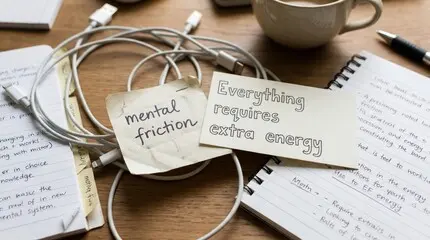
That’s because this dynamic isn’t fundamentally about energy. It has a different root entirely. It’s not about capacity; it’s about friction.
And because culture is, at its core, about how work gets done, unless we address that, the burnout just keeps coming back.
Rest, on its own, doesn’t solve a lack-of-progress problem.
Most organizations are still trying to solve both forms of burnout with the same set of tools, which is why these conversations can feel so active while the underlying experience stays the same.
I sometimes call these zombie conversations because they look alive, but in reality, they’re completely dead—void of life and meaning.
If senior leadership doesn’t address this head-on, the cost shows up quickly—in turnover, often concentrated among high performers and high potentials, and in a lack of traction that quietly drains the business.
Is It Frustration Burnout? A Quick Check
Do any of these sound familiar?
“I’ve been so busy, but I’m not sure what has actually moved forward.”
“We talked about this already. Why is it coming up again?”
“That meeting had great conversation, and everyone said it was time well spent, but I’m not sure what we actually decided or what the next steps are.”
(Zombie meetings.)
“This should be a simple decision, so why are there so many people involved?”
“I’m spending more time figuring out how things work here and playing politics than actually doing the work.”
“I have a question about this, but I’m not sure who owns it… I’ll just CC a few people and hope someone answers.”
“Why is it so hard to get a clear answer on this?”
“I’m not even exhausted. I’m just… irritated.”
“I just took time off, and I don’t feel reset at all.”
“I don’t see how to make it better.”
“I don’t see how to be successful here.”
If that’s the pattern, the issue usually isn’t “too much work.”
It’s that the work isn’t functioning well.
This is less about wellness tactics and more about fixing friction in how work actually happens.
If you’re in senior leadership, this is where the responsibility really sits, and it’s also where this gets easier to influence.
Start at the top and get clear on who owns what. An accountability chart is a great place to start. And just as important, name what’s happening.
As you grow, you have to be intentional about catching your systems up. Have clear periods of growth and clear periods of process optimization.
Do that, and you’ll see even healthier growth with less overhead.
If You’re Not in Leadership: How to Work Through This Without Burning Out More
1. Shrink the Problem to What You Can Actually Touch
You’re not going to fix decision-making across the organization. Trying to do so will just add another layer of frustration.
Instead, narrow it down:
- One recurring issue
- One workflow
- One type of meeting
- One decision pattern
Think: Where do I personally feel this most often?
2. Create Clarity Where None Exists (Even If No One Asked for It)
A lot of frustration comes from ambiguity that everyone is tolerating. You can start reducing that by being the person who names things clearly:
- “Just to confirm—who is making the final decision here?”
- “What problem are we actually solving?”
- “What does success look like here?”
This isn’t about being difficult. It’s about removing the fog that slows everything down.
3. Use Lightweight Structure, Not Process Overhauls
You don’t need a new system. You just need small behavioral changes that begin to create new norms.
Examples:
- Send a quick recap after meetings: decisions, owners, and next steps. Better yet, start using AI meeting recaps.
- Drive outcomes by framing requests or proposals with options instead of open-ended questions.
- Propose a recommendation instead of asking for broad input. Put something in front of people to react to, rather than having everyone simply admire the problem for an hour.
You’re making it easier for decisions to happen without requiring formal authority.
4. Reduce Unnecessary Inputs (Where You Can)
You may not control who should be involved, but you often control how you engage them.
- Instead of asking six people for input, align with one or two first.
- Instead of starting broad group threads or CC’ing five people “just in case,” go directly to the decision-maker.
- Instead of asking, “What does everyone think?” try, “Here’s my recommendation. Are there any major objections?”
This slowly tightens the system.


