
What Happens After Discharge? Why Caregiver Stabilization Matters to Continuity of Care
Supporting caregivers through structured stabilization programs ensures better patient outcomes and sustainable continuity of care after discharge.

What Happens After Discharge? Why Caregiver Stabilization Matters to Continuity of Care
By Lynnel Townsend, CEO & Founder of Structured Holistic Services & Schedules, LLC (SHS&S)
When a patient is preparing to leave a hospital or healthcare facility, much of the attention is focused on what the patient will need after discharge. But there is another important question: Who will be providing that care at home, and is that caregiver prepared and supported to do so?
For families, discharge can mark the beginning of new responsibilities. An unpaid family caregiver may suddenly be responsible for managing daily routines, following instructions, coordinating support, and helping a loved one adjust. Without adequate structure and support, these responsibilities can become overwhelming. This is where the SHS&S approach begins.
We Stabilize the Caregiver First
At SHS&S, we recognize that supporting the caregiver is an important part of supporting continuity of care. We help caregivers create a personalized manual—a structured Plan of Care that organizes instructions, routines, and resources to guide their caregiving journey. Our stabilization program provides practical tools to help caregivers manage their responsibilities while protecting their own health and well-being.
Connecting Caregivers and Professionals
SHS&S provides services and education that can benefit medical and non-medical professionals who work with caregivers and families. When we approach hospitals, healthcare facilities, and agencies, we are not trying to duplicate their specialized training or compliance programs. We bring an established caregiver support and stabilization program already being used with families, along with a system to support implementation and follow-up.
Why does this matter? Caregivers and professionals are part of the same ecosystem. When caregivers become overwhelmed, maintaining routines and carrying out caregiving responsibilities can become more difficult. Providing caregivers with structure, practical resources, and support can help make those responsibilities more manageable and support the wider care process.
The Operating System: Supporting Implementation and Reporting
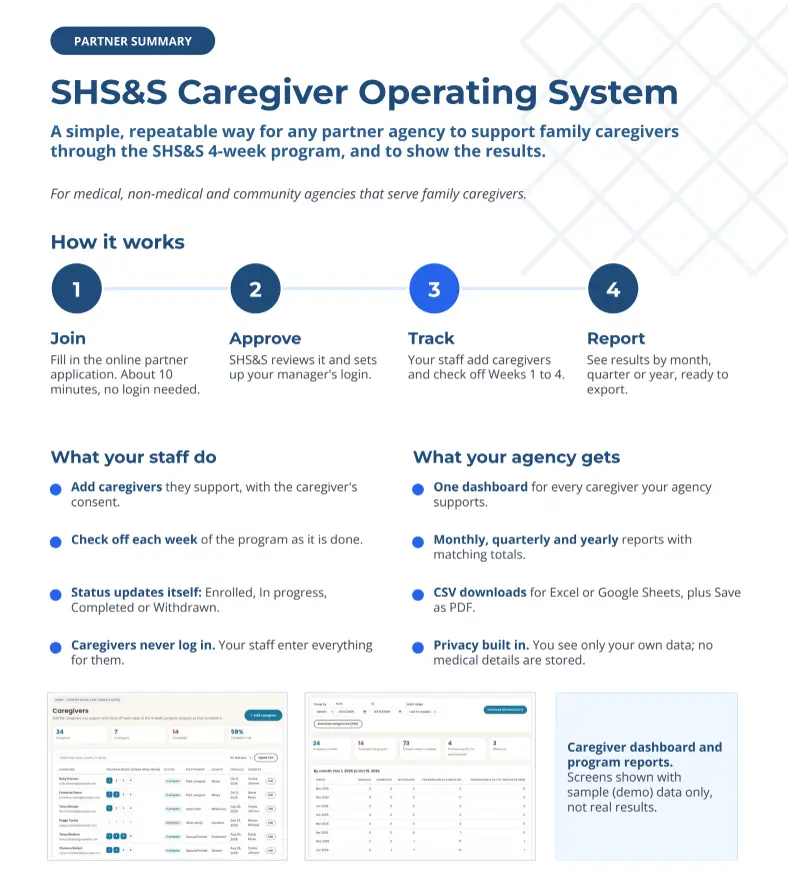
Providing a service is important, but organizations also need a way to document participation and follow up over time. That is why SHS&S developed its Caregiver Operating System. It organizes caregiver participation, program completion, and feedback, helping organizations review how their services are being used.
Following the program, caregivers complete a short questionnaire, which is repeated quarterly to check whether the support is still working for them. The system supports monthly, quarterly, and annual reporting on participation, completion, and benefits reported by caregivers, with follow-up for one year.
The purpose is to make documentation and reporting more manageable, not to create additional administrative burdens for professionals. By organizing individual participation and feedback, the system gives organizations information they can review to better understand service use and caregivers' reported experiences over time. We have included a sample of our actual operating system as an example of how we document continuity of care for up to a year.
A Connected Approach to Caregiver Support
SHS&S brings together caregiver stabilization, professional education, practical resources, and an Operating System that supports documentation and reporting. Our four-hour professional training addresses the causes, effects, and consequences of caregiver burnout and introduces tools professionals can share with the caregivers and families they serve.
Ultimately, we believe the care journey must consider more than the patient alone. It must also consider the person providing care after the patient returns home. Caregiver stabilization is an important part of supporting both the caregiver and the continuity of care.
Learn more about our professional training:
https://end-caregiver-burnout.netlify.app/professional-training
Visit SHS&S:

Lynnel Townsend, The Caregiver Coach, is a Professional Caregiver, Coach, and Mentor with more than 30 years of hands-on caregiving experience in many forms of caregiving. Her greatest role was serving as a Direct Support Professional (DSP) since 2007. She completed more than 100 training modules across multiple areas of caregiving and has worked with individuals requiring significant and total care. Her experience…





