When Leadership Becomes Interference: Navigating Micromanagement From Above
Strategies for maintaining your authority and team trust when facing pressure from above.

When Leadership Becomes Interference: Navigating Micromanagement From Above
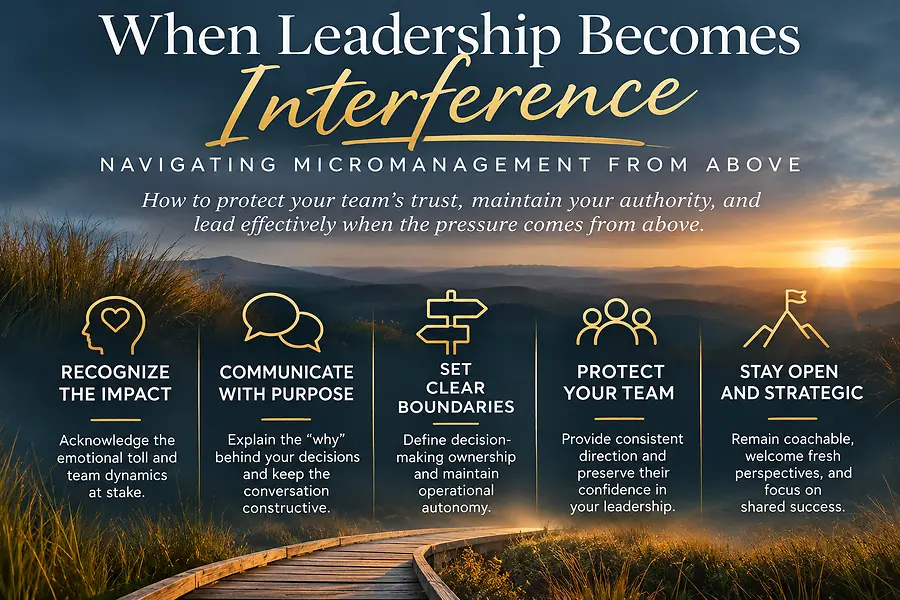
How to protect your team's trust, maintain your authority, and lead effectively when the pressure comes from above.
There is a particular kind of frustration that comes with being an experienced leader and suddenly feeling as though you have to defend your ability to do the very job you were hired to do.
You've spent years developing your leadership style. You've built relationships, earned trust, established systems, and learned the personalities and dynamics of your team.
You know what works. More importantly, you know why it works.
Then someone above you steps in.
Perhaps they're new to the organization. Perhaps they have a different leadership philosophy. Or perhaps they genuinely believe they're helping.
Suddenly, decisions that have historically belonged to you are being questioned. Processes you've carefully developed are being rearranged. Meetings you once facilitated independently now have an additional observer. And suggestions begin sounding less like collaboration and more like instructions.
The frustrating part isn't necessarily that someone has an opinion.
It's the feeling that your experience, judgment, and understanding of your team are being overlooked.
And when you've worked hard to build something meaningful, that can be incredibly difficult to navigate.
The Difference Between Support and Interference
Strong senior leadership should provide direction, remove obstacles, challenge assumptions, and help department leaders succeed.
That doesn't mean senior leaders shouldn't ask questions or suggest improvements.
In fact, some of the best professional growth comes from having someone challenge the way we've always done things.
But there is an important distinction between challenging a leader's thinking and taking over their decision-making.
Supportive leadership asks, "What are you trying to accomplish, and how can I help?"
Micromanagement often sounds more like, "Here's how I want you to do it."
One creates space for ownership.
The other slowly removes it.
And the consequences extend far beyond the relationship between two leaders.
The Impact Nobody Talks About Enough
When senior leadership becomes overly involved in the daily decisions of a department, the department leader isn't the only person affected.
The team notices.
Employees are remarkably perceptive when it comes to leadership dynamics. They notice when their manager's decisions are repeatedly questioned, when direction changes unexpectedly, or when someone higher in the organization begins making decisions that would normally belong to their direct leader.
Over time, this can create uncertainty.
Who is actually making the decisions?
Whose direction should they follow?
Does their manager still have the authority to lead?
Even when no one openly challenges the department leader, those questions can quietly change the dynamics of a team.
And trust, once disrupted, isn't always easy to rebuild.
This becomes particularly important in environments where employee engagement, honest communication, and leadership development depend on psychological safety.
You cannot force people to participate meaningfully simply by changing where they sit, who attends a meeting, or how a conversation is structured.
Sometimes the quietest person in the room is still learning.
Sometimes participation looks different from what an outside observer expects.
And sometimes the leader who has spent years building relationships understands dynamics that simply aren't visible during a single meeting.
You can change the structure of a room in five minutes. Building the trust required for people to speak freely can take years.
Why Experienced Leaders Sometimes Struggle to Push Back
There is an uncomfortable contradiction in leadership.
We're expected to demonstrate confidence, independence, sound judgment, and ownership.
Yet when someone above us begins taking control of decisions within our area of responsibility, we're often expected to accept it without resistance.
Push back too strongly, and you risk being perceived as defensive.
Say nothing, and you risk gradually surrendering the authority necessary to do your job effectively.
For experienced leaders, this can be especially frustrating because the concern isn't always about the decision itself.
It's about the precedent being established.
If every process, meeting, or operational decision becomes subject to someone else's personal preferences, where does accountability actually sit?
How can a leader be fully responsible for outcomes when they no longer have meaningful control over the decisions producing those outcomes?
That's a legitimate leadership question, not simply an emotional reaction.
So How Do We Handle It Without Creating a Power Struggle?
The first instinct may be to defend everything we've built.
That's understandable.
But protecting our leadership authority doesn't require turning every disagreement into a confrontation.
It requires intention, communication, and a willingness to establish professional boundaries.
1. Separate the intention from the impact.
Not every overbearing leader is deliberately trying to undermine someone.
Some are new and eager to contribute. Others are accustomed to being deeply involved in operations. Some genuinely believe that offering more direction demonstrates stronger leadership.
Understanding their intention doesn't mean ignoring the impact.
It simply allows us to address the behavior without making assumptions about the person.
2. Explain the reasoning, not just the preference.
"I've always done it this way" rarely makes a compelling leadership argument.
But explaining the history, relationships, results, and strategic thinking behind a decision changes the conversation.
Instead of saying, "I don't want to change how these sessions are structured," consider:
"I've intentionally designed these sessions around the dynamics of this particular group. Some team members are naturally less vocal, and I've learned that participation develops through consistency and trust. I'd like to preserve that environment while continuing to evaluate what works."
That's not resistance.
That's leadership judgment supported by experience.
3. Establish decision-making boundaries before they become blurred.
One of the most effective conversations a department leader can have with their director is about ownership.
Which decisions require collaboration?
Which decisions require approval?
And which decisions should remain with the person directly accountable for the department?
These conversations don't need to be confrontational.
They can be framed around efficiency, consistency, and clear accountability.
A simple statement such as, "I value your perspective and want to make sure we're aligned on the outcomes. I'd also like to maintain ownership of the day-to-day execution so my team continues receiving consistent direction," can establish an important boundary.
4. Invite feedback without automatically surrendering control.
Being open to feedback does not mean implementing every suggestion.
We can listen, consider another perspective, and still make a different decision.
Sometimes the most professional response is:
"That's an interesting approach. Let me consider how it would work with this team before making any changes."
It acknowledges the input without immediately committing to a direction.
Of course, there will be times when senior leadership makes a final decision. Understanding and respecting that authority is part of the job.
But respectful disagreement and thoughtful discussion should also be part of a healthy leadership relationship.
5. Protect your team's confidence without involving them in the conflict.
This may be the most important responsibility of all.
When leadership disagreements occur above the department level, employees shouldn't be placed in the middle.
Avoid publicly contradicting senior leadership, expressing frustration to your team, or creating an environment where employees feel they must choose sides.
Address concerns privately.
Clarify decisions directly.
And once a direction has been established, communicate it consistently.
Protecting your authority isn't about proving who has more power.
It's about ensuring your employees continue to experience stable, dependable leadership.
The Responsibility Goes Both Ways
Department leaders must remain coachable.
Experience does not make us immune to blind spots, and tenure does not automatically make every existing process the best one.
We should welcome thoughtful questions, fresh perspectives, and opportunities to improve.
But senior leaders have a responsibility, too.
Before changing something, take time to understand why it exists.
Before questioning a leader's approach, learn the dynamics of the team.
Before inserting yourself into a process, consider whether your presence will strengthen it or unintentionally change it.
And perhaps most importantly, recognize that empowering leaders means allowing them room to actually lead.
A director doesn't have to personally influence every decision to demonstrate leadership.
Sometimes the strongest thing a senior leader can do is provide clarity, offer support, and trust the person they've placed in charge.
Leadership Is Not About Defending Territory
There is a fine line between protecting your leadership responsibilities and becoming territorial.
The goal should never be to keep others out simply because we've invested time in building something.
The goal is to preserve what works, remain open to what could work better, and ensure that accountability and authority remain appropriately aligned.
We don't have to agree with every decision made above us.
We don't have to abandon our professional judgment to demonstrate respect.
And we certainly don't have to confuse compliance with collaboration.
But we do have to choose how we respond.
Because our teams are watching how we handle pressure, disagreement, and difficult leadership relationships.
And perhaps that is where our own leadership is tested most.
Not when everyone agrees with us, but when we must respectfully stand behind our judgment while remaining open to someone else's.
Great leadership should never require another leader to become smaller.
It should create the conditions for both to become better.
An important question for leaders at every level:
How do you maintain a healthy balance between providing oversight and giving the leaders who report to you the autonomy they need to succeed? When Leadership Becomes Interference: Navigating Micromanagement From Above
How to protect your team's trust, maintain your authority, and lead effectively when the pressure comes from above.
There is a particular kind of frustration that comes with being an experienced leader and suddenly feeling as though you have to defend your ability to do the very job you were hired to do.
You've spent years developing your leadership style. You've built relationships, earned trust, established systems, and learned the personalities and dynamics of your team.
You know what works. More importantly, you know why it works.
Then someone above you steps in.
Perhaps they're new to the organization. Perhaps they have a different leadership philosophy. Or perhaps they genuinely believe they're helping.
Suddenly, decisions that have historically belonged to you are being questioned. Processes you've carefully developed are being rearranged. Meetings you once facilitated independently now have an additional observer. And suggestions begin sounding less like collaboration and more like instructions.
The frustrating part isn't necessarily that someone has an opinion.
It's the feeling that your experience, judgment, and understanding of your team are being overlooked.
And when you've worked hard to build something meaningful, that can be incredibly difficult to navigate.
The Difference Between Support and Interference
Strong senior leadership should provide direction, remove obstacles, challenge assumptions, and help department leaders succeed.
That doesn't mean senior leaders shouldn't ask questions or suggest improvements.
In fact, some of the best professional growth comes from having someone challenge the way we've always done things.
But there is an important distinction between challenging a leader's thinking and taking over their decision-making.
Supportive leadership asks, "What are you trying to accomplish, and how can I help?"
Micromanagement often sounds more like, "Here's how I want you to do it."
One creates space for ownership.
The other slowly removes it.
And the consequences extend far beyond the relationship between two leaders.
The Impact Nobody Talks About Enough
When senior leadership becomes overly involved in the daily decisions of a department, the department leader isn't the only person affected.
The team notices.
Employees are remarkably perceptive when it comes to leadership dynamics. They notice when their manager's decisions are repeatedly questioned, when direction changes unexpectedly, or when someone higher in the organization begins making decisions that would normally belong to their direct leader.
Over time, this can create uncertainty.
Who is actually making the decisions?
Whose direction should they follow?
Does their manager still have the authority to lead?
Even when no one openly challenges the department leader, those questions can quietly change the dynamics of a team.
And trust, once disrupted, isn't always easy to rebuild.
This becomes particularly important in environments where employee engagement, honest communication, and leadership development depend on psychological safety.
You cannot force people to participate meaningfully simply by changing where they sit, who attends a meeting, or how a conversation is structured.
Sometimes the quietest person in the room is still learning.
Sometimes participation looks different from what an outside observer expects.
And sometimes the leader who has spent years building relationships understands dynamics that simply aren't visible during a single meeting.
You can change the structure of a room in five minutes. Building the trust required for people to speak freely can take years.
Why Experienced Leaders Sometimes Struggle to Push Back
There is an uncomfortable contradiction in leadership.
We're expected to demonstrate confidence, independence, sound judgment, and ownership.
Yet when someone above us begins taking control of decisions within our area of responsibility, we're often expected to accept it without resistance.
Push back too strongly, and you risk being perceived as defensive.
Say nothing, and you risk gradually surrendering the authority necessary to do your job effectively.
For experienced leaders, this can be especially frustrating because the concern isn't always about the decision itself.
It's about the precedent being established.
If every process, meeting, or operational decision becomes subject to someone else's personal preferences, where does accountability actually sit?
How can a leader be fully responsible for outcomes when they no longer have meaningful control over the decisions producing those outcomes?
That's a legitimate leadership question, not simply an emotional reaction.
So How Do We Handle It Without Creating a Power Struggle?
The first instinct may be to defend everything we've built.
That's understandable.
But protecting our leadership authority doesn't require turning every disagreement into a confrontation.
It requires intention, communication, and a willingness to establish professional boundaries.
1. Separate the intention from the impact.
Not every overbearing leader is deliberately trying to undermine someone.
Some are new and eager to contribute. Others are accustomed to being deeply involved in operations. Some genuinely believe that offering more direction demonstrates stronger leadership.
Understanding their intention doesn't mean ignoring the impact.
It simply allows us to address the behavior without making assumptions about the person.
2. Explain the reasoning, not just the preference.
"I've always done it this way" rarely makes a compelling leadership argument.
But explaining the history, relationships, results, and strategic thinking behind a decision changes the conversation.
Instead of saying, "I don't want to change how these sessions are structured," consider:
"I've intentionally designed these sessions around the dynamics of this particular group. Some team members are naturally less vocal, and I've learned that participation develops through consistency and trust. I'd like to preserve that environment while continuing to evaluate what works."
That's not resistance.
That's leadership judgment supported by experience.
3. Establish decision-making boundaries before they become blurred.
One of the most effective conversations a department leader can have with their director is about ownership.
Which decisions require collaboration?
Which decisions require approval?
And which decisions should remain with the person directly accountable for the department?
These conversations don't need to be confrontational.
They can be framed around efficiency, consistency, and clear accountability.
A simple statement such as, "I value your perspective and want to make sure we're aligned on the outcomes. I'd also like to maintain ownership of the day-to-day execution so my team continues receiving consistent direction," can establish an important boundary.
4. Invite feedback without automatically surrendering control.
Being open to feedback does not mean implementing every suggestion.
We can listen, consider another perspective, and still make a different decision.
Sometimes the most professional response is:
"That's an interesting approach. Let me consider how it would work with this team before making any changes."
It acknowledges the input without immediately committing to a direction.
Of course, there will be times when senior leadership makes a final decision. Understanding and respecting that authority is part of the job.
But respectful disagreement and thoughtful discussion should also be part of a healthy leadership relationship.
5. Protect your team's confidence without involving them in the conflict.
This may be the most important responsibility of all.
When leadership disagreements occur above the department level, employees shouldn't be placed in the middle.
Avoid publicly contradicting senior leadership, expressing frustration to your team, or creating an environment where employees feel they must choose sides.
Address concerns privately.
Clarify decisions directly.
And once a direction has been established, communicate it consistently.
Protecting your authority isn't about proving who has more power.
It's about ensuring your employees continue to experience stable, dependable leadership.
The Responsibility Goes Both Ways
Department leaders must remain coachable.
Experience does not make us immune to blind spots, and tenure does not automatically make every existing process the best one.
We should welcome thoughtful questions, fresh perspectives, and opportunities to improve.
But senior leaders have a responsibility, too.
Before changing something, take time to understand why it exists.
Before questioning a leader's approach, learn the dynamics of the team.
Before inserting yourself into a process, consider whether your presence will strengthen it or unintentionally change it.
And perhaps most importantly, recognize that empowering leaders means allowing them room to actually lead.
A director doesn't have to personally influence every decision to demonstrate leadership.
Sometimes the strongest thing a senior leader can do is provide clarity, offer support, and trust the person they've placed in charge.
Leadership Is Not About Defending Territory
There is a fine line between protecting your leadership responsibilities and becoming territorial.
The goal should never be to keep others out simply because we've invested time in building something.
The goal is to preserve what works, remain open to what could work better, and ensure that accountability and authority remain appropriately aligned.
We don't have to agree with every decision made above us.
We don't have to abandon our professional judgment to demonstrate respect.
And we certainly don't have to confuse compliance with collaboration.
But we do have to choose how we respond.
Because our teams are watching how we handle pressure, disagreement, and difficult leadership relationships.
And perhaps that is where our own leadership is tested most.
Not when everyone agrees with us, but when we must respectfully stand behind our judgment while remaining open to someone else's.
Great leadership should never require another leader to become smaller.
It should create the conditions for both to become better.
An important question for leaders at every level:
How do you maintain a healthy balance between providing oversight and giving the leaders who report to you the autonomy they need to succeed?

Kay Combs-John is an Executive Operations Leader with 18+ years of experience leading complex operations across luxury hospitality, resorts, private residential communities, healthcare, and senior living. Currently at Bandon Dunes Golf Resort, she leads an 82-person, multi-function organization spanning housekeeping and janitorial operations, overseeing workforce planning, labor and budget management, quality…