
When the Door Opens, Hold It Open
Using Your Opportunities to Create Access for Others

When the Door Opens, Hold It Open
Lately, I have found myself sitting with one word: access.
I was recently appointed to the Michigan Board of Nursing. I serve on the Board of Directors for Community of Hearts. I was also named runner-up for Executive Director of the Year. These are opportunities and recognitions that I am incredibly grateful for, and I do not take any of them lightly.
But the more doors that open for me, the less I find myself thinking only about what is on the other side of them.
I keep thinking about who has never been invited to walk through.
I know there are people working just as hard as I am. Some are making even greater sacrifices. There are women raising families, caring for aging parents, working two jobs, going back to school, serving their communities, leading teams, solving problems, and carrying responsibilities that will never appear on a résumé.
Some of them are exceptional leaders.
They just haven't been seen yet.
And that has made me think differently about mentorship, leadership, and what we do with access once we receive it.
Talent Is Everywhere. Access Is Not.
We have a habit of recognizing leadership once someone has the title, the degree, the office, the appointment, or the seat at the table.
But leadership often exists long before recognition catches up with it.
There is a caregiver somewhere teaching new employees how to treat residents with dignity.
There is a nurse encouraging her coworkers when the shift becomes difficult.
There is an administrative assistant quietly holding an entire operation together.
There is a young woman who has the ability to become an executive, entrepreneur, clinician, professor, or community leader, but she has never had anyone tell her, "I see something in you."
That matters.
Sometimes the difference between potential and progress is not intelligence, ambition, or work ethic.
Sometimes it is access.
- Access to information.
- Access to someone willing to answer the questions you feel embarrassed to ask.
- Access to professional spaces you did not know existed.
- Access to people who can explain how decisions are made.
- Access to someone who will tell you what you need to improve instead of simply telling you that you are doing great.
- Access to somebody willing to say your name in a room you have not entered yet.
I did not always have that kind of access.
Because of that, I have learned a great deal through trial and error. I have made mistakes. I have figured things out while already doing them. I have walked into spaces where I did not completely understand the rules and learned them as I went.
Perhaps that is why mentorship has been on my heart lately.
Mentorship Is More Than Advice
We use the word mentorship often, but real mentorship is not simply giving someone motivational speeches.
A mentor helps another person see possibilities.
A good mentor shares knowledge, gives perspective, challenges thinking, offers honest feedback, and sometimes helps someone avoid a mistake they had to learn the hard way themselves.
Mentorship also requires discernment.
Not every mentoring relationship needs to be formal. Not every person needs the same type of mentor. And mentorship should never create dependence.
The goal is not to create someone who needs you in order to move.
The goal is to help cultivate someone who eventually understands how to navigate without you.
And sometimes mentoring begins much smaller than we think.
- It may be explaining how to prepare for an interview.
- Reviewing someone's résumé.
- Encouraging someone to apply for a position they believe is beyond them.
- Explaining what serving on a board actually looks like.
- Helping someone understand how to communicate with senior leadership.
- Introducing someone to a professional association.
- Or simply telling a person, "You belong in rooms like this."
Those conversations can change trajectories.
Greatness Does Not Always Wear a Suit
One thing I hope we stop doing is assuming that leadership potential only lives in executive offices.
It does not.
There are extraordinary people throughout our communities who may never have had the opportunity to develop the skills, confidence, network, or exposure that others received early in life.
That does not make them less capable.
It means someone may need to recognize the potential before the position ever does.
We should be looking for leadership everywhere.
- Look for the employee people naturally come to for guidance.
- Look for the woman who asks thoughtful questions.
- Look for the person who notices problems and begins thinking about solutions.
- Look for the individual who serves without needing attention for it.
- Look for integrity.
- Look for curiosity.
- Look for consistency.
- Look for someone willing to learn.
Those qualities deserve cultivation.
Because sometimes greatness is sitting in a breakroom, standing behind a medication cart, working at a front desk, raising children at home, or volunteering in a neighborhood organization.
It simply has not been given a microphone yet.
What Will We Do With Our Overflow?
I believe there are seasons when God allows us to experience things we once prayed for.
- Opportunities come.
- Relationships change.
- Doors open.
- Responsibilities increase.
And sometimes the answer to a prayer looks very different than we imagined.
I am living in a season where I am deeply aware of that.
I am grateful.
But gratitude cannot only be about receiving.
At some point, gratitude should become stewardship.
- If God gives me access, what will I do with it?
- If I learn something valuable, who can I teach?
- If I enter a room someone else has never entered, who can I prepare to enter after me?
- If my network grows, whose name can I mention?
- If my voice carries further than it once did, who can I encourage?
That, to me, is overflow.
Overflow is not having more so that we can simply say we have more.
Overflow is having enough that something can pour through us and reach somebody else.
I am still learning what that will look like in my own life. Perhaps one day it becomes formal mentorship. Perhaps it becomes programs, conversations, introductions, leadership development, or simply being more intentional about recognizing people who might otherwise be overlooked.
I do not have every answer yet.
But I know this much.
When doors begin opening for us, our first instinct should not always be to close them behind us.
Sometimes our greatest contribution will not be the seat we earned.
It will be the person we helped prepare to sit there next.
When the door opens, walk through it gratefully. Then turn around and see who you can help through next.
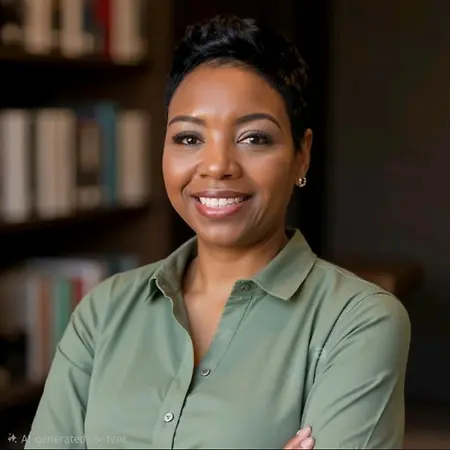
Tarita Dooley is an Executive Director in long-term care and geriatrics with over 20 years of experience in healthcare. Based in Grand Rapids, Michigan, she has held her current role for nearly two years and has been with her company for more than five years. She holds a bachelor's and a master's degree in Health Administration and Health Management from the University of Phoenix, where she is also pursuing a…





