
When the Story Keeps Changing, the Problem May Not Be Your Memory
How to recognize when the story keeps changing and what to do about it.

You were in the meeting. You asked the clarifying question. You may have even sent the recap afterward. And a week later, someone describes that same conversation in a way you barely recognize.
The decision you made together is now something you decided on your own. The concern you raised is now a problem with your attitude. And somehow, you’re the one explaining yourself.
If that’s ever happened to you, you know how disorienting it is. In You’re Not Imagining It, I wrote: “And before long, you find yourself defending an account of events you never imagined would be disputed.”
I’ve spent a lot of time in corporate America, and I’ve watched this play out more often than most organizations would like to admit. I want to talk about it honestly because the conversation around it tends to swing between two unhelpful extremes. Either every disagreement gets labeled gaslighting, or the person who keeps noticing the pattern gets told they’re overreacting.
Neither one helps anyone see clearly.
Before we get to frameworks, I want to speak to you directly. Not just if you lead people. If you work anywhere, with anyone. On a team, in a family business, on a nonprofit board, in a part-time job, in your first role or your fifteenth.
Maybe you’ve started rehearsing conversations before you have them. Maybe you double-check work you already checked. Maybe a normal, uneventful meeting now feels like a win.
I described it this way in the book: “You begin checking work that you’ve already checked, not because you lack confidence in your ability, but because you’ve become uncertain about how your work will be judged.”
If that sounds familiar, here’s what I want you to hear: you are not imagining it. The fact that you keep asking, “Did I misunderstand?” doesn’t mean you did. Thoughtful people ask that question. It becomes a problem when, as I wrote, “those questions stop helping you understand a situation and start becoming the reasons you dismiss what you’re experiencing.”
And if your confidence has taken a hit, I’d gently shift the question you’re asking yourself. One line from the book I come back to often: “What has their confidence been asked to survive?”
I want to be careful here because the word gaslighting gets used loosely. People genuinely remember things differently. Memory is not a recording. Priorities shift. Messages get lost.
In the book, I put it this way: “But there is a difference between two people remembering an event differently and a pattern in which the story repeatedly changes to protect one person while making someone else responsible.”
That’s the distinction that matters. When I do use the word, I mean something specific: “Gaslighting involves a pattern of psychological manipulation that undermines another person’s confidence in their perceptions, memory, or understanding of reality.”
A pattern. Not a single bad conversation. Not one person forgetting one detail.
So how do you tell the difference? This is the part I wish someone had explained to me much earlier: “The disagreement itself is not always the warning sign. The response to clarification may be.”
When someone remembers things differently but operates in good faith, they get curious. They look at the email. They allow that the direction might have been unclear. When something else is going on, the conversation moves. It stops being about what happened and starts being about your judgment, your tone, your memory, or your credibility.
When the story changes, I’ve found it helps to slow down and sort what’s in front of you into four layers. I call it the Story Check. It’s built on the three layers I describe in the book, plus the question that so often reveals the most.
1. Observation: What actually happened? What was said, done, changed, or withheld? Who was there? What’s written down? Stick to what you could show someone else. As I wrote, “‘My deadline was moved after I completed the assignment’ is an observation.”
2. Interpretation: What do I believe it means? This is where our minds naturally go, and it’s where we need the most honesty. “‘Alex wants me to fail’ is an interpretation.” It might be right. It might not. Name it as an interpretation so it doesn’t quietly pass itself off as fact.
3. Impact: How has it affected me? Your work, your confidence, your sleep, your willingness to speak up. Impact is real even when intent is unclear. In the book’s words, “I stopped trusting the instructions I received” describes an impact.
4. Response: What happened when I asked for clarity? Did the other person get curious? Review the record? Acknowledge any role they played? Or did the conversation pivot to you? Watch for what I call the moment when your reaction becomes the evidence, when the original concern disappears and only your frustration is left on the table.
The point of the Story Check isn’t to build a case against anyone. “We do not build a record to convince ourselves we are right. We build one so that we can be more accurate.” Sometimes the check shows you a fixable communication problem. Sometimes it shows you that your first interpretation was off. And sometimes it shows you a pattern that deserves your attention.
All three outcomes are useful. If you can’t tell yet, I wrote that “I need more information” is “a complete and respectable conclusion.”
When the same kind of revision keeps happening, there’s one more question I find clarifying. Instead of trying to prove what was in someone’s head, look at what the changing version does. “Not simply, ‘Did someone forget?’ But, ‘What does this version of events accomplish?’”
Does it preserve someone’s authority? Shift accountability? Make a reasonable question look like resistance? You don’t need to know someone’s intent to notice the effect. “These questions do not establish intent. They help us examine function.”
If you’re someone who takes ownership, this can be especially hard to see. Capable, conscientious people instinctively look for what they can do better. Clearer emails. More documentation. Earlier check-ins. That’s a strength when the relationship runs on good faith.
When it doesn’t, it turns into a loop. “The employee keeps changing their approach. The circumstances keep changing around them. And somehow, the conclusion remains the same: they are still the problem.”
I’ve seen people start saving every message and summarizing every hallway conversation, not to manage their work, but to hold on to what happened. “Documentation becomes less about managing work and more about protecting reality.” That shift deserves attention, both from the person living it and from anyone responsible for the environment.
You don’t have to argue every version of every event. Your job isn’t to make someone adopt your memory. It’s to establish the facts reasonably, protect your integrity, and decide what’s within your control. Here are a few lines straight from the book that I’d encourage anyone to keep handy:
- “My understanding was different. I have the original communication, and I’d like us to review it.”
- “I understand the priority has changed. Going forward, I’d like to confirm the new expectations.”
- “I am open to feedback about how I handled the conversation. I would also like us to address the concern that prompted it.”
None of these guarantee resolution. They let you take part without surrendering your perspective.
If you’re in a position where your account of events carries weight, the Story Check applies to you too, maybe even more so. Before you settle on what happened, ask what the original direction was, what changed, when it was communicated, and what the other person would say. Notice whether your team feels safe asking for clarity or whether clarification has started to feel like conflict. “A workplace in which the story can never be questioned is a workplace in which learning becomes increasingly difficult.”
- When someone challenges my recollection, do I automatically assume they’re right, assume they’re wrong, or look at the evidence?
- Have I ever apologized for my delivery while the original concern went untouched?
- Am I spending more energy proving what happened than deciding what I need next?
- Have I ever repeated someone else’s version of a colleague without knowing the full context?
Looking back, many of us wonder why we didn’t see it sooner. I think it’s often because we were being fair. “Busy giving people the chance to be human. There is nothing foolish about that.”
Fairness can include you, too. You can stay curious, leave room for honest misunderstanding, and still trust what you saw. As I close that chapter: “You do not have to rewrite your experience to make someone else’s version more comfortable.”
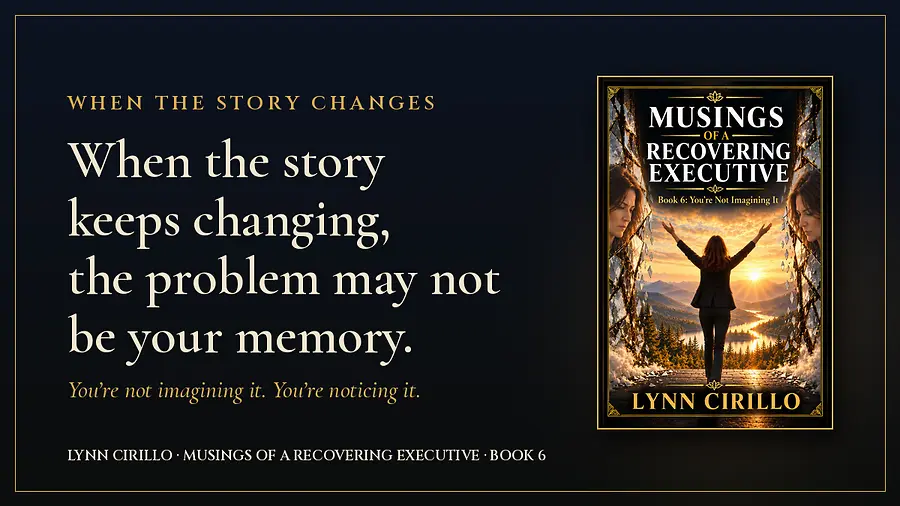
You’re Not Imagining It is the sixth and final book in my Musings of a Recovering Executive series. It walks through noticing what’s happening, understanding the pattern, choosing what to do about it, and reclaiming yourself afterward, with reflection exercises at the end of every chapter. You can learn more at https://MusingsOfaRecoveringExecutive.com/books/youre-not-imagining-it/.
Lynn Cirillo is an author, leadership mentor, and founder of Grounded Leadership LLC, based in Cheyenne, Wyoming. She lives with ADHD, OCD, and dyslexia and writes the six-book Musings of a Recovering Executive series about leadership, identity, boundaries, reinvention, neurodiversity, and reclaiming confidence after difficult workplaces. Learn more at https://MusingsOfaRecoveringExecutive.com/.

Lynn Cirillo is an author, leadership mentor, and Founder and Principal of Grounded Leadership, LLC in Cheyenne, Wyoming. She brings nearly 40 years of professional experience across commercial real estate, corporate operations, research, and technology. Her six-book nonfiction series, Musings of a Recovering Executive, explores the journey from burnout and reinvention to boundaries, identity, neurodiversity, and…





