Building Public Systems That Serve Communities
Where policy meets people: building public systems designed for those they serve.

For most of my career, I have worked in public service spaces where policy, operations, technology, compliance, and community needs all meet.
That intersection is complicated.
It is also where the work becomes real.
A policy can be well-written and still be difficult to navigate. A program can be well-intended and still feel overwhelming to the person trying to access it. A system can meet its technical requirements and still leave people confused, frustrated, or disconnected.
That is why I keep coming back to one central belief:
Public programs are strongest when they are designed around the people they are meant to serve.
That sounds simple.
It is not.
It requires us to look beyond the rule, the process, the form, the dashboard, or the meeting agenda and ask better questions.
How does a neighbor know where to start?
What information do they need before they arrive?
Who do they trust enough to ask for help?
What barriers are we unintentionally creating?
What burden are we placing on customers, staff, or community partners that could be reduced through clearer communication, better tools, stronger partnerships, or a more thoughtful process?
These are not soft questions.
They are operational questions.
They are integrity questions.
They are leadership questions.
Because access and accuracy are not competing values. They strengthen each other when the system is designed well.
Over the last several months, I have spent a lot of time thinking about what it means to build capacity in public systems. I am not referring to capacity solely in terms of staffing levels or funding, but also to an organization's, a team's, and a community's ability to respond with clarity, consistency, and purpose.
Capacity shows up in how we prepare people for change.
It shows up in whether our partners have accurate information.
It shows up in whether our teams understand the “why” behind the work.
It shows up in whether a customer can move through a process with dignity instead of confusion.
It shows up in whether a community organization knows enough to say, “Here is what you may need,” without being asked to become an eligibility worker.
That distinction matters.
Community partners are not there to replace the formal process. They help prepare people for it. They can reduce anxiety, clarify expectations, and help neighbors arrive better informed.
I often think about how we prepare children for their first day of school. We tell them what to expect. We explain who the teacher is. We tell them where to go, what to do, and how to ask for help. They may still be nervous, but they are not walking in completely unprepared.
That is what trusted community engagement can do.
It prepares people before they reach the door.
That preparation matters because public systems are often complex by design. They are shaped by federal rules, state policies, technology constraints, funding requirements, quality standards, timelines, and operational pressures. The complexity may not disappear, but our responsibility is to make the experience as clear and navigable as possible.
That is where leadership lives.
Not only in making decisions.
Not only in writing policy.
Not only in launching programs.
Leadership also lives in building the bridge between the system and the person trying to use it.
For me, that bridge is becoming clearer every day.
It looks like connected colleagues.
It looks like community partners at the table.
It looks like data being used to ask better questions.
It looks like technology that reduces burdens instead of adding another layer.
It looks like listening before designing.
It looks like recognizing that every number represents a neighbor.
It looks like refusing to accept that “the process is complicated” is the end of the conversation.
One of the lessons I have learned is that better systems are rarely built by one person or one program. They are built through connected communities: colleagues, partners, advocates, local agencies, schools, food banks, health organizations, retailers, faith communities, workforce partners, and neighbors themselves.
When those connections are strong, the work becomes more than program administration.
It becomes a shared responsibility.
That does not mean the work becomes easy.
It means the work becomes possible.
I have also learned that meaningful change often starts smaller than people expect. A conversation. A convening. A table at a community event. A partner asking a better question. A team deciding to try something new. A leader willing to say, “We can build this differently.”
Those moments may not look transformational at first.
But they can become the beginning of a new way of working.
That is why I believe so deeply in documenting the work, naming the lessons, and creating language that people can carry with them.
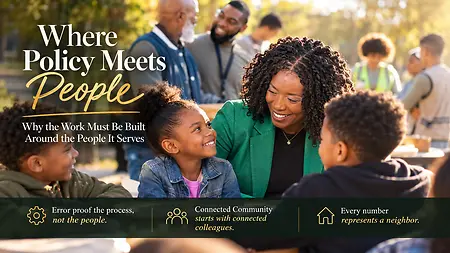
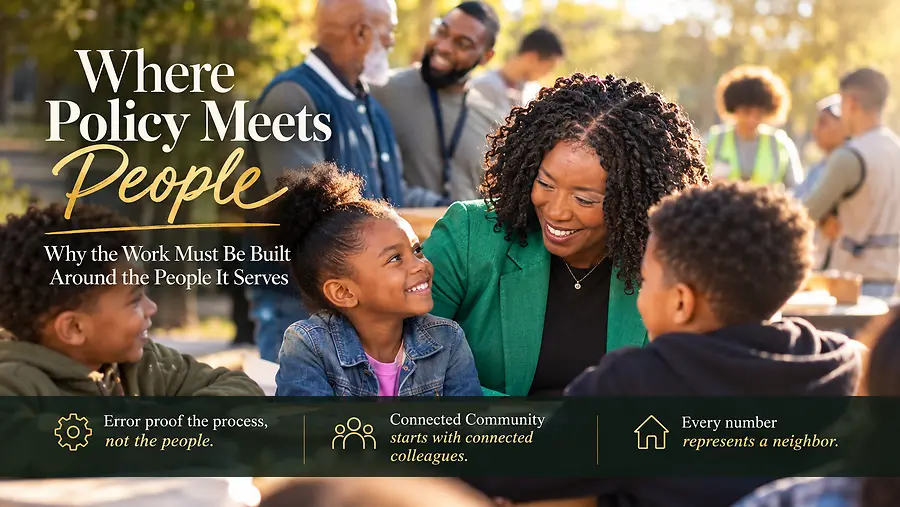
Error-proof the process, not the people.
Connected Community starts with connected colleagues.
Every number represents a neighbor.
These are not just phrases. They are reminders.
They remind us that the work is human.
They remind us that systems are not neutral when they are difficult to navigate.
They remind us that strong programs require strong relationships.
They remind us that operational excellence and compassion belong in the same room.
This newsletter is my space to explore those intersections.
The place where policy meets people.
The place where leadership is not only about authority, but also about clarity, trust, capacity, and care.
The place where we can talk honestly about what it takes to build systems that work better—not just on paper, but in practice.
I do not believe public service is strengthened by pretending the work is simple.
I believe it is strengthened when we are willing to make the work clearer, more connected, and more responsive to the people depending on it.
That is the work I care about.
That is the work I keep returning to.
And that is the conversation I hope to continue here.
Because when policy meets people, the real question is not only whether the program exists.
The real question is whether people can reach it, understand it, trust it, and use it.
That is where the work begins.
And that is where thoughtful leadership can change lives.
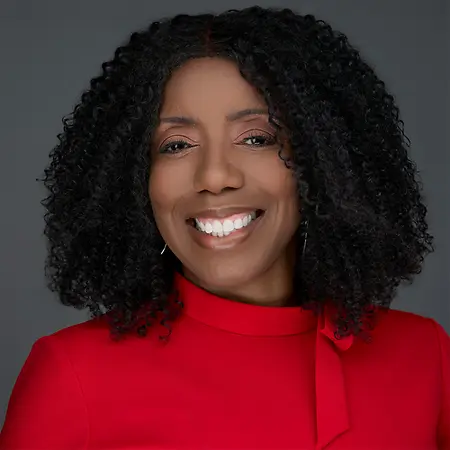
Michele B. Thomas is a public-sector leader and strategist with more than 25 years of experience advancing food and nutrition assistance programs and strengthening the systems that connect individuals and families to essential resources. As Food and Nutrition Assistance Manager for the Commonwealth of Virginia, she works at the intersection of policy, program administration, innovation, and community engagement,…