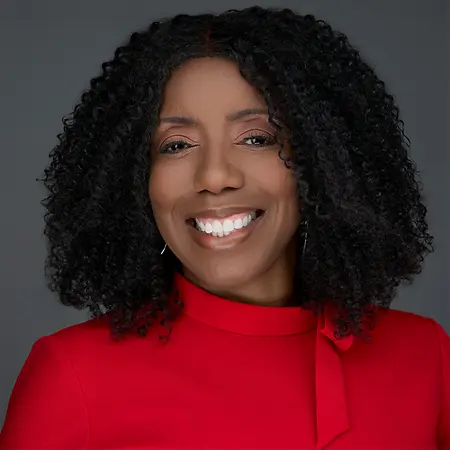
Being needed and being valued are not always the same thing. Some partnerships teach you how to build together; others teach you when it's time to build differently.
Michele B. Thomas · In Her Own Words
Her Story
About Michele
Michele B. Thomas has spent more than 25 years learning what happens when public policy meets real life.
Her career began on the front lines of human services, working directly with individuals and families navigating food insecurity, housing instability, and public benefit systems. Those early experiences gave her a perspective that has remained central throughout her career: a policy can be well intended, but its true measure is whether it works for the people expected to navigate it.
Today, Michele serves as Food and Nutrition Assistance Manager for the Commonwealth of Virginia, where her work spans strategy, policy implementation, program modernization, community engagement, and the administration of large-scale nutrition assistance initiatives. Over the course of her career, she has helped transform complex policy requirements into operational systems, build and expand statewide programs, strengthen partnerships across sectors, improve program accuracy and access, and explore how technology and innovation can create better experiences for both the people receiving services and the employees delivering them.
But Michele's story is not simply about administering programs. It is about questioning what can be better.
She has built a career around understanding systems deeply enough to challenge them thoughtfully looking beyond “the way we have always done it” to identify opportunities to simplify processes, strengthen organizations, build capacity, and create solutions that are both operationally sound and deeply human. She believes the strongest systems do not simply identify where people make mistakes; they are intentionally designed to help people succeed.
That philosophy also shapes how Michele approaches leadership. She believes in listening before acting, following the facts even when they reveal uncomfortable truths, developing people rather than simply managing work, and creating space for new ideas to grow. Her approach is grounded in integrity, curiosity, collaboration, and the belief that meaningful innovation can happen even within highly regulated environments.
After more than two decades in public service, Michele remains a student of the work. She continues to ask the question that has followed her throughout her career: How can we make this better?
For Michele, the answer almost always begins with understanding the people on the other side of the policy.
Her Interview
Ten minutes with Michele
01What do you attribute your success to?
I attribute much of my success to curiosity, resilience, and an unwillingness to simply accept that something cannot be better. I have always wanted to understand not only what we do, but why we do it, who it affects, and what happens when the systems we create do not work the way we intended.
My career has also given me the benefit of seeing public service from many different vantage points. I understand the policy, but I also understand the person sitting across the desk trying to navigate it. I understand the operational requirements, but I am equally interested in what we can build, redesign, or simplify to make those requirements work better. That perspective has taught me that some of the best solutions come from listening closely to the people doing the work and the people experiencing it.
I also attribute my success to learning how to trust my own voice. Experience has taught me that leadership is not always about having the loudest voice in the room or waiting for permission to lead. Sometimes it is recognizing what is needed, being willing to challenge what no longer serves us, and having the courage to build something better.
Most importantly, I have never lost sight of the people behind the programs. Titles, policies, budgets, and systems matter, but ultimately the work is about people. Keeping that at the center has shaped the leader I have become and continues to shape the work I choose to do.
02What’s the best career advice you’ve ever received?
Talk less. Listen more.
It is simple advice, but it has become more meaningful to me as my career has progressed. Early in your career, there can be a tendency to believe that demonstrating what you know is how you establish your value. Experience taught me that some of the most valuable information in the room becomes available when you stop trying to fill the silence.
Listening has helped me become a better leader, strategist, and problem solver. I listen to the people closest to the work because they often see challenges long before they appear in a report. I listen to the people we serve because their experiences tell us whether our policies and programs actually work. And I listen for what isn't being said, because sometimes that is where the real issue lives.
I've also learned that listening does not mean diminishing your own voice. It means using it more intentionally. Listen long enough to understand the problem, ask the questions that others may not be asking, and then speak when you have something meaningful to contribute.
The older I get, the more I appreciate the wisdom of those four words: talk less, listen more. They have taught me that leadership isn't measured by how much you say, but by how well you understand before you act.
03What advice would you give to young women entering your industry?
Become a student of the work. Learn as much as you can, not just about your own responsibilities, but about the policies, systems, people, and decisions that shape the work around you. The deeper your understanding becomes, the more clearly you will see where opportunities exist to make things better.
Be innovative and grow your own ideas. Do not assume that something must continue simply because it has always been done that way. At the same time, understand the environment you are working within. In public service, there will always be policies, regulations, budgets, and other constraints. Innovation is not about ignoring those boundaries; it is about understanding them well enough to discover what is possible within them and sometimes recognizing when those boundaries themselves need to be reconsidered.
I would also tell young women not to wait for a title, position, or invitation to begin thinking like a leader. Ask questions. Pay attention. Bring forward ideas. Find mentors, but develop your own point of view. Your perspective has value, even while you are still learning.
And never become so comfortable with the process that you stop thinking about the people on the other side of it. If you can master the work, remain curious, and keep asking, “How can this be better?” you can build a career that does more than administer programs you can help transform them.
04What are the biggest challenges or opportunities in your field right now?
One of the greatest challenges in our field is ensuring that people who are eligible for assistance can successfully access and retain it. We are seeing concerning declines in program participation among vulnerable households, including working families with children. Too often, the barrier is not necessarily eligibility it is navigating increasingly complex processes, verification requirements, communications, and systems.
That challenge also presents one of our greatest opportunities. There is a growing willingness to embrace technology, innovation, and data and, importantly, to invest in them. We have an opportunity to rethink how people experience public benefit programs by simplifying processes, using plain language, improving how we communicate, and using technology to identify and remove barriers before they result in the loss of assistance.
But modernization cannot be limited to technology. We also have an opportunity to change the way we talk about the people these programs serve. I would like us to move away from thinking about “participants” as an abstract population and begin thinking about them as our neighbors the older adult down the street, the parent working beside us, the child sitting next to ours in school, or the family experiencing an unexpected hardship.
The future of this work requires both innovation and humanity. If we can combine better technology and smarter systems with a deeper understanding of the people those systems are designed to serve, we have an extraordinary opportunity to build public programs that are not only more efficient, but more accessible, responsive, and effective.
05What values are most important to you in your work and personal life?
Integrity, authenticity, and factual storytelling are among the values that guide me most, both professionally and personally. I believe in being honest about what the facts tell us, even when those facts are uncomfortable or do not support the easiest narrative.
As a public servant, I believe we have a responsibility to tell the story truthfully. Data represents real people, real experiences, and real consequences. Factual storytelling means giving context to the numbers without manipulating them, acknowledging both successes and shortcomings, and using what we learn to identify a path forward.
I also try to approach decisions with a simple principle: do no harm. Policies and operational decisions that may appear straightforward on paper can have significant consequences for the people required to navigate them. That makes integrity more than a personal characteristic; it becomes a responsibility to consider the human impact of the choices we make.
Authenticity is equally important to me. I believe you can be thoughtful, professional, and respectful without abandoning your own voice or perspective. Particularly in polarized environments, I have found that facts can create common ground. We may not always agree on the solution, but if we are willing to begin with truth, listen to one another, and remain focused on the people affected by our decisions, we can usually find a path forward.
Join Influential Women and start making an impact. Register now.