
Designing customer-centered systems that prioritize clarity, accessibility, and support over regulatory complexity.
Centering People in Service Delivery: Error-Proofing Processes, Not People

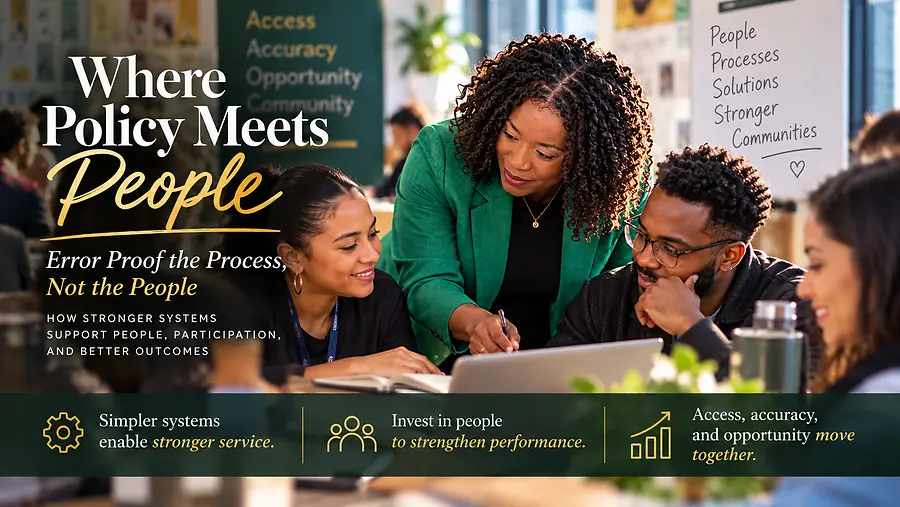
As we develop improved systems, better ways to gather information, target services, and meet needs, we must keep the people using those systems at the center of the experience.
Regulatory requirements are essential, but they can be complex and difficult to translate into clear steps for customers. Even with good intentions, we may use words people don’t understand or phrase directions in ways that meet legal requirements but leave room for ambiguity. A notice can be technically correct and still leave someone unsure about what to send, whose information is needed, or how to submit it.
When staff repeatedly report that customer information is incomplete, missing, or mismatched, our instinct should be to pause. Someone may submit only part of the information, nothing at all, or information that seems reasonable but does not answer the actual question. Those patterns can point to an opportunity to examine how we determine what is needed, explain it, help customers locate and submit it, and retrieve and review what they provide. That review can reveal where the instructions or submission process need attention.
Imagine a system that gathers what is required and makes it clear what customers need to provide. Wherever customers encounter the process—in a form, notice, or online—they should be able to tell what information is needed, whose information it concerns, why it is needed, what dates it should cover, how and when to submit it, and what happens next. An intuitive online experience could let someone start, pause, and later continue where they left off. Clear prompts can explain how to correct a problem and help people submit accurate information.
People have different questions at different stages. Someone considering an application needs different guidance from someone who has already applied, been asked to provide more information, or is waiting for a decision. The experience can reflect those everyday needs without requiring customers to understand an agency’s internal stages or program labels. It should help each person see where they are and find a useful next step.
Support can take different forms at different moments: plain-language notices and forms, translated information, frequently asked questions (FAQs), short videos, or real-time chat. When someone struggles online, a live agent may be able to help them continue where they left off. Phone, mail, and in-person assistance can offer other options when digital services do not meet someone’s needs or are not their preference. The goal is to offer choices that account for language, access needs, schedules, and personal preferences.
These options need to be connected and supported. Staff need training, clear ways to route questions, and enough capacity to help customers move forward. If people have to repeat information or start over when they switch between online, phone, or in-person assistance, the process can add to their burden. Common questions and reasons for contact can reveal where people get stuck and which parts of the process need attention.
Trusted community partners can help bring people with firsthand experience into system design. Customers and partners need a safe way to describe what is working, where the process breaks down, and what would help them move forward. That requires a willingness to hear uncomfortable feedback: a notice was confusing, a step felt repetitive, assistance was hard to reach, or the process asked for information people could not easily provide. Frustration is not always a personal criticism of staff; it may reflect the time, uncertainty, or repeated effort the process creates. We can acknowledge that impact without becoming defensive, then ask what in the process caused the difficulty and what would help. Feedback can help us test notices, forms, online steps, and support materials before they are widely used. Closing the loop—showing how input shaped a decision—helps build trust.
We can measure whether the process is improving. Are more submissions complete the first time? Are the same items repeatedly missing or mismatched? Are people abandoning the process, making repeat contacts, or waiting longer because they are unsure what to do? Reviewing those patterns alongside customer and partner feedback can help us decide where to revise a notice, form, workflow, or support option.
The goal is a complete, accurate submission and a sound decision. Clear information, usable tools, trusted guidance, and meaningful choices can help customers and agencies get there together.
Simply put, when we error-proof the process, not the people, we all win. We must build the organizational capacity to listen, learn, and adapt while keeping people at the center of the work.

Michele B. Thomas is a public-sector leader and strategist with more than 25 years of experience advancing food and nutrition assistance programs and strengthening the systems that connect individuals and families to essential resources. As Food and Nutrition Assistance Manager for the Commonwealth of Virginia, she works at the intersection of policy, program administration, innovation, and community engagement,…





