
Who Has the Capacity to Develop Your Potential?
Understanding The Right Container Principle™: Why Developmental Capacity Matters More Than Position

How many of us have found ourselves engaged in a conversation only to realize that we have the wrong audience?
We entered the conversation ready to share an idea, an aspiration, a challenge, or perhaps a vision for what could be next. Yet somewhere in the exchange, we recognized that the person receiving it did not have the capacity, perspective, experience, or influence to fully understand what we were bringing to them.
What happens next matters.
Some of us begin to shrink the vision. We make the goal smaller, soften the ambition, or reconsider an idea that only moments earlier felt possible. Others walk away disappointed, discouraged, or even defeated, wondering whether we were unrealistic for imagining something more.
And then there are the conversations that do the opposite.
We leave feeling expanded. Someone saw possibility where we saw uncertainty. They asked the question we had not considered. They challenged our thinking without diminishing our vision. They connected us to a resource, an opportunity, or another person who could help us move forward. Sometimes, they simply had enough capacity to listen without immediately reducing what we brought to them.
The difference is not always the quality of the person. Sometimes, it is the capacity of the relationship.
That distinction has significant implications for organizational leadership.
Organizations routinely evaluate talent through performance, competencies, experience, and demonstrated results. Yet an equally important question often receives less attention: Do the individuals entrusted with developing talent possess the capacity to recognize and cultivate its potential?
What happens when an employee's aspirations exceed a manager's experience? When a leader can evaluate performance but struggles to recognize emerging capabilities? Or when an organization identifies high-potential employees without creating the relationships and opportunities necessary for their continued growth?
These questions invite us to examine not only the potential of employees but also the developmental capacity of the leaders and systems surrounding them.
The Right Container Principle™
Not every person is equipped to hold every conversation.
This is not an indictment of someone's intelligence, leadership ability, organizational position, or value. It is an acknowledgment that individuals bring different experiences, perspectives, capabilities, and levels of influence to developmental relationships.
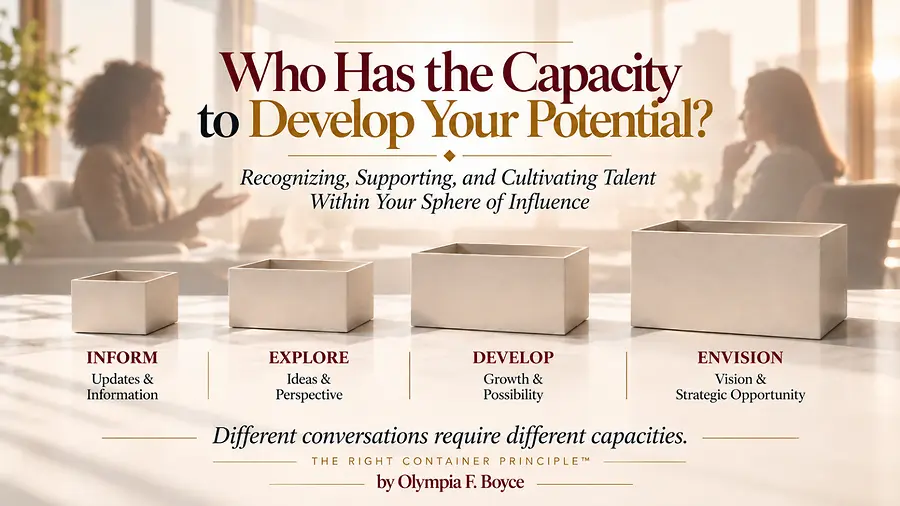
This is what I call The Right Container Principle™: Different conversations require different capacities.
Capacity is contextual, not hierarchical.
A manager may possess extraordinary operational expertise while having limited experience preparing someone for executive leadership. A mentor may offer exceptional perspective but lack the organizational influence necessary to create advancement opportunities. A sponsor may recognize someone's potential and advocate for their visibility, yet not be the appropriate person to guide every aspect of their professional development.
Effective leadership requires understanding these distinctions rather than expecting one individual to fulfill every developmental need.
The principle can be understood through four capacities: Inform, Explore, Develop, and Envision. These are not fixed rankings of leaders or mandatory stages of advancement. They represent distinct forms of support that may be needed at different points in an individual's development.
Inform: Creating Clarity and Understanding
Information is foundational to development.
Employees need to understand organizational expectations, performance standards, available resources, and the capabilities required to succeed.
Leaders who effectively inform create clarity. They communicate expectations, share knowledge, provide context, and help employees understand how their contributions connect to broader organizational objectives.
Yet providing information is not the same as developing potential.
An employee can fully understand the requirements of a position and still lack the support necessary to prepare for the next level.
Information establishes understanding. Development requires something more.
Explore: Creating Space for Possibility
Exploration begins when leaders move beyond communicating what is known and become willing to examine what could be possible.
This capacity requires curiosity, active listening, thoughtful questioning, and the ability to consider perspectives beyond one's own experience.
When employees share aspirations, effective leaders do not immediately reduce those ambitions to the boundaries of the employees' current positions.
Instead, they explore.
What capabilities would be necessary? What experiences could strengthen readiness? What assumptions need to be challenged? What opportunities might exist beyond the employees' immediate responsibilities?
Exploration does not require agreement with every ambition. It requires a willingness to examine potential before prematurely dismissing it.
A leader who explores creates room for employees to think beyond their present circumstances while remaining grounded in the realities of professional growth.
Develop: Translating Potential Into Capability
Recognizing potential is important. Developing it requires intentional action.
This is where leadership moves from conversation to commitment.
Development requires coaching, constructive feedback, stretch assignments, meaningful learning opportunities, and accountability. It also requires an honest assessment of the difference between aspiration and readiness.
An employee may demonstrate the ambition to lead without yet possessing the capabilities necessary for a particular leadership position. Effective development neither dismisses that ambition nor promises advancement without preparation.
Instead, it creates a pathway.
Leaders must identify strengths, address developmental gaps, provide opportunities for practical experience, and evaluate progress over time.
Organizations must also ensure that managers have the resources, skills, and support necessary to carry out these responsibilities.
We cannot expect consistent talent development from leaders whom we have never adequately prepared to develop talent.
That is not simply an individual leadership issue. It is an organizational responsibility.
Envision: Recognizing Potential Beyond the Present Role
One of the most consequential leadership capacities is the ability to recognize possibilities that extend beyond an employee's current responsibilities.
Envisioning requires leaders to consider not only what an individual contributes today but also what that individual could become with appropriate development, exposure, and opportunity.
It calls for organizational perspective, strategic thinking, and a willingness to cultivate talent that may eventually move beyond one's immediate team.
This is where mentorship, sponsorship, succession planning, and organizational visibility become especially important.
A leader who recognizes emerging potential may not personally possess the expertise or influence necessary to develop it fully. However, that leader can still play a significant role by connecting the employee with someone who does.
Leadership is not diminished when we acknowledge the limits of our capacity. It is strengthened when we use that awareness to create opportunities for others.
The Organizational Cost of Misaligned Developmental Capacity
When organizations fail to recognize differences in developmental capacity, the consequences can extend beyond individual disappointment.
Employees may become disengaged when their aspirations are repeatedly misunderstood or dismissed. Emerging capabilities may remain unidentified. Internal mobility can become constrained by the perspectives or influence of individual managers.
Succession planning may focus too heavily on familiar talent rather than identifying individuals whose potential has not yet been fully cultivated. Organizations may also lose capable employees who perceive greater developmental opportunity elsewhere.
Not every unmet aspiration represents a failure of leadership. Employees must demonstrate readiness, accept feedback, and take responsibility for their growth. Organizations also face legitimate constraints involving resources, opportunities, and business priorities.
Nevertheless, leaders must distinguish those constraints from limitations in their own experience or perspective.
An employee's potential should not be defined exclusively by the developmental capacity of one individual.
Building a Developmental Ecosystem
The manager remains central to employee development, but effective talent cultivation often requires relationships beyond the immediate reporting structure.
Managers provide performance guidance, coaching, and accountability. Mentors offer experience, perspective, and developmental counsel. Sponsors advocate for talent, create visibility, and help connect individuals with meaningful opportunities. Peers and professional networks contribute collaboration, shared knowledge, and exposure to different ways of thinking.
These relationships are complementary rather than hierarchical. Their effectiveness depends on the developmental need, the quality of the relationship, and the capacity of the individuals involved.
For organizational leaders, this raises important questions.
Are employees encouraged to seek mentorship across functions? Are managers recognized for developing talent that advances beyond their teams? Are sponsorship opportunities accessible and thoughtfully structured? Are succession decisions informed by demonstrated capability and future potential rather than familiarity alone?
These are organizational design questions, not simply employee-development conversations.
An organization committed to cultivating talent must examine whether its systems create meaningful access to the relationships, experiences, and opportunities that development requires.
The Responsibility of the Individual
Employees also have a responsibility to understand what they need from developmental relationships.
Before sharing an aspiration or seeking guidance, it is worth considering the purpose of the conversation.
Do I need information to better understand an opportunity? Am I seeking perspective to refine an idea? Do I need coaching and experience to strengthen my capabilities? Or am I ready for a conversation about long-term potential, visibility, and strategic opportunity?
Understanding the developmental need helps identify the appropriate audience.
This does not mean concealing aspirations from managers or bypassing organizational relationships. It means approaching professional development with intentionality and recognizing that one conversation, or one relationship, may not be sufficient.
Employees must remain open to feedback, willing to develop necessary capabilities, and accountable for translating aspiration into action.
Ownership of development requires both ambition and discernment.
What Kind of Capacity Are You Creating as a Leader?
While employees must learn to identify the right developmental relationships, leaders must examine the capacity they create for others.
When someone brings you an aspiration that exceeds their current responsibilities, how do you respond?
Do you become curious about their potential, or do you immediately evaluate the aspiration through the limitations of your own experience?
Are you willing to challenge their thinking without diminishing their confidence?
Can you distinguish between an employee who is not yet ready and an employee whose potential has not yet been fully developed?
And when you recognize that someone needs guidance beyond your expertise, are you willing to connect them with another leader who can provide it?
These questions speak to the responsibility that comes with leadership influence.
We cannot always determine the full extent of another person's potential. But we can influence whether the environments we create encourage that potential to be explored, strengthened, or prematurely constrained.
Rethinking the Responsibility of Leadership
Perhaps the future of talent development requires a shift in how organizations define developmental responsibility.
Rather than assuming that every manager possesses the capacity to meet every employee's developmental needs, organizations must intentionally cultivate networks of leadership capability.
Rather than viewing talent development solely as preparation for the next position, leaders must recognize it as an ongoing process of identifying strengths, expanding capabilities, and creating pathways for meaningful contribution.
The Right Container Principle™ reminds us that developmental effectiveness is not determined solely by the willingness to help. It is also shaped by the capacity to provide the kind of support that is actually needed.
Different conversations require different capacities.
Effective leadership is not about becoming every container for every person. It is about recognizing what we are equipped to hold, acknowledging where our capacity has limits, and ensuring that those within our sphere of influence have opportunities to develop beyond those limits.
Because the true measure of leadership is not simply the potential we recognize in others, but the opportunities we help create for that potential to become reality.
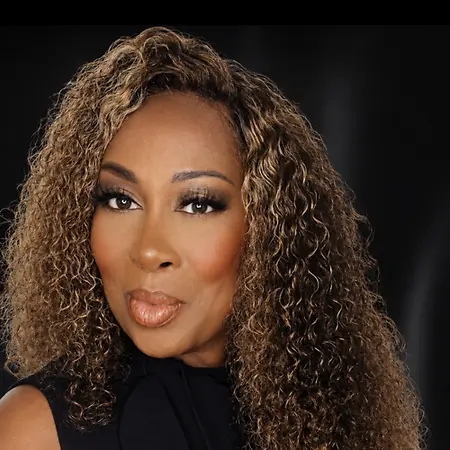
Olympia F. Boyce is an executive leader, author, speaker, leadership consultant, entrepreneur, songwriter, and music producer with more than 25 years of experience helping organizations and leaders cultivate workplaces where people and purpose thrive. She serves as Director of Human Resources at HONOR while leading The Empowered Leader Group, including EmpowerHer Coaching & HR Consulting, through Lady O Enterprises…





