Who Will Be There After the Storm?
Why FEMA's Workforce Capacity Matters More Than Ever in an Age of Climate Disasters

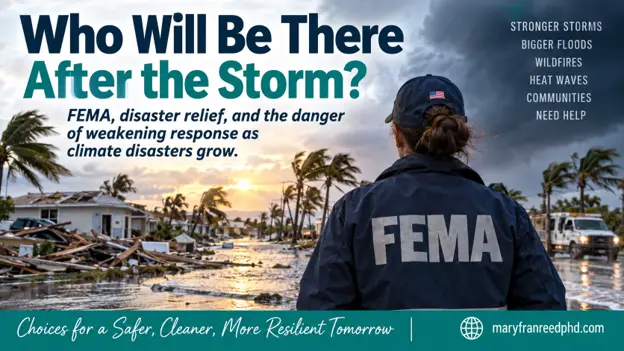
When disaster strikes, most people do not think first about federal staffing levels, agency structure, budget lines, or bureaucratic authority.
They think about safety.
- Is my family safe?
- Is the water safe?
- Is the road open?
- Is the hospital functioning?
- Is help coming?
- Will anyone answer when we call?
After a hurricane, flood, wildfire, tornado, heat emergency, or major storm, disaster response becomes very personal, very fast.
It is not an abstract government program.
It is rescue. Shelter. Food. Water. Debris removal. Medical support. Emergency communications. Temporary housing. Rebuilding help. Coordination among local, state, tribal, territorial, and federal agencies.
In the United States, the Federal Emergency Management Agency—FEMA—is central to that system.
That is why the current state of FEMA deserves national attention.
At the very moment climate-related disasters are becoming more frequent, expensive, and complex, the federal government has been debating, cutting, reorganizing, and legally contesting the capacity of the agency responsible for helping the country respond.
That should concern all of us.
Disasters Are Not Waiting
Climate disasters do not pause while agencies reorganize.
Hurricane season arrives whether staffing plans are ready or not. Wildfires ignite whether budgets are settled or not. Floodwaters rise whether computer systems are modernized or not. Heat waves kill whether emergency plans are fully staffed or not.
The United States has already seen the cost of repeated extreme weather. NOAA's billion-dollar weather and climate disaster database was retired after 2024, but Climate Central continued the analysis and reported that, through June 2026, the United States had experienced 438 billion-dollar weather and climate disasters since 1980, with total costs exceeding $3.2 trillion.
Those numbers are not just economic statistics.
They represent destroyed homes, damaged businesses, flooded schools, burned neighborhoods, ruined crops, washed-out roads, broken power systems, stressed hospitals, and families trying to rebuild their lives.
And disasters are no longer rare exceptions.
They are becoming part of the national operating environment.
That means disaster relief cannot be treated as an occasional emergency function. It has become a permanent pillar of public safety.
FEMA's Job
FEMA is not the only responder after a disaster. Local firefighters, police, paramedics, emergency managers, public works crews, hospitals, utilities, volunteers, churches, nonprofits, and state agencies often arrive first.
But FEMA plays a crucial coordinating role when disasters exceed local and state capacity.
- It helps support emergency protective measures.
- It helps fund debris removal.
- It helps individuals and communities recover.
- It coordinates federal resources.
- It works with states and local governments.
- It supports mitigation and resilience projects.
- It helps manage the Disaster Relief Fund.
Through the Disaster Relief Fund, FEMA can support authorized federal disaster activities and eligible state, territorial, tribal, and local actions, including emergency protection and debris removal.
In plain language, FEMA is part of the national backstop.
When the disaster is too large for a community or state to handle alone, FEMA helps bring federal resources to bear.
That backstop matters more in a warming world.
The Workforce Question
Disaster response depends on people.
Experienced people.
People who know how to move supplies, coordinate agencies, process claims, inspect damage, communicate with local officials, manage shelters, track logistics, support survivors, and keep complicated systems functioning under pressure.
That is why recent reports about FEMA's workforce are so troubling.
The Government Accountability Office reported that FEMA began the 2024 and 2025 hurricane seasons with only 17 percent and 15 percent, respectively, of its incident-management workforce available to respond to disasters.
That is a startling figure.
A disaster agency cannot do its job with confidence if too few trained people are available when disasters arrive.
The issue is not simply the number of employees on paper. It is readiness. It is surge capacity. It is experience. It is institutional memory. It is whether the right people are available when the country needs them.
AP reported that more than 4,300 FEMA employees, about 17 percent of the agency's workforce, left during fiscal 2025, and that GAO warned the departures caused a loss of institutional knowledge and experienced personnel.
That matters because disaster response is not something people learn overnight.
You cannot instantly replace years of experience during a hurricane.
The 50 Percent Cut
The most alarming recent development was the Trump administration's plan to cut FEMA's workforce by half.
A federal judge ruled this month that the plan was unlawful. According to Reuters, U.S. District Judge Susan Illston found that the Department of Homeland Security acted unlawfully by directing FEMA to cut thousands of disaster-response jobs and by stopping renewal of contracts for on-call reservists who respond to disasters.
AP reported that Judge Illston said the 50 percent staffing reduction appeared arbitrary and that the directive came from top DHS officials despite objections from FEMA leadership.
That should stop us.
This was not a small administrative adjustment.
A 50 percent reduction in FEMA staffing would have changed the country's disaster-response capacity at a time when disasters are larger, costlier, and more complex.
The court ruling does not solve every problem. Remedies are still being worked out. Some workers have reportedly been rehired. FEMA has said it remains focused on workforce stability and disaster preparedness.
But the episode raises a much larger question:
Why would any administration weaken disaster-response capacity during an era of escalating climate risk?
The Argument for Shifting Responsibility
The Trump administration and its supporters have argued that FEMA needs reform, that federal disaster relief should not replace state responsibility, and that the federal government should reduce waste and improve accountability.
Those are not unreasonable topics to discuss.
FEMA is not perfect. Disaster aid can be slow. Paperwork can be confusing. Some communities struggle to access help. Rebuilding can take years. Insurance gaps are enormous. Fraud prevention matters. Accountability matters. State and local preparedness matter, too.
But reform is not the same as weakening capacity.
Better disaster response requires stronger planning, clearer rules, modern technology, faster delivery, transparent oversight, and better coordination.
It does not require hollowing out the people who know how to respond.
A serious reform plan should answer practical questions:
- Who will staff disaster operations when multiple emergencies occur at once?
- Who will inspect damage?
- Who will coordinate with states?
- Who will process aid?
- Who will manage logistics?
- Who will support survivors?
- Who will help small towns that lack emergency-management staff of their own?
- Who will respond when disasters cross state lines?
If the answer is "the states," then another question follows:
Which states? With what money? With what trained personnel? With what mutual-aid capacity when several states are hit at the same time?
Climate disasters do not respect state boundaries or state budgets.
States Cannot Do It Alone
States and local governments are essential. They know their communities. They understand local geography, roads, hospitals, shelters, evacuation routes, and vulnerable populations.
But states are not equal in resources.
Some states have large emergency-management systems. Others have smaller agencies and fewer reserves. Some communities have strong tax bases. Others do not. Some counties have professional emergency-management staff. Others rely on a handful of overworked people.
Disasters also do not strike evenly.
A major hurricane can devastate several states at once. Wildfire smoke can cross the continent. Flooding can overwhelm entire regions. Heat waves can stress power grids across multiple states. Tornado outbreaks can hit many communities in a single day.
In those moments, the federal role matters.
Not because Washington knows everything.
But because national capacity exists for a reason.
The United States is one country. When Americans are hit by disaster, they should not be left to depend only on the wealth of their ZIP code or the staffing level of their county office.
Climate Change Raises the Stakes
This is where climate change becomes central.
A warmer atmosphere holds more moisture. That can intensify heavy rainfall. Hotter temperatures worsen heat waves. Drought can dry landscapes and increase wildfire risk. Warmer oceans can add fuel to hurricanes. Sea-level rise worsens coastal flooding. Weather whiplash can bring drought and flooding to the same region in different seasons.
No single disaster can be reduced to one cause.
But the overall pattern is clear: the climate system we built our infrastructure around is changing.
That means disaster response must change, too.
- We need stronger building codes.
- Better flood maps.
- Modernized drainage.
- More resilient hospitals.
- Better evacuation planning.
- Stronger electric grids.
- More cooling centers.
- More wildfire mitigation.
- Better water systems.
- More reliable communications.
- And faster, fairer disaster recovery.
FEMA is not responsible for all of that.
But it is part of the system that helps the country prepare, respond, recover, and rebuild.
Weakening FEMA in a warming world is like cutting fire crews during a drought.
Disaster Relief Is Climate Adaptation
Too often, climate adaptation is discussed as if it means only sea walls, tree planting, or future planning documents.
But disaster relief is also adaptation.
So is emergency management.
So is FEMA staffing.
So is debris removal.
So is temporary housing.
So is helping communities rebuild above flood level.
So is strengthening infrastructure before it fails.
So is making sure elderly people, people with disabilities, low-income families, rural communities, and medically vulnerable households are not abandoned after disaster strikes.
Adaptation is not only about preventing damage.
It is also about being prepared when damage occurs.
The question is not whether disasters will happen.
They will.
The question is whether we will have the systems in place to reduce suffering when they do.
Who Gets Help First?
Disaster relief also raises a moral question.
- Who gets help quickly?
- Who waits?
- Who has insurance?
- Who has savings?
- Who can evacuate?
- Who can rebuild?
- Who knows how to navigate federal forms?
- Who has internet access, transportation, documentation, and time to fight bureaucracy?
Wealthier families can often recover faster. They may have insurance, credit, savings, vehicles, generators, and somewhere else to stay.
Poorer families may lose everything and have nowhere to go.
Older adults may not be able to evacuate easily.
People with disabilities may depend on powered medical equipment.
Rural communities may be far from services.
Renters may be displaced without control over rebuilding.
Small towns may lack staff to apply for complex federal grants.
That is why disaster response must be designed around people, not paperwork.
Cutting capacity does not fall equally on everyone.
It usually hurts the most vulnerable first.
Preparedness Costs Less Than Failure
Some people object to disaster spending because it is expensive.
But failure is more expensive.
It costs more to rebuild after floodwaters destroy a town than to reduce flood risk ahead of time.
It costs more to treat heatstroke than to provide cooling and reliable power.
It costs more to restore destroyed infrastructure than to harden it.
It costs more to improvise during a disaster than to plan before one.
It costs more to lose experienced emergency personnel than to retain them.
Preparedness is not waste.
Preparedness is insurance.
And in a country facing rising disaster costs, insurance is not optional.
What Strong Reform Would Look Like
FEMA can and should be improved.
But real reform should strengthen disaster readiness.
It should ensure that FEMA has enough trained staff before disasters occur.
It should modernize outdated systems.
It should simplify aid for survivors.
It should make mitigation funds easier for vulnerable communities to access.
It should improve coordination with states, tribes, territories, local governments, utilities, hospitals, and nonprofits.
It should protect taxpayer dollars while speeding legitimate aid.
It should invest in resilience before disaster, not only recovery after disaster.
It should maintain a strong national response capacity for events that exceed state and local resources.
And it should be guided by evidence, not ideology.
The question should never be: How small can we make FEMA?
The question should be: What capacity does the country need for the disasters we are now facing?
The Storm Does Not Care About Politics
Hurricanes do not care whether a county voted red or blue.
Floods do not check party registration.
Wildfires do not ask whether a neighborhood supports big government or small government.
Heat waves do not spare people based on ideology.
Disaster response is one of the clearest tests of public responsibility because the need is immediate and human.
When people are trapped, flooded, burned out, displaced, overheated, or without power, they need help.
Not slogans.
Not political theater.
Help.
Who Will Be There?
The current debate over FEMA is really a debate over what kind of country we intend to be in as this age of climate disruption continues.
- Will we strengthen the systems that protect people?
- Or weaken them just as the risks grow?
- Will we invest in preparation?
- Or pay more after failure?
- Will we protect only the communities wealthy enough to protect themselves?
- Or maintain a national commitment to disaster response?
- Will we treat emergency management as bureaucracy?
- Or recognize it as public safety?
The next storm will not wait for the next court ruling.
The next flood will not wait for a staffing study.
The next wildfire will not wait for a budget negotiation.
The next heat emergency will not wait for political agreement.
Ask your elected officials what they are doing to ensure FEMA and state and local emergency agencies have the trained people, resources, and capacity they need before the next disaster strikes. Support strong preparedness in your own community. Know your evacuation routes, emergency contacts, and local warning systems.
We should not wait until people are stranded, flooded, burned out, or without power to discover that the systems meant to help them have been weakened.
Disasters are coming.
The question is whether help will be ready when they arrive.
Who will be there after the storm?
That is not a partisan question.
It is a human one.
And in a warming world, it is one of the most important questions we can ask.