Working In A Hard World, Building A Soft Business
How one woman left the corporate rat race to build a business rooted in compassion, connection, and rescue puppies.

Working in a Hard World, Building a Soft Business
There has never been a shortage of sharp edges in the corporate world: targets, deadlines, restructures, and “urgent” emails that land at 10:47 p.m.
For a long time, I thought success meant learning to live with those edges—maybe sanding them down a little, but never questioning whether the entire system could feel different.
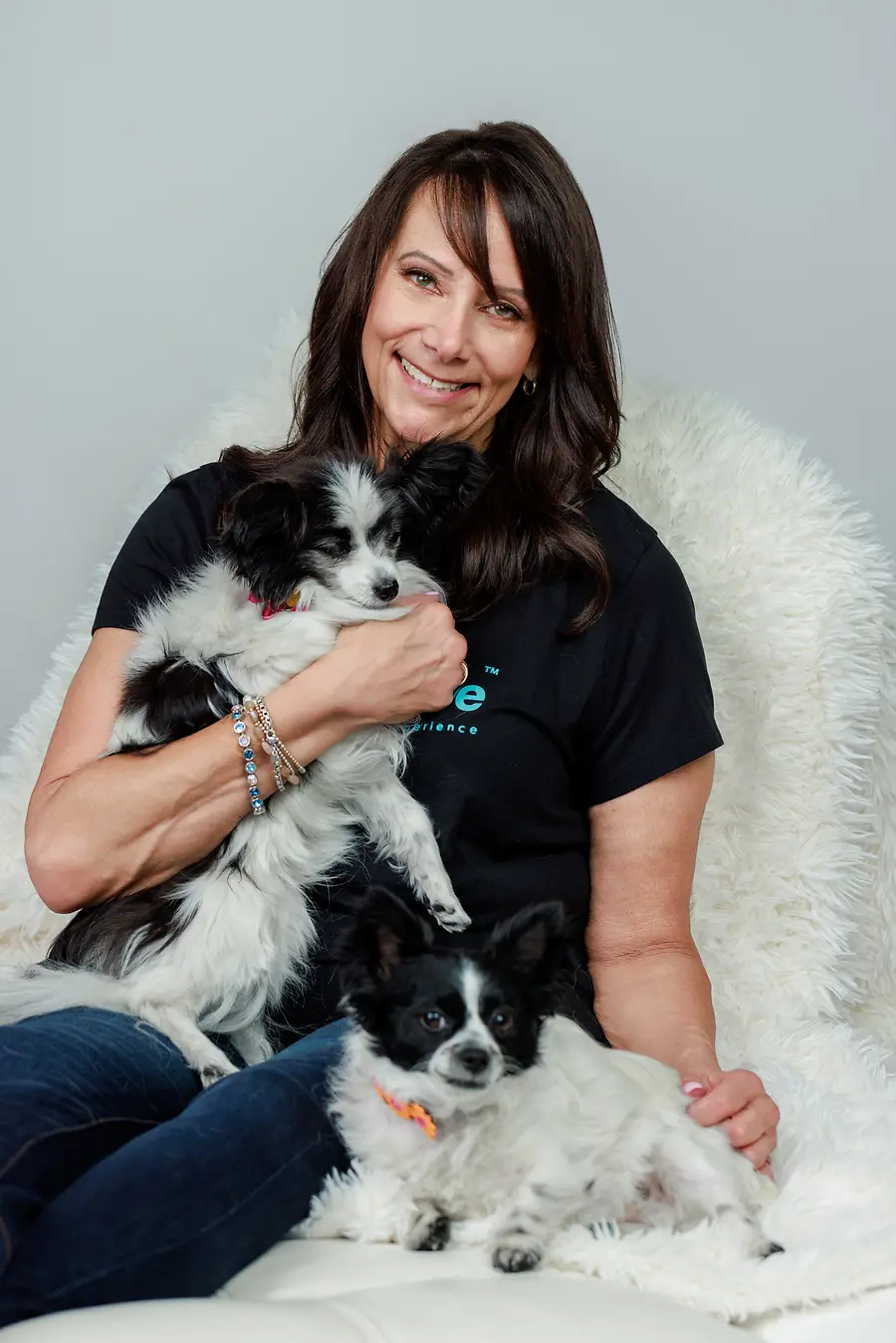
Today, my work looks entirely different: a room full of adults in business attire sitting on the floor, exhaling for the first time all week with puppies asleep in their laps.
That didn’t come from a perfect five-year plan. It came from a decision I made in midlife: if I was going to keep working this hard, it had to be in service of more softness. More relief. More humanity.
This is the story of how I built a business around that decision—and what it taught me about leadership, risk, and the quiet power of joy during difficult times.
The Ladder Was Leaning Against the Wrong Wall
I spent 25 years climbing.
Global trade shows. National sales meetings. Incentive programs for some of the biggest companies in the world.
I had the titles, the travel, the responsibility, and—if I’m honest—the exhaustion to prove it.
I also carried a chip on my shoulder. I didn’t have a college degree, and people made sure I knew it. I responded the only way I knew how: by outworking everyone in the room.
I looked to people like Steve Jobs and Bill Gates as proof that there was more than one path to building a successful career.
On paper, it worked.
I kept getting promoted, earning bigger budgets, and taking on higher-stakes responsibilities. But inside, something began to fray.
As the programs grew, so did the politics. I spent more time navigating executive egos and less time creating the electric moments when people genuinely connected.
At some point, I realized the beautiful ladder I had spent years climbing was leaning against the wrong wall.
So I did the thing that terrifies many high achievers.
I stepped sideways.
I left my in-house executive role for agency and contract work, then kept moving forward—allowing myself to say, This version of success no longer fits me, even though I had no idea what would come next.
The Year I Couldn’t Find My Passion
There’s a glamorous version of reinvention where inspiration arrives like a lightning bolt at exactly the right moment.
Mine didn’t look anything like that.
I hired a life coach. I journaled. I made lists of “things I might want to do when I grow up”—as a fully grown woman.
I gave myself an entire year to figure out my next chapter.
Somewhere around month ten, I hit a wall of genuine frustration.
Everyone loves to say, “Follow your passion.”
Almost no one talks about the quiet panic that comes when you realize you’re no longer sure what your passion actually is.
Then, during a rooftop event-planning meeting, I made a joke that changed everything.
The Idea That Wouldn’t Leave Me Alone
We were brainstorming ideas for a rooftop activation.
Without thinking, I said, “What about a puppy kissing booth?”
Everyone laughed.
Then they paused.
Then the logistics started flying: liability, cleanup, permits.
In the end, it never happened. The idea stayed on paper.
But it wouldn’t leave my mind.
I kept picturing grown adults—even senior executives—dropping their shoulders the moment a puppy landed in their arms.
I imagined the shift I had witnessed countless times over the years: when something authentic cuts through the corporate script and people begin showing up as themselves again.
I started researching rescue organizations, reading about animal-assisted therapy, and circling an idea that felt equal parts calling and challenge.
What if my next chapter wasn’t in another boardroom at all?
What if it was on the floor of that boardroom, surrounded by rescue puppies and people who desperately needed a break?
The moment I gave myself permission to take the idea seriously, everything accelerated.
Building Something Soft in a Hard World
Within six weeks, I had a business plan.
Within three months, I had a company.
It didn’t begin with Fortune 500 offices. It began with children’s parties and small community events that allowed me to test logistics, refine safety protocols, and learn what it meant to be responsible for both animals and people in the same space.
Six months later, I landed my first corporate client.
For the next nine months, I lived in two worlds: corporate work during the day and Puppy Love during every spare hour I could find.
Eventually, the scales tipped.
The puppy events began filling both my calendar and my heart in ways the meetings no longer could.
I stopped asking whether it was reasonable to keep doing both and started asking myself what kind of life I truly wanted to build.
So I jumped.
Seven years later, that “silly” idea operates in multiple markets and has served hundreds of companies.
The lesson isn’t that everyone should quit their job and start a puppy business.
It’s that there is room in the business world for ideas that treat softness as a strength rather than a liability.
When the Ground Disappeared
It would be easy to tell this story as a tidy success arc.
But that would leave out the part I’m proudest of: I kept going when there was every reason to quit.
When the pandemic hit, my business went to zero almost overnight.
- No offices.
- No conferences.
- No in-person events.
People were kind—but blunt.
“You should look for a real job.”
“Events are over.”
“Offices are never coming back.”
I listened.
I nodded.
Then I quietly refused to believe them.
I took a part-time job caring for an elderly woman a few hours each day. It got me out of the house, kept me moving, and reminded me that value isn’t always measured on a balance sheet.
Every afternoon, I worked on Puppy Love.
- I updated systems.
- I strengthened the business.
- I continued sending a monthly newsletter—even when I had nothing to sell.
When events returned, they didn’t trickle back.
They surged.
Companies were desperate to reconnect their teams and acknowledge everything people had endured.
The following year became the most successful in my company’s history.
For me, resilience wasn’t about bravado.
It was about quietly believing that human connection would always matter—even when that belief felt lonely.
What Joy Actually Tells You
Building Puppy Love has completely reshaped my understanding of leadership.
I used to believe strong leaders gripped the wheel tightly, had every answer, and never revealed uncertainty.
Today, I believe leadership is about creating spaces where people can exhale.
Sometimes that means designing experiences where employees step away from their screens for fifteen guilt-free minutes.
Other times, it means leading my own team differently—letting them see the messy middle instead of only polished victories, admitting when I’m afraid and making the decision anyway, or saying no to lucrative opportunities that don’t align with the well-being of either the dogs or the people we serve.
I think women, in particular, are often taught to be endlessly accommodating.
Ironically, building a “soft” business has required incredibly firm boundaries.
Soft isn’t weak.
Joy isn’t frivolous.
When a CFO emails after an event to say, “I haven’t seen my team smile like that in years,” I’m reminded that joy is data, too.
It tells us something meaningful about the health of a workplace, the well-being of its people, and the quality of its leadership.
The Permission You’re Looking For Is Already Yours
If there’s one thing I hope someone takes from this story, it isn’t a strategy or a framework.
It’s this:
The version of yourself that felt “too much” in certain rooms—or “not enough” in others—isn’t a flaw waiting to be corrected.
It may be exactly what your next chapter requires.
I was too emotional for some boardrooms and not credentialed enough for others.
Those same qualities enabled me to create experiences that feel deeply human and build trust with clients and rescue partners who know I care about far more than appearances.
You don’t have to burn your life down to honor that part of yourself.
But you may have to disappoint people who are invested in the old version of your success.
You may have to say:
"I know this looks unconventional, and I’m doing it anyway."
The ground you land on may be richer than you ever imagined.
For me, it looks like conference centers and rooftops filled with laughter, dog hair, and the quiet sound of people remembering what it feels like to feel good at work.
It’s not a traditional business story.
It’s mine.
And if it gives you permission to ask,
"What if there’s a softer way to do this?"
then every leap, every late night, and every puppy cuddle was worth it.