Workplaces Aren’t Broken — But the Way We Respond Inside Them Often Is
How Emotional Regulation and Intentional Leadership Transform Workplace Culture Under Pressure

Most workplace problems are not caused by a lack of intelligence, talent, or capability.
They are caused by unmanaged reactions under pressure:
Deadlines.
Miscommunication.
Stress.
Unclear expectations.
Personality clashes.
Burnout.
Competing priorities.
Emotional exhaustion.
These moments do not just test productivity—they reveal regulation.
In today’s workplace, the ability to respond with intention instead of reaction may be one of the most valuable leadership skills of all.
For years, leadership was often associated with authority, toughness, and the ability to push through challenges without emotion. Many people were taught that professionalism meant suppressing feelings, avoiding difficult conversations, and simply “getting the job done.”
But modern workplaces are shifting.
Employees are no longer looking only for intelligent leaders. They are looking for grounded leaders.
Leaders who can communicate clearly under pressure.
Leaders who know how to listen without immediately becoming defensive.
Leaders who create environments where people feel respected, valued, and psychologically safe enough to contribute honestly.
The reality is this:
Pressure does not create most workplace issues. Pressure reveals them.
It reveals communication habits, emotional triggers, leadership gaps, unresolved tension, lack of clarity, poor boundaries, and reactive behaviors.
When pressure rises, people often default to survival behaviors rather than intentional leadership.
Some become defensive.
Some shut down.
Some overreact.
Some avoid accountability.
Some communicate harshly.
Some stop communicating altogether.
While these reactions may happen in a moment, their impact can shape an entire workplace culture over time.
Many teams are not struggling because people do not care. They are struggling because people are overwhelmed, emotionally exhausted, dysregulated, and reacting faster than they are reflecting.
That distinction matters.
One reactive conversation can damage trust.
One emotionally charged response can create hesitation within a team.
One leader who lacks self-awareness can unintentionally create environments where people feel unheard, dismissed, or constantly on edge.
Over time, those moments accumulate.
Morale decreases.
Collaboration weakens.
Burnout increases.
Communication becomes strained.
Productivity suffers.
People disengage emotionally long before they disengage physically.
And yet, many organizations continue focusing almost exclusively on performance metrics without addressing the emotional and behavioral patterns influencing those metrics in the first place.
We often train people how to produce, but we rarely teach them how to regulate. That is where emotional regulation becomes powerful.
Emotional regulation is not about pretending emotions do not exist. It is not about suppressing frustration, avoiding conflict, or becoming passive. It is about learning how to pause long enough to respond intentionally instead of reacting impulsively. It is about self-awareness and recognizing what pressure is bringing out of you before that pressure begins impacting everyone around you.
The strongest leaders are not always the loudest people in the room. Often, they are the people who know how to remain clear during chaos. The people who can navigate tension without escalating it. The people who can communicate honestly while still maintaining emotional discipline and respect for others.
Regulation is not weakness.
It is leadership and emotional responsibility.
In many ways, it may become one of the defining leadership skills of this generation.
As workplaces continue evolving, emotional intelligence can no longer be treated as a “soft skill.” The ability to manage pressure, communicate intentionally, and lead with clarity directly impacts team performance, workplace culture, retention, trust, and long-term organizational health.
People may forget policies, but they rarely forget how a workplace made them feel.
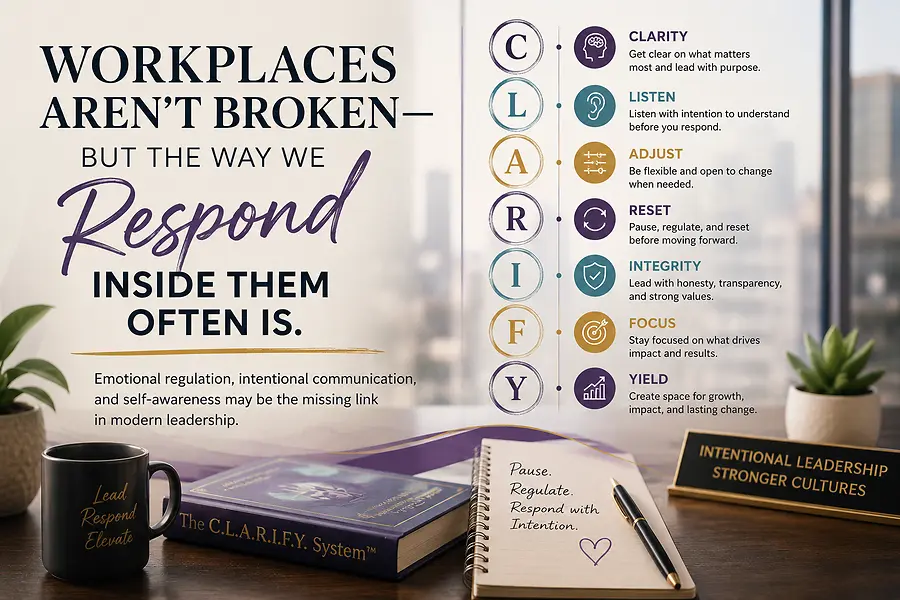
That realization is what led me to create The C.L.A.R.I.F.Y. System™, a practical mindset framework designed to help people pause, regulate, and respond with intention instead of reaction.
The framework was later expanded in my book, The C.L.A.R.I.F.Y. System: A Mindset Framework for Healing the Workplace & Elevating Productivity, where I explore how emotional regulation, communication, self-awareness, and intentional leadership directly impact workplace culture and productivity.
The truth is that healthier workplaces are not built only through better systems. They are built through healthier responses—and when leaders become more intentional about how they communicate. Additionally, when teams learn how to navigate tension without destroying trust, stop operating from constant emotional survival mode, and begin responding from clarity instead of pressure.
Workplaces do not transform simply because policies change. They transform when people become more aware of how they show up inside those environments. The future of leadership will not belong only to the most knowledgeable people in the room. It will belong to the people who can remain grounded, intentional, emotionally aware, and clear when pressure rises.
Workplaces are not always broken...
but the way we respond inside them often is.


