You Forgot the Comment. They Didn't.
How a single dismissive moment can reshape how you see yourself at work—and what leaders can do to repair the damage.

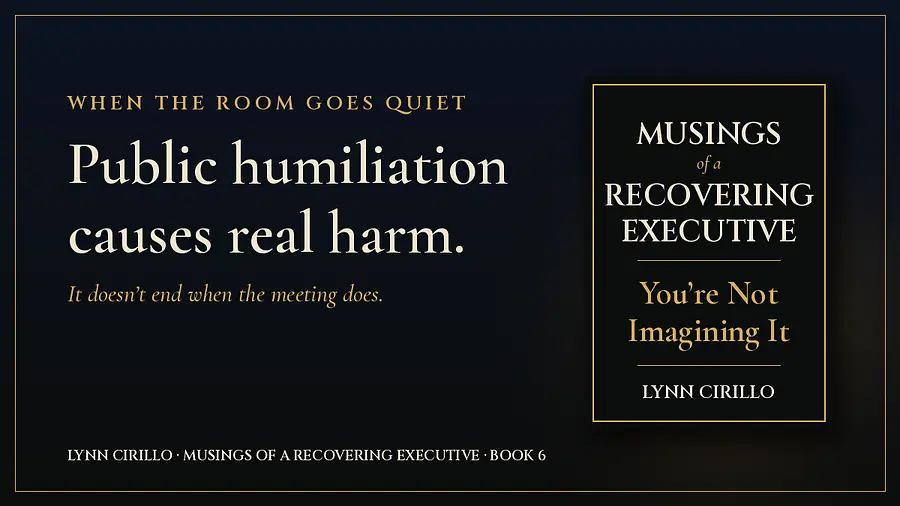
It usually takes less than ten seconds. A sharp remark in a meeting. A sigh and an eye roll when someone asks a question. A "joke" about a mistake, delivered in front of the whole team. The leader moves to the next agenda item. By lunch, they've forgotten it happened.
The person on the receiving end hasn't. They'll remember the room going quiet. They'll remember who looked away and who smirked. Years later, in a different job with a different boss, they may still hesitate before raising their hand, without quite knowing why.
I've seen this gap play out across corporate America more times than I can count, and I've been on both sides of it. In You're Not Imagining It, I wrote that "A manager may believe they're providing direct feedback while an employee experiences that same feedback as humiliating." The same moment lands in two very different places. One person files it under "Tuesday." The other files it under "who I am here."
This piece is for both of them.
First, If This Happened to You
If a comment someone else forgot is still living rent-free in your head, I want you to hear this clearly: you are not too sensitive, and you are not making it bigger than it was.
Humiliation is built to stick. It doesn't just hurt; it tells you something about your standing. It happened in front of people whose opinions matter to you, from someone who has power over your work. Your brain is doing exactly what it's designed to do when it marks that moment as important and keeps returning to it.
The book describes it with a list that I suspect many readers will recognize: "A comment. A look. A joke at your expense." None of those is dramatic on its own. That's part of what makes them so hard to talk about. And as I wrote, "Someone can experience a comment as humiliating even when the speaker didn't intend humiliation. That doesn't make the impact imaginary."
Intent matters. So does impact. You're allowed to hold both.
Why It Lingers
It happened in public. Being corrected privately stings. Being corrected in front of colleagues rewrites how you think they see you. You don't just carry the comment; you carry the guess about what everyone else concluded.
It came from power. When someone with authority over your work, your reviews, or your next opportunity says something dismissive, it doesn't feel like an opinion. It feels like a verdict.
There was no repair. This one matters most. When a leader notices the impact and comes back to fix it, the memory changes shape. When nobody says anything, the moment is left unfinished, and unfinished moments are the ones we keep reopening.
The room taught a lesson. If everyone laughed or stayed silent, the person learns not just that the leader thinks less of them, but that no one will step in.
The Replay Loop
Here's what the speaker never sees: what happens afterward.
"The conversation you replayed on your drive home." "The comment you laughed off, even though it bothered you." Those lines from the book describe the quiet second shift that humiliation creates. You rehearse what you should have said. You question whether you deserved it. As I put it, "You replay meetings at dinner."
Then the doubt starts to spread. You check your work twice before sharing it. You stop volunteering ideas, not because you have none, but because you've learned what it can cost. "Someone publicly embarrassed may become anxious before the next team meeting."
I still live with imposter syndrome, and I can tell you that a single dismissive moment from the right person can feed it for a very long time. It doesn't need repetition to do damage. It just needs to land on a doubt you already carry.
What It Costs Teams
Leaders who forget the comment often don't connect it to what happens next. But the bill arrives.
Questions stop. People stop asking for clarification, and errors that could have been caught early surface late and become expensive.
The best ideas go quiet. The people most likely to notice a problem are often the ones who have learned it isn't safe to say so.
Everyone else is watching. Humiliation is never just between two people. The book describes the scene: "A leader humiliates someone in a meeting. The room grows quiet. A colleague changes the subject." And then: "Repeated incidents begin to teach everyone the rules of survival."
Good people leave. Rarely because of one comment. Usually because that comment was the moment they started paying attention to everything else.
When a capable person starts doubting every decision, the book offers a reframe I keep coming back to: "perhaps the most useful question is not, What happened to their confidence? Perhaps it is, What has their confidence been asked to survive?"
What Leaders Can Do Instead
Most leaders who humiliate people aren't villains. Many are stressed, rushed, or repeating what was once done to them. That explains the behavior. It doesn't excuse it. Here's a simple framework I call The Repair Window.
1. Notice. Pay attention to the room after you speak. Did someone go still? Did the questions stop? Silence is information.
2. Name it. Don't wait for the person to raise it; they likely won't. A short, private "I was out of line in that meeting" carries enormous weight.
3. Repair where the harm happened. If you embarrassed someone in front of the team, acknowledge it in front of the team. A private apology for a public moment only fixes half of it.
4. Change the pattern. An apology followed by the same behavior teaches people that apologies are a performance. The repair that counts is the next meeting going differently.
And before you speak, especially when you're frustrated, it helps to remember that critique of work and critique of a person are not the same thing. As I wrote, "In a healthy environment, mistakes can be named without becoming identities."
Questions for Leaders to Sit With
- Can I name the last time I said something sharp in a meeting? If not, is that because it didn't happen, or because I didn't notice?
- Who on my team has gone quieter, and when did it start?
- When someone was embarrassed in front of me by another person, did I say anything?
- Do people on my team ask me "dumb questions"? If not, why not?
Recovering From a Moment You Can't Forget
If you're the one still carrying it, here are steps that have helped me and the people I work with.
Write down what happened, plainly. Not the replay, not the interpretation, just the facts: what was said, who was there, what you did. Getting it out of your head and onto paper often takes some of its power away.
Separate the comment from the conclusion. "My manager said my idea was naïve in front of the team" is a fact. "I'm not good enough to be here" is a conclusion you may have drawn from it. Those deserve to be examined separately.
Check it against your evidence. What do your results, your peers, and your track record actually say about you? One moment from one person is not a full account.
Say it out loud to someone you trust. Humiliation thrives in silence. Saying it to a friend, mentor, or counselor often shrinks it back to its real size.
Decide what you need now. That might be a conversation with the person, a boundary, a conversation with someone else, or simply permission to stop replaying it. You get to choose.
Notice when it's a pattern. "One comment may be careless. Repeated comments may reveal something else entirely." If it keeps happening, that isn't about your sensitivity. That's about the environment.
You're Not Imagining It
Confidence rarely disappears in one dramatic moment. As I wrote in the book, "Sometimes it wears thin when the ground beneath our work keeps moving." A humiliating comment is one of those moments when the ground moves. It's no surprise that you're still steadying yourself.
If the person who said it forgot within minutes, that tells you something about them, not about you. You're allowed to remember. And you're allowed to stop letting that moment decide how much space you take up.
You're Not Imagining It is the sixth book in my Musings of a Recovering Executive series. It's about toxic workplaces, gaslighting, and reclaiming confidence: noticing what's happening, understanding the pattern, deciding what to do, and finding your way back to yourself, with reflection exercises at the end of every chapter. You can learn more at https://MusingsOfaRecoveringExecutive.com/books/youre-not-imagining-it/.
About the Author
Lynn Cirillo is an author, leadership mentor, and founder of Grounded Leadership LLC. I help people trust themselves again at work and in life, and stop measuring their worth by how much they can carry. I'm over 55, I still live with imposter syndrome, and I write about both because pretending otherwise helps no one. Learn more at https://MusingsOfaRecoveringExecutive.com/.

Lynn Cirillo is an author, leadership mentor, and Founder and Principal of Grounded Leadership, LLC in Cheyenne, Wyoming. She brings nearly 40 years of professional experience across commercial real estate, corporate operations, research, and technology. Her six-book nonfiction series, Musings of a Recovering Executive, explores the journey from burnout and reinvention to boundaries, identity, neurodiversity, and…