
Your Age Is Not Your Trajectory
How ageism decides your future—and why you get to keep that choice for yourself.

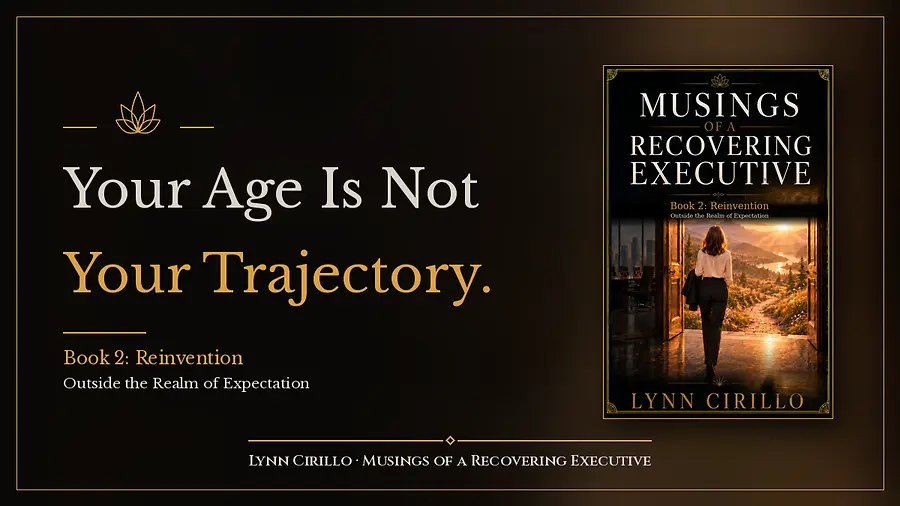
Your Age Is Not Your Trajectory
Ageism doesn't only overlook people. It quietly decides where they're headed. Here's how to notice it, question it, and keep your own vote.
By Lynn Cirillo
Most conversations about ageism at work focus on what gets taken away: the opportunity, the promotion, the seat at the table. Those losses are real, and they matter.
But I've come to believe the deeper harm happens earlier and more quietly. Ageism isn't only about being passed over. It's about someone else deciding which direction your life is moving, based on a number, and then treating every choice you make as proof they were right.
I'm over 55, so I'm not writing this from a safe distance. And I'm writing it for everyone, not just people who lead teams. If you work anywhere, with anyone, at any age, this touches you, either now or later.
First, Some Validation
If you've ever sat in a conversation and felt your future being decided around you, I want to say clearly: that reaction deserves validation, not dismissal.
It isn't rare, either. AARP Research's 2025 survey of workers 50 and older found that 64% had seen or experienced age discrimination at work, and 22% said they sometimes or always feel pushed out of their jobs because of their age. The U.S. Equal Employment Opportunity Commission's own data shows age discrimination charges rising from 11,500 in fiscal year 2022 to 16,353 in fiscal year 2025.
Those numbers don't tell your whole story. They do tell you that you are not the only one and that what you're noticing has a name.
The Problem With Treating Age as a Direction
In Reinvention Outside the Realm of Expectation, the second book in my series, I wrote about one assumption that does a lot of damage in the workplace: "One of the most limiting assumptions in the workplace is that everyone should want to move up."
When you combine that assumption with age, something predictable happens. At thirty, wanting more looks like ambition. At fifty-five, wanting more can look like denial, and wanting less can look like checking out. Either way, someone has already drawn the line on the graph and is just waiting for you to follow it.
The book offers a different way to see it: "A person can be ambitious at thirty and want more peace at fifty without either version of their life being a mistake."
That sentence works in both directions. It means wanting peace at fifty isn't a sign of decline. It also means wanting a new challenge at sixty isn't a sign you don't know your place. Your age can inform your choices. It doesn't get to make them for you.
The Trajectory Test
When I look closely at how ageism shows up, I see it borrowing the same four assumptions over and over. I call this the Trajectory Test. For each assumption, there's a better question to ask, whether you're the one being judged or the one doing the judging.
1. The Ladder Assumption: "If you're not climbing by now, you're coasting."
This is the belief that a career only has one healthy shape and that anyone past a certain age who isn't reaching for the next rung has stopped caring. In the book, I wrote, "A leader who assumes everyone wants advancement may overlook the employee who wants mastery."
The better question: What does this person actually want more of and less of right now? As I put it, "Declining a management position does not tell you whether they are capable of leading."
2. The Learning Assumption: "They won't adapt."
This one gets aimed at people who have often spent their whole working lives adapting: new systems, new leaders, reorganizations, and economic swings. I wrote in the book, "Adaptation is not weakness. In many cases, adaptation is survival."
The better question: What has this person already learned their way through? Look at the record before you predict the future.
3. The Clock Assumption: "Why invest in someone with fewer years left?"
This assumption decides who gets development, stretch assignments, and mentoring by doing quiet math about time. But nobody, at any age, comes with a guaranteed number of years in a role. People of every age leave, get recruited, change careers, or stay far longer than anyone expected.
The better question: What could this person contribute and grow into during the time they are here?
4. The Mirror Assumption: "Maybe they're right about me."
This is the one that hurts most because it happens inside us. After enough signals, we start making the assumptions ourselves. We stop applying. We stop proposing ideas. We talk ourselves out of the class, the project, or the reinvention before anyone else has to. In the book, I named a fear many people carry when they think about changing direction: "They fear losing relevance."
The better question: Whose definition of relevance am I using? And does it still fit the life I want?
The Trajectory Test doesn't require anyone to prove bad intent. It simply asks whether an assumption about age is standing in for a real conversation with a real person.
What This Means for Organizations
Ageism rarely announces itself in policy. It lives in patterns, which means organizations have to look for it on purpose. A few concrete practices:
- Audit who gets invested in. Look at stretch assignments, training budgets, high-visibility projects, and mentoring pairs. If they consistently skew younger, ask why before someone else does.
- Clean up age-coded language. Phrases like "digital native," "fresh energy," or "young, dynamic team" in job postings, performance reviews, and promotion discussions tell people who is expected to fit, whether you meant them to or not.
- Replace the five-year ladder question. Instead of "Where do you see yourself in five years?", try "What do you want more of and less of in the next year?" It works for a 26-year-old and a 62-year-old alike.
- Let people raise their own timelines. Plans about stepping back, slowing down, or retiring belong to the person whose life it is. Leave room for them to bring it up.
- Build learning that runs both ways. Pair people across generations on real work, with the expectation that each has something to teach. Nobody becomes the permanent student or the permanent expert.
What You Can Do, Wherever You Sit
If you're on the receiving end, a few things help:
- Name the assumption, gently and specifically. "I want to make sure we're not assuming I'm not interested. I am." Clarity removes the room an assumption needs.
- Keep a record. Note what was offered, to whom, and what reasons were given. If a pattern forms, you'll want facts rather than a feeling. In the U.S., the Age Discrimination in Employment Act protects workers 40 and older, and knowing that can steady you even if you never use it.
- Keep choosing your direction. Take the class. Propose the project. Or decide you want something quieter, and say so on your own terms. In the book's words, "People are allowed to evolve. That should not feel revolutionary."
And if you're younger, this is your conversation too. Every assumption you accept about someone older is one you're building for yourself. The colleague you are now is the colleague you'll someday hope to work beside.
Questions to Sit With
- Have I ever let my age, or someone else's, answer a question that deserved a real conversation?
- Which of the four assumptions do I hear most often? Which one do I repeat to myself?
- If my age weren't part of the picture, what would I want next?
- When I decide who gets an opportunity, am I looking at what someone can do or how long I think they'll be around?
The Road Still Counts
One of my own lessons from Book 2 is this: "Changing direction does not erase the value of the road that brought you there." The same is true for getting older. The years behind you will still be yours. As I wrote, "But those years do not get to make every decision about the years ahead."
In my fourth book, I wrote, "What served us at twenty-five may not serve us at fifty-five. That does not make the younger version of us wrong." It doesn't make the older version of us finished, either.
So here's the hope I want to leave you with. You are allowed to ask the question the book keeps returning to: "What matters to me now? Not ten years ago." You are allowed to answer it at 35, 55, or 75. And you are allowed to expect the people around you to ask it with you, rather than for you.
The dignity you recognize in other people has to include you. That holds at every age.
Reinvention Outside the Realm of Expectation is the second book in my Musings of a Recovering Executive series. It's about identity, ambition, dignity, and giving yourself permission to choose what comes next, with reflection questions at the end of every chapter. You can learn more at https://MusingsOfaRecoveringExecutive.com/books/reinvention-outside-the-realm-of-expectation/.
About the Author
Lynn Cirillo is an author, leadership mentor, and founder of Grounded Leadership LLC, based in Cheyenne, Wyoming. She lives with ADHD, OCD, and dyslexia, and writes the six-book Musings of a Recovering Executive series about leadership, identity, boundaries, reinvention, neurodiversity, and reclaiming confidence after difficult workplaces. Learn more at https://MusingsOfaRecoveringExecutive.com/.

Lynn Cirillo is an author, leadership mentor, and Founder and Principal of Grounded Leadership, LLC in Cheyenne, Wyoming. She brings nearly 40 years of professional experience across commercial real estate, corporate operations, research, and technology. Her six-book nonfiction series, Musings of a Recovering Executive, explores the journey from burnout and reinvention to boundaries, identity, neurodiversity, and…





