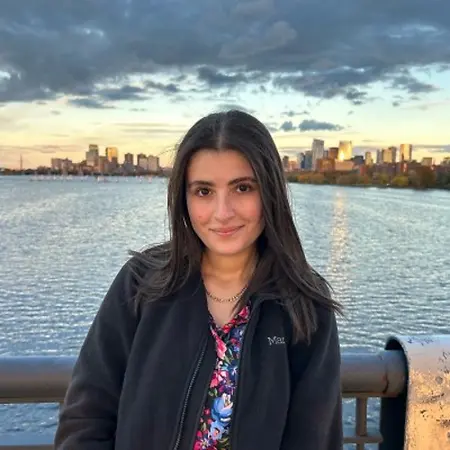
Her Story
About Amber
My career began in anthropology, born from a deep fascination with people and what shapes the way we live and learn. That curiosity led me across disciplines: a degree in political science, studies in environmental science, and a Master's in data analytics and computational social science. Each field added a new lens, and together they revealed how profoundly technology and learning have become intertwined, and how urgently we need to shape that relationship with intention. I became committed to a healthier model of learning, one that resists the overuse of technology and keeps human creativity firmly at its center.
Today, I pursue that mission from several vantage points at once. As a Research Assistant at the Child-Centered AI Lab at the Harvard Graduate School of Education, I study how young people can engage with AI safely and creatively. As COO of AI Global, I design and teach open-source courses in AI literacy and cognitive security. And as the co-founder of CogSec & CogSafe, an early-stage venture I launched with Oscar Sanchez of MIT Professional Education, I help build practical frameworks and guardrails, including configurable settings and safety controls, that make cognitive security tangible and usable in everyday tools. Alongside this, I consult with organizations navigating AI adoption, team onboarding, and the challenge of embedding creativity and cognitive safety into their culture.
Her Interview
Ten minutes with Amber
01What do you attribute your success to?
I attribute my success first and foremost to curiosity: a persistent desire to ask questions, embrace uncertainty, and keep learning. I've never been afraid to reinvent myself or to see mistakes as opportunities for growth rather than reasons to stop. Every new chapter in my life has been shaped by a willingness to challenge my own assumptions and continue evolving.
I also owe a great deal to the women in my family, who instilled in me resilience, integrity, and a deep sense of purpose. Their example taught me that strength is measured not only by perseverance, but by generosity, humility, and the courage to keep moving forward.
My journey has also been shaped by navigating different cultures and identities—as an Indigenous Algerian, a French citizen, and later as an immigrant building a life in the United States. Those experiences broadened my perspective and taught me to see challenges from multiple angles. Rather than allowing barriers to define what was possible, I learned to view them as opportunities to think differently, adapt, and create new paths.
Today, that perspective influences everything I do. I see myself as a bridge-builder, connecting people, ideas, and disciplines. My work draws from anthropology, political science, environmental science, data science, computational social science, and learning design because the most meaningful solutions rarely come from a single field. They emerge when diverse perspectives intersect. If there's one principle that has guided my career, it's this: stay curious, keep learning, and use every experience—whether difficult or rewarding—to build something that creates opportunities for others.
02What’s the best career advice you’ve ever received?
The best advice I've ever received was to start with an MVP—a minimum viable product. Early in my career, I sometimes felt that every idea had to be fully developed before it was worth sharing. Learning to build the simplest version first changed the way I work. It taught me that progress creates momentum, while perfectionism often creates delay.
Starting small allows you to test ideas, gather feedback, and improve through iteration. Some of the most successful projects aren't perfect from day one—they evolve because someone was willing to take the first step.
Closely related to that is another lesson I've carried with me throughout my career: you learn by doing. Experience is one of the best teachers, and every project teaches you something that makes the next one better.
03What advice would you give to young women entering your industry?
My advice would be to give yourself permission to apply before you feel completely ready. Many talented women wait until they meet every qualification before pursuing an opportunity, but growth often happens because you take on challenges that stretch your abilities. If you meet many of the core requirements and you're excited about the role, don't count yourself out. Apply, be willing to learn, and trust that you can continue developing your skills along the way.
I'd also encourage young women not to be afraid of taking an unconventional path. My own journey has crossed anthropology, political science, environmental science, data analytics, computational social science, and now education and learning design. At first, those experiences seemed unrelated, but over time I realized they gave me a broader way of thinking.
Just as importantly, don't be afraid to be authentic. Your perspective has value, and your voice deserves to be heard. Share your ideas, ask questions, and contribute to conversations even when you don't have every answer. Innovation comes from diverse perspectives, and some of the best ideas emerge when people are willing to think differently and speak up with confidence and respect.
Today, many of the most interesting challenges sit at the intersection of disciplines. The ability to combine technical knowledge with an understanding of people, policy, culture, or education can become a real strength. Rather than feeling pressured to fit into a single box, embrace the unique combination of experiences, interests, and perspectives that only you can bring. Often, that's where your greatest value lies.
04What are the biggest challenges or opportunities in your field right now?
One of the biggest opportunities in my field is that technology—and especially AI—is becoming far more interdisciplinary. Solving today's challenges requires people who can bridge technical expertise with an understanding of human behavior, education, ethics, policy, and design. That's an exciting shift because it creates space for people with diverse backgrounds to make meaningful contributions.
Like many industries, technology has also been working toward greater diversity and inclusion. While there are still environments where women and younger professionals are underrepresented, I've seen encouraging progress. More organizations are recognizing that the best ideas come from teams with different perspectives and experiences.
For me, one of the biggest lessons has been to contribute with confidence. Early in my career, I was often one of the younger people—and sometimes one of the few women—in the room. Over time, I realized that you don't have to wait until you have decades of experience to add value. If you've done the work, prepared thoughtfully, and have something meaningful to contribute, your perspective deserves a place in the conversation.
I'm optimistic about where the field is heading. As technology continues to shape every aspect of society, we'll need people with different backgrounds, disciplines, and lived experiences working together to build solutions that are innovative, inclusive, and truly serve the communities they're designed for.
05What values are most important to you in your work and personal life?
I would say being mission-driven is important. Having a strong sense of purpose, or building that sense of purpose. Also, honesty with yourself and others. And I think also curiosity and willingness to learn.
Join Influential Women and start making an impact. Register now.