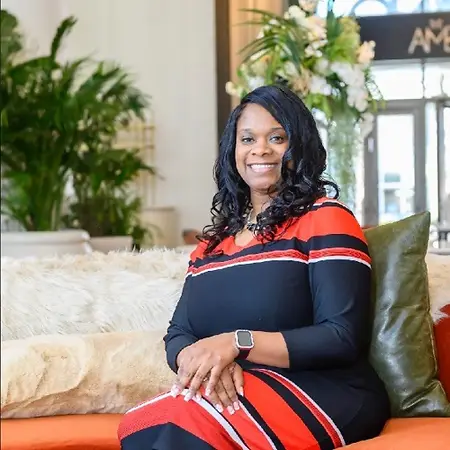
Her Story
About April
I've been in education for over 20 years, and I've been blessed to work with several grade-level bands throughout my career. I started as an English teacher for 10th and 12th graders, but my heart took me to school counseling because I wanted to know what was going on in students' lives - not just the academic piece, but the social-emotional piece as well. I was a school counselor for 6th through 12th graders in middle and high school, then for elementary school. After that, I became a climate and culture specialist for a high school, then a vice principal for middle school for three years. Five years ago, I decided to go for it and became a principal. Now I'm an upper elementary principal for second through fifth graders, responsible for 1,000 students. My main area of expertise is climate and culture - finding the strengths and passions of people and helping them shine, whether that's students or my staff. I love building character and helping people bring out things they're really good at but didn't realize they were. I'm very big in leadership and love John Maxwell. I'm on the board of directors for the New Jersey Principal and Supervisors Association and serve as president of my Burlington County Principal Supervisors Association. I keep myself connected to school counseling because it's my heart. I'm that administrator who will say, hey, I see something in you, and I'm not only going to tell you I see it, but I'm going to help you through that process so we can both make it together. I love students at every grade level - high schoolers have amazing conversations that influence you, middle schoolers are trying to figure it out, and the elementary babies love so wholeheartedly and give you hugs immediately.
Her Interview
Ten minutes with April
01What do you attribute your success to?
I'll start out with my father. My father has always been my hero, not just because he's my daddy, but because he always wanted me to believe in myself. He always said I could do anything I put my mind to, and not in a cliche way, but he truly believed it. If I had an idea, he would back that idea and throw me into something so I couldn't leave that dream out. He's always allowed me to keep dreaming. When I first got my first administrative job, I went into a Hallmark store and there was this little plaque that said 'Girls with dreams become women of vision,' and it's still in my office and I'm taking it to every office I go to. That came from my dad. I'm also a woman of faith, big woman of faith, and I believe God has me and He does one in my past. It's really my faith, my father's faith in me, and my own inner go-getter. I've always had that ambition, and I've always been curious about different things. I say, oh, I want to try this, or let me try that, or let me take on a project and make it my own. It's so true that when you try different things that are hard at first, eventually they're easier and they become part of you, and you're like, well, what can I do? Let me try everything, why not?
02What’s the best career advice you’ve ever received?
The best career advice I ever received was 'Trust yourself.' When I became an administrator, I thought that I had to change who I was in order to fit in, or in order to fit the ideal of what a principal is, quote-unquote. One of my mentors, who was a principal at the time, said to me, 'April, you are exactly who you need to be to make change.' He said, 'The moment that you change who you are to fit an ideal, you will no longer be able to influence anyone, or to help people, because you won't be genuine, you won't be true to yourself.' It was the best thing ever, and I always go back to it, because whenever I start having that imposter syndrome, I come back to, you know what? I matter, I'm somebody, I am special, and I am making a difference, I'm connecting with people, and that is so important, and I don't need to be anyone that I'm not.
03What advice would you give to young women entering your industry?
I would say trust yourself. You know more than you think you know. And also, ask for help. Ask for help when you need it. There's nothing saying that you can't handle it, that you're not good enough, that you don't have what it takes to be successful just because you asked for help. I think it's so important, and that doesn't mean you have to say sorry, or feel like you're less than, because you have to ask for help. Do it because you deserve to ask for help, and you deserve to get the help that you need so that you can be even better. And when you fall down, get back up with your head held high. Because there are several men and several other women that had done the same thing, and they came back stronger and were able to really accomplish everything that they needed to accomplish. Learn from that. There's nothing to put your head down for when you fall down.
04What are the biggest challenges or opportunities in your field right now?
Right now, we have a generation, especially after COVID, that wasn't only struggling in areas of their academics, but they were also struggling in areas of mental health. Mental health right now is serious, and it's not just for students, it's for families, for our teachers, for staff members, even for administrators in certain ways. We all struggle in that area, and because for so long, we didn't talk about it, we didn't even admit that it existed. Now, when it's glaring us in the face, we're like, oh my goodness, what do we do? We weren't prepared for this. We started throwing in the money that we could to put mental health programs together, and now it's all kind of being taken away a little bit, while we're slowly trying to put it back into place again. The challenge is that we don't necessarily have all the funds, as they're figuring out what we need the funds for, while we're trying to help the students be the best that they can be, and also understand how to identify their emotions, be able to regulate their emotions, and have actual coping skills. Our elementary students are dealing with things that middle school students used to deal with, and our middle school students are dealing with things that high school students used to deal with. They don't have it in them to be able to really deal with those adult, those higher situations. So, it's also an opportunity to be honest with what's going on. Ask those questions - not just what's happening, or what's wrong with you, but what happened to you, and what can we do to make it better. What can we do to give you the skill sets to get through these things, and also show you that we value you and we appreciate you throughout the process.
05What values are most important to you in your work and personal life?
The values most important to me are integrity, compassion, and growth. I think that making sure you're doing what you say you're gonna do, and being who you are all the time, is so important. You're not afraid to say, hey, it's not my best day today, but I'm still unapologetically myself. Great stuff still comes out of me, regardless of what's going on. And being compassionate to other people - I think that leading with compassion is so important, and leading your life personally with compassion. At the end of the day, when we're around people, we want to be around people because they make us feel better. They make us feel like we belong. They don't make us feel like we're othered, and if they do make us feel like we're othered, that it's something that they appreciate, not something they want to make fun of. If you're able to be compassionate to people's stories and what they're going through, I think that goes such a far way, because people want to be heard, they want to be listened to, and they want to be valued. And then there's growth. I had this thought process that if you're not being innovative, or if you're not growing, you're kind of dying. I know that sounds black and white, and I know there's a lot of gray in between, but it just kind of works for me, because I love being able to grow. And growing looks different at different points in your life, but some amount of growth, even if that's, hey, you know, I forgive myself today, or I want to be a better person in this situation today.
Join Influential Women and start making an impact. Register now.