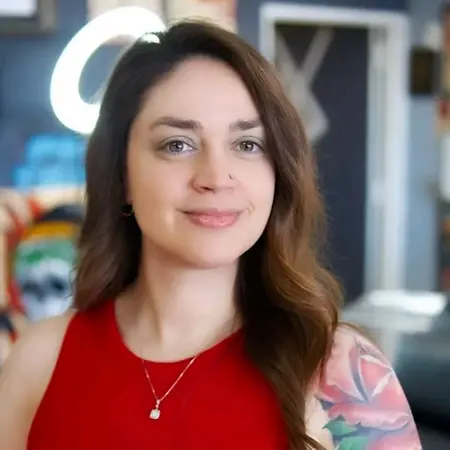
Her Story
About Christine
My journey into psychology began during my undergraduate studies, driven by watching people close to me struggle with mental health. That experience deepened my commitment to the field and eventually led me toward working with children, helping them navigate challenges I had personally lived through. As my career evolved, I found myself increasingly drawn to trauma work with adults, which led me to pursue specialized training and coursework in that area. When I met my husband, Dr. Dennis Boseman, a tattoo artist with over 20 years of experience, we began noticing striking parallels between tattooing and traditional clinical therapy. I remember one conversation where I reflected that some of my most trauma-intensive clients could take months, sometimes nearly a year, to work through deeply rooted experiences in a clinical setting. Yet Dr. Boseman could sit with a client for an eight-hour tattoo session and witness profound breakthroughs in a single day. Through clinical research and direct observation, we identified a genuine gap in trauma recovery services, and a unique opportunity to fill it. The result was the Tattoo Therapy® framework, born from Dennis's original vision and shaped together into what I consider our most significant professional contribution to the field. What began as an insight became a family business and a new frontier in trauma-informed care. Today, we offer Tattoo Therapy® services at our studio, Nobility Tattoo, alongside two other artists, including Dr. Boseman, who holds a PhD in Creative Arts Therapy with a background in psychology, and a second trauma-informed tattoo artist, Seth Clark. I oversee our clinical practices to ensure our work remains grounded in trauma-informed care principles, and I continue to see therapy clients through my own mental health practice, Revibe and Rise Mental Health, virtually and in person at the studio itself.
Her Interview
Ten minutes with Christine
01What do you attribute your success to?
A cornerstone of my success has been my husband and partner in every sense of the word. He has been an unwavering source of motivation and confidence throughout this journey, including the demanding stretch of pursuing my PhD. He trained me as a tattoo artist, opening up a dimension of creative problem-solving I wouldn't have found on my own, and together we have built a thriving family business despite real obstacles, including the weight of student debt. Beyond our partnership, what truly drives me is the opportunity to create space for people to heal. The world is carrying an enormous amount of pain, and the work we do to bridge mental health care with the deeply personal experience of tattooing, is one meaningful answer to that need.
02What’s the best career advice you’ve ever received?
The best career advice I've ever received is simple: have a plan. Reflecting on my own path, it's advice I didn't encounter until I was already well into my career, long after accumulating years of education and significant student debt. Planning matters for everything. What you want to do professionally, how you intend to fund the journey, and perhaps most importantly, how you will protect and prioritize your family along the way. It can be easy to get swept up in the pursuit of degrees and career milestones, but the people who matter most shouldn't become an afterthought to ambition. Had I embraced this kind of holistic planning earlier, I believe I would have navigated not only the financial realities of my education, but also the balance between building a career and nurturing the relationships that make it all meaningful.
03What advice would you give to young women entering your industry?
My deepest advice, especially to women in this field, is to put your family first, before the career, before the clients, before the next degree or milestone. I've experienced and witnessed so many talented, deeply caring women, colleagues and friends alike, burn out far sooner than they should have. Mental health is an inherently nurturing field, and when you combine the natural nurturing spirit that so many women carry with the emotional demands of this work, it's easy to pour everything you have into your clients and leave only the remnants for the people at home who love you most. That truth has shifted something profound in me since starting my own practice. Your family deserves your best, not what's left over at the end of a long day. When you root yourself in that priority, everything else finds its proper place. Your career becomes more sustainable, your work becomes more intentional, and the burnout that claims so many good people in this field loses much of its power over you. Take care of what matters most, and you will be far better equipped to take care of everyone else, including yourself.
04What are the biggest challenges or opportunities in your field right now?
One of the most pressing challenges in mental health today is access to care. Too many people are turned away from the help they need, not because they don't want it, but because the system makes it difficult to reach. Even for those with health insurance, mental health coverage is often inadequate or excluded altogether. And layered beneath the financial barriers is something just as stubborn, including persistent stigma of seeking mental health care. It is alarming, even now in 2026, that mental health care remains so marginalized within the broader healthcare conversation, as though the health of the mind is somehow less worthy of attention than the health of the body. But within that challenge lives our greatest opportunity with Tattoo Therapy®. Through our programming, we have been able to meet people where the system has failed them, offering our services freely to those who need them most. Between pro bono therapy sessions and complimentary tattooing through our nonprofit, Tribal Temple, we have found meaningful ways to remove the barriers that keep people from healing. Tribal Temple runs on the generosity of community. Donors contribute in whatever way they are able, monetary gifts, donated time, or even everyday supplies that keep our doors open. Fellow tattoo artists have volunteered their skills, showing up for clients who might otherwise never experience this kind of care. We also offer a Pay It Forward program, where clients have the beautiful option of covering the cost of a future client's session. It is community care in its truest form, and a reminder that healing, when shared, multiplies.
05What values are most important to you in your work and personal life?
At the center of everything is family. It has been one of the greatest blessings of my life to build a business alongside my husband, combining our passions and our strengths in service of something larger than either of us could create alone. We have also been able to weave our children into the fabric of what we've built, and there is something truly special about creating something your whole family can be part of and proud of. Equally close to my heart is the community we serve. We chose to plant our roots in the Mahoning Valley where we grew up. This community has faced more than its share of hardship, particularly when it comes to mental health struggles that have only deepened in recent years. Being able to give back in a way that is genuinely meaningful and healing is important to us individually and as a business. There is a particular kind of purpose that comes from serving the people and the place that shaped you, and we appreciate the opportunity every day.
Join Influential Women and start making an impact. Register now.