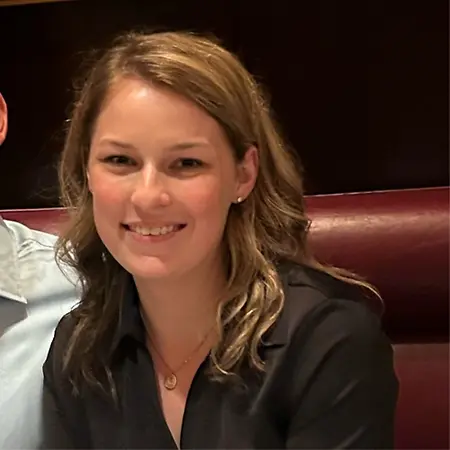
Her Story
About Emily
I've been working in laboratory medicine for about 5 years, and it's been an incredible journey of growth and learning. My main area of expertise is laboratory medicine, where I work in a core lab handling everything from hematology and coagulation to chemistry and microbiology. Every day, I test patient samples that come from the hospital, running tests like CBCs, basic chemistry panels, and clotting tests. What we do helps doctors diagnose patients and figure out the correct treatment, and I never forget that these aren't just samples - they're coming from real patients with real diseases and real issues who rely on us to do our job so they can get the treatment or diagnosis they need. I started this career right after graduating from Stevenson University with my bachelor's in medical laboratory science, and it was actually my first job in my career field. I've progressed quickly, moving from a clinical laboratory scientist to CLS3, then CLS4, and I also took on the role of chemical and hygiene safety officer for the pathology department at Johns Hopkins, where I currently work. I wear many hats in the lab and do a lot of different things. I also earned my master's degree from George Washington University about 2 years ago. I recently accepted a new position as a laboratory technical specialist at Anne Arundel Medical Center under Luminous Health, which is a promotion from what I'm doing now. I'll be in charge of hematology coagulation for that hospital. What's amazing about this field is that we're often the first ones to see things - I'm looking under the microscope and seeing malignant, cancerous-looking cells before even the doctors or pathologists get to look at it. We're kind of the underdogs in the hospital, working behind the scenes, but we make a huge difference in patient care.
Her Interview
Ten minutes with Emily
01What do you attribute your success to?
I would attribute my success to my determination, but also to my colleagues who have helped me grow in my field. A lot of people I work with have had 20 to 40 years of experience in what they're doing, so being able to work with such experienced people has really helped me grow. I also have a lot of determination when it comes to getting things done. I set goals for myself, and I always do my hardest to achieve them. That combination of learning from experienced mentors and staying determined to reach my goals has been key to my success.
02What’s the best career advice you’ve ever received?
The best career advice I've ever received is to never limit yourself - you're always capable of more. That advice has really helped me grow pretty fast throughout my career and move up quickly. It's what guided me when I decided to transition to a new hospital, because where I was could only offer me so much, so I'm expanding. Change can be hard, but you have to overcome that. I was told to never limit myself or my potential, and I feel like that's really helped me make my decisions, like leaving where I'm at now, while also knowing that I'm much more capable of more than I might think.
03What advice would you give to young women entering your industry?
My advice would be to absorb as much information as you can and do as much as you can. Give yourself every opportunity - any opportunity that comes your way, take it, because it's your best chance to be able to learn and grow in the field. Don't be afraid to try new things and do new things outside your comfort zone. All those opportunities to learn and step outside what's comfortable are what will help you develop and succeed.
04What are the biggest challenges or opportunities in your field right now?
I think the biggest challenge is that laboratory medicine is a profession that not a lot of people know about. We're kind of like the underdogs in the hospital - we're not seen. That makes it challenging because opportunities can be a little bit limited when people just don't know about the profession itself. Even in the hospital, we kind of get forgotten about. The nurses and doctors are in the forefront, they're who the patients see physically, so people tend to forget about the people working behind the scenes in the lab. We're doing critical work, but the lack of visibility and awareness about what we do is definitely a challenge in terms of recognition and opportunities.
05What values are most important to you in your work and personal life?
Teamwork is a really big value for me, both in my work and personal life. In the lab, we work so closely with each other, but also with the doctors and nurses, and we have to be able to communicate well not only with other people in the hospital, but with each other. Attention to detail is another important value. In the lab, there are a lot of pre-analytical things that can happen to specimens or during the testing process, and you have to be able to recognize certain things that can benefit the patient - whether a sample's been contaminated or maybe it's mislabeled. You've got to be able to use your critical thinking and problem solving in the lab, and I feel like I can also use that in my personal life too. It's also important to remember that these samples aren't just blood or urine or whatever - they come from real patients with real diseases or real issues. You're actually affecting somebody's life. Sometimes day-to-day, when you're just putting samples on and running them, going through the motions, you might forget that these are coming from somebody that relies on us to do our job so that they can get the treatment or the diagnosis that they need.
Join Influential Women and start making an impact. Register now.