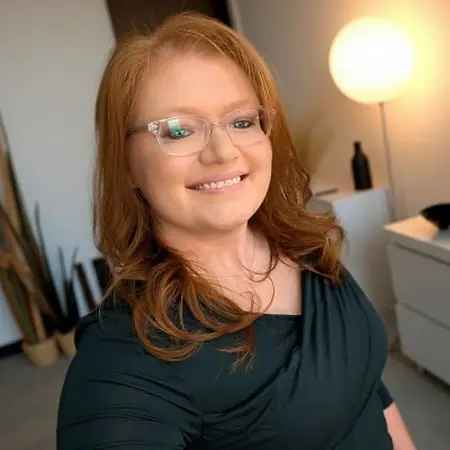
Her Story
About Hope
I've been in the print and mailing industry for almost 10 years. I got a little bit of print industry background because my grandfather used to own the Independent Mail and the Independent News down south, so I heard about it always around the table. I started working with a mail house, and now I currently work with a postal software company called Assurity that helps optimize, streamline and automate the back-end postal process. My current title is Client Advocate. I spend a lot of time listening to clients and understanding where their biggest issues are, and doing my best to resolve them, whether that's offering them different automation or software our company offers, or just spending time with them showing them how to use the postal service to their benefit. We offer goodwill - our idea is we just want to help people, and whether we gain money off of it isn't the focus. I get my self-worth out of helping people. I help onboard clients, I help manage development processes and programming, and I do a lot of my time really fighting for what their needs are. I spend some time at MTAC and different user groups. I'm also a member of Leaders Connect, which is working as a non-profit to develop leadership in the postal industry. The goal is to create mentees and mentors because in this industry, people have either been in it for 30 or 40 years, or they're only in it for a couple years - there's not a lot of middle people. I was one of the first people through that project, and now my goal is to become a mentor. It's really to help develop people within the postal industry and spread the knowledge and networking, and promote support, leadership, and training within the industry. In my previous job, I saved the company over a million dollars in postage savings by helping them leverage promotions and different strategies in mailing. At the facility we worked at, it was about $180,000 in that year for savings. A lot of my training was just on the job - it really comes down to a single-threaded environment where only one or maybe two people have postal knowledge. When the one person who had the postal knowledge left my previous company, they asked if I'd like to take it on, and it was trial and error. I broke a lot of stuff before I figured out how it worked. But I absolutely love the postal industry and the camaraderie and teamwork.
Her Interview
Ten minutes with Hope
01What do you attribute your success to?
I attribute my success to networking and my team of supporters. I've had so many team members that have helped me grow and develop - Kim Waltz, Lisa Bose, Dina and Carol, Joel Bailey, Art - just people that have just always been there to reinforce, encourage, and uplift. They're the biggest impacts in my life, for sure. My network of supporters has been instrumental in helping me navigate this industry and grow in my career.
02What’s the best career advice you’ve ever received?
The best career advice I ever received was to learn to say no. Setting up a boundary is the best thing I've ever done in my life. In any career I've ever worked, I've always just done the job and done what's asked of me. But to a point, if you have a good manager, that's great. But in the scenario where that gets taken advantage of, learning to say no properly is the best thing you can do for your mental health, your work-life balance, and your structure. I'm a chatter, I could talk your ear off, so learning to say no and to limit what I say is the biggest thing I've ever done in my life. Really making sure what I say is value-added, not just whatever, because often you give too much information and open up a whole different can of worms. Learning to say no is the only thing - I can't stress enough to guard yourself in any industry, is learning to say no properly.
03What advice would you give to young women entering your industry?
My advice to young women entering this industry is to stand your ground and be confident. This is an industry where you're not expected to know everything. Your goal is to get good at what you need to get good at, and then network and get to know people. Be an extrovert and ask questions. Do the best you can to ask questions - you're not expected to know everything. That was my biggest struggle, as if I don't know an answer, I would feel like I failed. It's impossible to know everything in this industry. It is important that you ask and you put yourself first. Asking questions is the best thing that I can say. Learning to say no and asking questions - it has made a world of difference as I have grown and developed. I can tell you that the support system that I have will answer my question any time of the day. You'll get that if you continue to just be kind and ask questions. The big struggle for me was that it's a very male-dominated industry, and the amount of times in my day that I was called honey, darling, sweetheart - I was able to work through those stereotypes and behaviors and just get the job done.
04What are the biggest challenges or opportunities in your field right now?
Growth is a big thing right now, because it is a paper industry. Adjusting to that lack of growth is challenging. The industry is trying their best to really embrace AI, but in addition, also embrace the tactile - something physically you touch. With a lot of the emotions and trends that are happening right now, I really think that's the biggest opportunity. But the knowledge is so needed. It is such an important thing - joining WILD, joining Leaders Connect, learning from these extremely tenured people, they're going to help guide you through what could be our toughest stuff, which is the AI and the growth in the industry itself. There is an uptick right now, which is great, but there's a lot of mergers and acquisitions of companies, and that is extremely difficult to face when you have AI coming in to do a lot of the automation. And you've got mergers and acquisitions happening from these marketing firms. Being, growing and learning is the biggest thing you could defend from it. A lot of AI requires quality control, so not just learning postal, but learning it enough to QC, because unfortunately, AI can't read the DMM. So as long as you come in as an expert, you're golden. Really just reaching out, learning all you can, creating that network - it's going to offset what's coming. But really, growth, which we're all working on, that's our focus in AI.
05What values are most important to you in your work and personal life?
Honesty is such a big deal to me. That's why I decided to move to this company. We meet with clients, and if it's just not a good fit, we're going to say, hey, we're not a good fit for what you need, but here are some suggestions. I am adamant that the worst experiences of my life have been revolved around lies, and being honest is all I ask. I'm never going to get angry, we're just going to say, okay, this is our situation, let's figure out how to resolve it. Truly, honesty is my most important act of a person. Just be honest with me. I don't care if you want to call in and say you just don't feel anything today. I'd rather you say that than feign being sick, because I'm the type of person that's going to show up to your house, follow up and make sure you're okay. If you need to go to a doctor's, you need a ride, whatever the case may be. But I fully understand, too, that sometimes I just want to use a sick day and take a mental health break. Fully respected. I'd rather you be honest with me so that I can help. If you just need a day because of mental health, okay, tomorrow can we meet in the morning? We can come in and talk about where you are mentally. How can I help you be better? What are we doing that's failing you to feel that you need to come in like this? Or is something else happening? Just be honest. I can't help if you're not honest.
Join Influential Women and start making an impact. Register now.