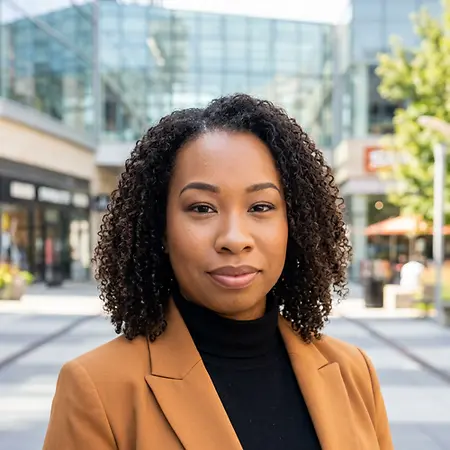
Her Story
About Jessica
Jessica Thurman is an international psychology scholar, organizational strategy consultant, and cross-cultural researcher whose work sits at the intersection of human behavior, organizational effectiveness, and global inclusion. Currently completing a PhD in International Psychology at The Chicago School of Professional Psychology, she specializes in helping organizations build more equitable and culturally responsive systems. Her academic and professional interests span international business environments, immigration and acculturation, neurodivergence, invisible disabilities, and organizational resilience. Drawing from both research and applied consulting experience, she focuses on creating frameworks that improve employee well-being, engagement, and long-term organizational success. Before transitioning into consulting and organizational development, Thurman spent more than five years as a UX researcher, including roles with Motorola Solutions and Twitter Inc. Her background in user experience research strengthened her ability to understand human behavior, identify systemic barriers, and design solutions that address real-world organizational challenges. Through doctoral fieldwork in Germany and research on immigration dynamics, cross-cultural business systems, and community resilience, she has developed expertise in helping organizations navigate cultural integration, workforce diversity, and global adaptation. She has also led initiatives focused on onboarding, cross-cultural team development, and workplace well-being, achieving measurable improvements in engagement and organizational outcomes. Inspired by her own experience being diagnosed with dyslexia during college, Thurman has become a passionate advocate for greater recognition and support of neurodivergent individuals and those with invisible disabilities. She founded Amartha Consulting, a consultancy dedicated to aligning international psychology with organizational strategy to help global companies better support diverse employees and communities. Guided by values of dignity, equity, and cultural understanding, her work emphasizes that organizational effectiveness is strengthened when businesses embrace different lived experiences, cultural backgrounds, and ways of thinking. Through research, consulting, and education, she continues to champion inclusive frameworks that empower both individuals and organizations to thrive in an increasingly interconnected world.
Her Interview
Ten minutes with Jessica
01What do you attribute your success to?
What I can point to, when I trace it back, is a combination of confidence, resilience, and the people who chose to invest in me. My great-grandparents gave me a line I've carried my whole life: "You are no better than anybody else, but nobody is better than you." That's not arrogance — it's equilibrium. It's the thing that kept imposter syndrome from having the final word. It reminded me that I belong in every room I walk into, not because I've earned some special status, but because my presence and perspective have value. Full stop.
I've also been shaped by mentors and colleagues who didn't have to share what they knew but did anyway. That kind of generosity leaves a mark. It's why paying it forward doesn't feel optional to me, it feels like the only honest response to the access I was given.
And then there's what I know from the inside: navigating the world as someone with dyslexia and as a neurodivergent person has given me a different relationship with problems. I don't always arrive at solutions the way others do, and at some point I stopped apologizing for that and started recognizing it as an asset. That perspective is woven into everything I build which are the frameworks, the advocacy, the way I show up for people whose experiences get flattened or ignored. I'm not working from theory. I'm working from memory.
02What’s the best career advice you’ve ever received?
The most clarifying advice I ever received, and honestly, some of it I had to give myself, was that a nonlinear path isn't a liability. It's data. Every pivot, every industry shift, every role that looked like a detour from the outside was actually me gathering information about how I'm wired and what I'm here to do.
For a long time I measured myself against a conventional timeline. Stable job, clear title, predictable trajectory. And I kept not quite fitting it, not because I wasn't capable, but because I wasn't built for that container. What I eventually understood is that some people are meant to be employed, while others are meant to be funded. Those are genuinely different orientations, and the system only celebrates one of them. When I stopped trying to squeeze myself into a career model that was never designed for someone like me: a researcher, a framework builder, an advocate, a creative, and started positioning myself as someone whose work deserves institutional investment, everything reframed.
The unconventional path wasn't the problem. It was the preparation. Every role, every field, every lived experience I brought into a room became part of the lens I now build from. I just had to stop apologizing for the route and start trusting what it produced.
03What advice would you give to young women entering your industry?
Everything you've lived through, everything that lights you up, sit with it. Look at it closely and decide what it means to you. Not to your family (and it's almost always the family), not to your friends, not to some cultural script you didn't write. You don't have to shrink yourself into a category.
Here's something I had to learn the hard way: you don't need a niche. You need a lens. A niche boxes you in. A lens lets you see everything through your own specific, irreplaceable perspective. Nobody is just one thing. You might excel in a particular area, but you also carry a whole world of interests, instincts, and ideas that don't fit on a résumé or a bio. That's not a liability, that's the whole point.
Stop chasing some predefined version of who you're supposed to be. The things that make you different, the winding road that got you here, the way your mind connects things other people don't, that's not the problem. That's the gift.
04What are the biggest challenges or opportunities in your field right now?
The real friction is getting companies to see the ROI before they feel the pain. When things are profitable, the instinct is to leave it alone. But profitability and health aren't the same thing. Look at your turnover. Look at whether your people actually want to be there. Those numbers are telling you something. The hard part is that human-centered work, the psychological, the relational, the cultural — doesn't always translate neatly into a quarterly metric. That tension is real.
But here's the other side of it: the opportunity is enormous. We are genuinely on the ground floor of something. This isn't just a new service offering — it's a new way of thinking about how work functions as a human experience. And the landscape has shifted. We're not just navigating difference across a conference table anymore. We're doing it across time zones, through screens, through platforms that flatten context and strip nuance. Cross-cultural collaboration isn't a nice-to-have — it's the operating reality for most global organizations, and most of them are underprepared for it.
Culture isn't just ethnicity or background. It's epistemology, it's how people understand things, what they trust, how they make meaning. When you're building or leading across borders, you have to account for that depth. And within all of that, there is tremendous space for women to step into positions of real innovation and leadership. The field is still being written. That's not a gap...that's an invitation.
05What values are most important to you in your work and personal life?
My foundation was built by my grandparents. What they gave me wasn't just love, it was a worldview: that every person carries inherent worth and deserves to be treated accordingly. That's not something I learned in a classroom. It's something I watched lived out, and it's never left me.
What drives me most is advocacy for people who don't yet have the language for what they're experiencing. The ones who know something is wrong, or missing, or unfair, but haven't been handed the words to name it. Giving visibility to people who are routinely overlooked — that's not just what I do, it's why I do any of this.
The frameworks I build are intentionally designed to hold more than the standard corporate model accounts for. Neurodivergence, invisible disabilities, cultural difference...these aren't edge cases. They're the lived reality of a significant portion of the workforce, and they're almost entirely absent from the conversations happening in boardrooms. I believe your experience is data. It shouldn't be minimized or explained away because it doesn't fit a familiar pattern.
I also believe deeply in the power of perspective over prescription. You don't need to fit a mold or carve out a narrow niche to be credible. Your lens, the specific, unrepeatable way you move through and make sense of the world — is the thing worth protecting.
I named my firm Amarthra after my grandfather, great-grandmother, and grandmother. They were the most formative people in my life, and carrying their names forward into this work is my way of honoring what they gave me — and making sure it reaches further than any of us could have imagined.
Join Influential Women and start making an impact. Register now.