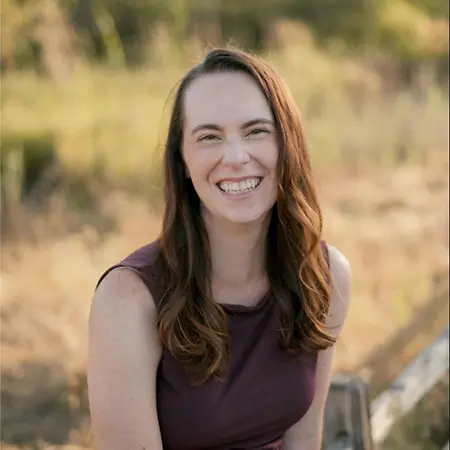
Her Story
About Julia
My career in pharmaceuticals and life sciences began in 2009 at Novartis, where I started in solid dosage manufacturing and packaging. I was fortunate to participate in a rotational program that exposed me to quality, operational excellence, engineering, and supply chain, and I spent over a year working in Switzerland, which really shaped how I think about organizational psychology and different cultures. I started as a production specialist and operational excellence manager before transitioning to automation engineering in 2014, which coincided with my move across the country from New York to the greater San Diego area's biotech hub. I joined Skellig in 2018 as an automation engineer when we were fewer than 30 people. My career here has been completely unplanned but driven by curiosity. I found joy in solving business problems alongside the leadership team, which led to an opportunity as Director of Innovation, focusing on Industry 4.0. I discovered I really enjoyed strategy and thinking several steps ahead, and my role evolved to overseeing all operations, from business development to recruiting to engineering and project management. Four months ago, I became CEO of Skellig Automation. Now, at around 115 people, I focus on leadership and operational strategy, staying connected with our engineers, maintaining our culture, and thinking about how to scale the culture we've worked so hard to build. My days vary greatly, but I'm always involved in business development, talent acquisition, and keeping a pulse on what's driving our engineers, because culture is why this company exists.
Her Interview
Ten minutes with Julia
01What do you attribute your success to?
I attribute my success to continuous curiosity and being open to whatever opportunities come my way, saying yes to most of them. My career was completely unplanned, even though I'm a very Type A person outside of work. I've had this meandering career of following what sounds interesting, trying new things, and maintaining optimism about what might happen as a result. It's that kind of optimism and willingness to explore that has made the difference. I never planned any of this, I just stayed curious and kept following my interests, being fortunate enough to work at a place that encouraged doing so.
02What’s the best career advice you’ve ever received?
The best career advice I've received is very simple but powerful: just be the person who gets things done. Not the loudest person in the room. Not necessarily the smartest. Not the one with the perfect title or the most polished presentation. Just the person people can trust when something matters. The person who creates a sense of relief when their name comes up because everyone knows: it’s handled.
There’s something so valuable about just being steady and following through consistently. Becoming someone who reduces friction instead of adding to it. Over time, I’ve realized that reliability is one of the rarest and most underrated forms of leadership. People remember how you made their lives feel — whether working with you created clarity, momentum, trust, and calm… or confusion and uncertainty.
I was given this advice a long time ago, but it’s coming back around for me in a bigger way now. Especially as I spend more time around younger engineers and people early in their careers. Those are the people I notice immediately — the ones who take ownership without being asked twice, who close loops, who care about the quality of their work, who make things easier for the team instead of waiting to be managed through every step.
Technical skills matter, of course. But early on, what really separates people is dependability. If people trust you, they’ll keep giving you opportunities. More responsibility. More visibility. More important problems to solve. And over time, that trust compounds into a career.
03What advice would you give to young women entering your industry?
I would say just go for it. Put yourself in things that will stretch you, things that might feel uncomfortable. I've done this throughout my career, approaching situations where I don't really understand something but having confidence in myself that putting myself in an uncomfortable and unfamiliar place will be okay. You will grow from that experience. Discomfort is good for you. Have that confidence that even when something feels unfamiliar or challenging, you'll be able to handle it and come out stronger.
04What are the biggest challenges or opportunities in your field right now?
At the risk of sounding cliche, I think from a tech perspective, it's learning how to adapt alongside AI and rapidly evolving technology. There are still a lot of unknowns, and I think that uncertainty makes people instinctively swing toward either fear or hype. But I don’t really see AI as something that simply replaces people. I see it as something that changes the nature of work itself.
The real shift is going to be in how we think, how we solve problems, how we make decisions, and how we use our time. The people and companies that do well won’t necessarily be the ones resisting change or blindly chasing every new tool. They’ll be the ones who learn how to thoughtfully integrate these technologies into the way they operate.
To me, the biggest opportunity is becoming dramatically smarter and more efficient in the work we do.
05What values are most important to you in your work and personal life?
Honesty and transparency are most important to me, along with being kind. There's a difference between being nice and being kind, and kindness carries with it a lot more honesty than niceness does. Nice usually just wants people to feel good, but kindness is more about giving feedback that might not be great but will make someone better. Throughout my life, I didn't like to step on toes, but as a leader you can't do that and do a good job. So I really try to keep that focus on being a person who practices kindness and transparency.
Join Influential Women and start making an impact. Register now.