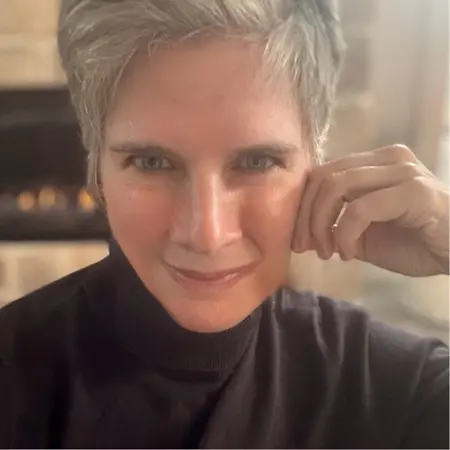
Her Story
About Kellee
I originally thought I was going to go into clinical psychology, but during my senior year of college working at the Medical University of South Carolina's Institute of Psychiatric Nursing, I discovered I loved the research side but not the hospital side. My dad had stood up the Organizational Development and Learning Center at GAO, the Government Accountability Office, which was the first of its kind, so I was familiar with using psychology within human systems to improve organizational and business performance. I pursued my master's degree at the University of Missouri focused in organization and community change, and then my doctorate to extend my studies. I was actively recruited by Booz Allen Hamilton in their defense and intelligence space because of my background in human-centered design. They needed someone who could bridge the gap between sophisticated technologies and the people who actually use them, because the technologists don't often speak the same language as the users. I spent 7 years doing projects from the White House to the Pentagon to all of the intelligence agencies, and then Booz Allen sent me to the Pacific Northwest to grow our regional footprint. I grew the office from 4 to over 80 during a very difficult economic time. After Booz Allen went through organizational redesign, I became interested in doing more work in Conscious Leadership, which my dissertation was around. I got involved with Wisdom 2.0 in San Francisco, working with high-tech corporations on how to hold on to humanity with the avalanche of technology coming into the workplace. I consider myself industry agnostic because I'm a human-centered design expert who understands human systems, so I can work within any organization comprised of humans. My most recent work was with Oliver Wyman, where they brought me in to help with Air Force One, which then turned into helping them with leadership development programming across their entire ecosystem of businesses. I'm also a breast cancer survivor, and I vowed if I survived I would take what I learned going through the patient experience and my human-centered design expertise to help healthcare become more patient-centered. I serve on boards and speak whenever asked, including recently at a Healthcare Symposium for a large engineering company about using AI to advance patient-centered care. I've taught for over 20 years both in the United States and abroad, most recently teaching PhD students in Bangkok about creating learning cultures and promoting growth mindsets in the age of AI. I consider myself a perpetual student with a kaleidoscope of careers - it's not a straight line, it's multicolored and multifaceted, and the through line has really been teaching, whether in a consulting role or academic setting.
Her Interview
Ten minutes with Kellee
01What do you attribute your success to?
I consider myself a perpetual student, which I think makes me more open and receptive to some of the bumps along the way, because I take it more as, oh, well, that was something I'm going to learn from, rather than taking it as a setback or a failure. The best advice I ever received was that feedback says more about the giver than it does the receiver. When I look back, I mean, I've gotten so much amazing advice, but I think that more than anything helped me, because anyone who spends even 30 minutes in a profession realizes how much people will share their opinion, and that doesn't necessarily mean that it's true. For me, to not let that knock you down, and for you to keep your head up, and that you have value and worth, I think is important to remember, always. I really approach my work as a learning exchange - I have a lot to learn and I have a lot to share from my own knowledge and expertise. It's been very rewarding.
02What’s the best career advice you’ve ever received?
The best career advice I ever received was from a gentleman who was a really good friend of my dad's and one of my advisors on my dissertation committee. He told me, 'Kelly, I want you to remember this: feedback says more about the giver than it does the receiver.' Of course, when he told me that, I was like, what is he talking about? But if you think about it, and through the years I came to learn what that meant. It really depersonalizes when you bump up against what we might refer to as criticism. I share that with my graduate students and they have the same kind of puzzled look when I tell them that comment, because it is kind of a little bit of a mind bender. But I think that probably, when I look back, I mean I've gotten so much amazing advice, but I think that more than anything has been important, because anyone who spends even 30 minutes in a profession realizes how much people will share their opinion, and that doesn't necessarily mean that it's true. For you to not let that knock you down, and for you to keep your head up, and that you have value and worth, I think is important to remember, always.
03What are the biggest challenges or opportunities in your field right now?
The biggest challenge and opportunity right now is understanding that consulting really is a people business, it's a relationship business. You can have the technical skills, but if you don't understand human systems, or how people relate to each other, or how to connect those dots, it's going to be much more difficult, because technology evolves and changes, but if you don't get people to move from A to B, nothing's going to happen. Let me give you a recent example: Microsoft rolled out Copilot, their AI product, internally first, and they thought it was going to be an easy win. It was a resounding failure. They did none of the people stuff. They just basically made these assumptions that, oh, well, we built this technical product and we're selling it to technologists, they're all going to just wildly embrace it. They didn't take the time to understand where people's temperature was on AI, and it failed. So they had to pull it back. Even in the most technical of spaces, it's all a people business, and unless you understand that, it's going to be much more difficult. Until we work within organizations that are not comprised of people, we must learn how to understand the relational aspect of business.
04What values are most important to you in your work and personal life?
The most important value to me is really about how I can take the time I have to do what I can, but then how can someone use my experience to take it to the next level. I'm only on this planet for so long, and I learned that crystal clear when I went through my own breast cancer experience. Being recognized and sharing the company of other women who have really advocated for other women is important to me, because if we don't have representation, it makes it more difficult for other women to understand and recognize that they too not only need to carry the torch forward, but that they too can succeed. My motivator is inspiring other women, and for that matter men, to recognize the voice of women. I also believe in approaching work as a learning exchange - I learn just as much if not more than the students do, which is why I love teaching so much. It's about that knowledge exchange and helping people through critical moments in their lives, whether that's professionally or personally.
Join Influential Women and start making an impact. Register now.