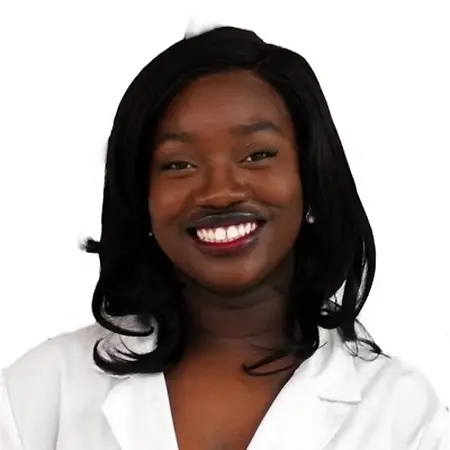
Her Story
About Keturah
I've been working in nuclear medicine for a little over 3 years, and the journey has truly been everything I expected plus more. I went through the nuclear medicine program at Hopkins, which exceeded my expectations, and was able to land my dream job right after graduation. I work a 9:30 to 6 schedule, Monday through Friday. When I get there, I swipe in, get my dosimeter badges, go into the control room, look at the schedule for the day, and see where my coworkers are. I pick up where they left off, either grabbing a new patient or getting a patient on the scanner that's already been started and waiting in the room. I get them scanned, start the paperwork, and proceed through the day until we get through all our patients. Early in my professional career, I had a notable achievement when a patient sent a long email to the vice president and director of our department praising my patient care skills. I had gotten her IV on the first try, explained the procedure, found her phone when she couldn't locate it, and got her another warm blanket. That recognition was something I really needed at that time and it's something I hold high for myself. What I love most about my career is truly the science behind it - learning how certain disease processes work, how our medicine works in the human body to diagnose or treat or do some form of intervention. I learn a new type of treatment every day, learn things from patients and coworkers. It's truly just being able to learn since it's such a growing field.
Her Interview
Ten minutes with Keturah
01What do you attribute your success to?
I attribute my success to a healthy mix of my eagerness to learn - I truly love learning - and my family. I've always just wanted to make my sisters proud, my mom proud. We're originally not from here, I was born in West Africa, Liberia, and we came here when I was 5. When my mom came here, she was working in a bread factory, and eventually she got her CNA license. Hearing that story is always motivational for me, because she truly could have just kept her head low, barely made minimum wage, worked 12 to 14 hours and never seen her kids, or she did what she did and was able to give us a life that we can now, or I can now, even be on the phone with you and talk to you about my story. That's my girl, she really is a strong woman.
02What’s the best career advice you’ve ever received?
The best career advice I've ever received definitely goes back to just being open to learning, because you never know everything. No matter what your student is, it doesn't matter how long you've been doing it, there's always going to be one person that knows one more thing than you, and you have to be open to that. You can't have your defenses up. And truly, you could be that for another person too. So if you're always going to be close-minded to learning something, how are you going to be open to even teaching somebody?
03What advice would you give to young women entering your industry?
My advice would definitely be, take up space. I'm learning to follow that advice every single day, and I cannot tell you the amount of times where just me speaking opened a lot of opportunities for me. I wouldn't have been able to get my job if I didn't just one day say, hey, I really love working with your team, how can I continue to do this? And next thing I know, I basically got the job. I had barely an interview, I had interviews set up, and then I got my dream job. The field is a healthy mix of men and women - I would say it's a healthy mix. And I love that, because for a lot of the males that I've interacted with, at least the normal ones, they're very open, they're very respectful, they treat you as a colleague, they see you as an equal, and there's usually no headbutting whenever you correct them or vice versa. Everybody's very respectful. However, of course, there's some people, mostly the physicians, but you know, what are you gonna do? You take it on the chin and you move on.
04What are the biggest challenges or opportunities in your field right now?
Right now with my company, Hopkins, we do these SMART goals, which I think a lot of companies do. We have to come up with 3 to 5 goals every year - personal goals, goals as a modality, goals as a suite, all these things. So that's kind of new for me, doing that and actually finding evidence to say that I meet those goals. One of my main things has been maintaining my CE credits, which is what I need to maintain to keep my licenses and certifications. That's something new, having still having a little bit of homework, but it's not really homework, it's all up to me - if I don't do it, girl, you're out of a license. And now that I'm working without having somebody watching me 24/7, it's up to me to maintain my radiation safety and those QC skills and QA skills. You can't see the radiation, but if it's on you, it's on you, so you better hope you're monitoring yourself, you better hope you're working smart and fast and efficient, and don't just go through the motions for the sake of it's almost time to clock out. You can't blame it on someone else. This is your license on the line.
05What values are most important to you in your work and personal life?
Maintaining that human connection is something that I've always tried to remind myself of when I'm working, especially when it's been like I'm on my third or fourth patient of the day, I've already been there since early in the morning, I'm hungry, I'm cold, I'm hot, whatever the case may be, and I just want to get through it. I know I can get a patient injected, all set up with their blankets, with their contrasts, whatever they need, let them sit for the hour in less than 10 minutes. But then I become kind of robotic. So it's kind of just a checklist - check off, check off, check off. Do you need anything? No? Okay, great. And there's no genuine human connection, which is what I always want to bring when I interact with patients.
Join Influential Women and start making an impact. Register now.