

Texas mandates AI awareness training for public employees, but true adoption requires addressing deeper human concerns about job security and change, not just compliance checkboxes.
Her Story
About LaChelle
LaChelle Bynum is the Founder and CEO of RISE Intelligence Group, LLC, where she serves as an AI Strategist and organizational readiness consultant, helping businesses, nonprofit organizations, educational institutions, and government-related organizations prepare for responsible growth and AI-driven transformation.
Drawing on more than 30 years of federal government experience, she brings extensive knowledge of program analysis, operations, records and information management, procurement, contract management, training, and organizational leadership. Her professional background has equipped her with a comprehensive understanding of how leadership, workforce readiness, governance, and operational strategy must align to achieve organizational success.
Through RISE Intelligence Group, LaChelle specializes in organizational AI readiness, workforce-readiness training, responsible AI governance, executive strategy, and leadership development. She works with organizational decision-makers to identify readiness gaps, strengthen accountability, improve information stewardship, and establish practical approaches to responsible AI adoption. Her approach emphasizes that successful transformation begins with leadership alignment, workforce preparedness, and organizational responsibility—not technology alone.
Throughout her career, LaChelle has held leadership positions in the Government Mailers Advisory Council and the Mail Systems Management Association, including serving as co-chair, regional director of new engagement, vice president of education, and president of the Washington, D.C. Metro chapter. She has shared her expertise at international conferences and authored the featured article, "From Mailroom to Intelligent Communication Center," published in MAIL: The Journal of Communication Distribution.
In addition to her consulting work, LaChelle is a Certified AI Agent Builder, Certified Master Transformation Life Coach, transformational speaker, author, and entrepreneur. Through her coaching, speaking engagements, and personal development initiatives, she encourages individuals to embrace change, build resilience, and pursue meaningful growth. Her work reflects a commitment to helping both organizations and individuals navigate transitions with clarity, confidence, and purpose.
She continues to expand her knowledge through professional development, including studies at Cornell University and certifications in transformation coaching and AI development. This commitment to lifelong learning strengthens her ability to connect established leadership principles with the evolving demands of artificial intelligence and organizational transformation.
Guided by a people-centered philosophy, LaChelle believes successful transformation requires more than technology; it requires prepared leaders, informed employees, trust, and responsible decision-making. Through RISE Intelligence Group, she champions an approach grounded in People, Purpose, and Potential, with a commitment to preparing leaders, empowering teams, and transforming organizations.
Her professional standard reflects her unwavering commitment to excellence:
"Excellence is not optional—it's the standard."
Her Interview
Ten minutes with LaChelle
01What do you attribute your success to?
I attribute my success to resilience, a commitment to lifelong learning, and the willingness to embrace change—even when the path forward is uncertain.
Throughout my journey, I've learned that success is not defined solely by titles, accomplishments, or recognition. It is shaped by the decisions we make, the challenges we overcome, and our willingness to continue growing through every season of life.
My more than 30 years of federal service taught me the importance of accountability, strategic thinking, and leading with integrity. Life itself taught me something equally valuable: the ability to begin again, redefine what's possible, and recognize that experience and wisdom are powerful foundations for new opportunities.
I have never believed that growth has an expiration date. Whether transitioning into entrepreneurship, expanding my knowledge of artificial intelligence, or helping others navigate transformation, I approach each opportunity with curiosity, purpose, and a commitment to excellence.
Above all, I attribute my success to remaining teachable, staying grounded in my values, and understanding that true leadership is not simply about personal achievement. It's about creating opportunities for others to grow, lead, and succeed.
My guiding principle remains simple: Excellence is the standard.
02What’s the best career advice you’ve ever received?
The best career advice I've ever received was simple but powerful: “Always bet on yourself, and never allow the word 'can't' to become part of your vocabulary.”
Over the years, I've come to understand that there is a significant difference between saying “no” and saying “I can't.”
When you say no, you're making a decision. You're acknowledging that something may not align with your priorities, interests, or direction. And there's nothing wrong with that. Not every opportunity is meant for you, and knowing when to say no is an important part of personal and professional growth.
But “I can't” carries a different weight.
Sometimes, we use those words not because something is truly impossible, but because we're uncertain, uncomfortable, or unwilling to take the risk. We leave the door slightly open, hoping circumstances might change or someone else might make the decision for us.
And while we're waiting, opportunities continue moving forward.
What I've learned is that the greatest limitation isn't always the obstacle in front of us. Sometimes it's the permission we haven't given ourselves to try.
Throughout my career, I've encountered situations where I could have allowed uncertainty to determine my next move. But I've learned to ask myself a different question: “Is this something I truly cannot do, or is this something I haven't yet decided I'm willing to do?”
That question changes everything.
It shifts the conversation from limitations to possibilities, from hesitation to accountability, and from waiting for permission to taking ownership of your future.
I believe one of the most difficult things to live with is the weight of the would've, could've, and should've—not because we tried and failed, but because we never gave ourselves the opportunity to discover what was possible.
So the advice I carry with me, and the advice I share with others, is this:
Bet on yourself. Be intentional with your no. Be honest about your can't. And never let fear make a permanent decision about a possibility you haven't explored.
Because sometimes the opportunity that changes your life begins with the decision to believe you're capable of pursuing it.
03What advice would you give to young women entering your industry?
My advice to young women entering the fields of artificial intelligence, organizational strategy, and leadership is to recognize that your greatest asset is not simply what you know today, but your ability to think critically, ask meaningful questions, and understand the value of your perspective.
We are entering an era where technology is evolving faster than many organizations can prepare for it. Artificial intelligence is changing how we work, communicate, make decisions, and serve others. But technology alone does not create meaningful transformation. People do.
Learn the technology, but also learn the business. Understand how organizations operate, how decisions are made, how policies influence outcomes, and how leadership establishes accountability. Develop your communication skills, strengthen your analytical abilities, and become comfortable asking questions that others may overlook.
Equally important, recognize the value of mentorship and meaningful professional relationships. Find mentors who are willing to share their experiences, challenge your thinking, and help you recognize opportunities you may not yet see for yourself. But also build relationships with peers and like-minded professionals who understand the responsibilities, challenges, and possibilities within your field.
Every woman needs a sounding board—not simply someone who listens, but someone who understands the conversation, offers thoughtful perspectives, and helps turn uncertainty into clarity and clarity into action.
That is why professional communities and platforms that bring women together are so valuable. They create opportunities for shared knowledge, genuine connection, collaboration, and mutual growth. Sometimes the perspective you need comes from someone who has already traveled the road ahead of you. Other times, it comes from someone navigating a similar journey alongside you.
Do not confuse having access to information with having the wisdom to apply it. Artificial intelligence can generate answers, but responsible professionals must know how to evaluate those answers, recognize risks, and understand the consequences of their decisions.
I also encourage young women to understand the difference between visibility and credibility. Being seen may create an opportunity, but preparation, integrity, consistency, and the ability to deliver meaningful results are what sustain a professional reputation.
And never feel pressured to have your entire career mapped out from the beginning. Your interests will evolve, industries will change, and opportunities will emerge that may not even exist today. Build transferable skills, remain curious, and surround yourself with people who encourage both your personal and professional development.
Most importantly, remember that you do not have to choose between being technically knowledgeable and being people-centered. The future needs women who can do both.
Don't simply aspire to have a seat at the table. Develop the knowledge, judgment, and courage to contribute meaningfully to the decisions being made there.
Your voice matters, but your preparation gives that voice influence. And the relationships you cultivate along the way can help that influence grow into lasting impact.
04What are the biggest challenges or opportunities in your field right now?
One of the greatest challenges I see in artificial intelligence today is that we have become very comfortable adopting the tools without always understanding what successful adoption actually requires.
Knowing how to use an AI application is one thing. Understanding how that application fits into a business, supports employees, strengthens decision-making, and advances an organization's mission is something entirely different.
Consider the small business owner who recognizes that artificial intelligence may be necessary to remain competitive. They begin exploring automation, customer engagement tools, and AI-powered business solutions. But an important question often remains unanswered: How do I incorporate this technology without losing the vision, mission, purpose, and personal connection that made my business valuable in the first place?
That is not simply a technology question. It is a strategic business question.
Now consider the employee whose organization has introduced AI into daily operations. The technology is available, expectations are changing, and new processes are being implemented. But has anyone explained how their role will evolve? Have they been invited to help shape the implementation? Do they understand how their experience, judgment, and creativity can contribute to making the technology more effective?
Employees should not simply be the recipients of AI transformation. They should be active participants in shaping how that transformation works.
I believe this is where the principles of Knowledge, Skills, and Abilities become especially valuable.
Knowledge begins with understanding the technology, its purpose, its limitations, and its responsible use. Skills develop when employees apply that knowledge to their daily responsibilities and gain practical experience. Abilities emerge as employees become capable of adapting what they have learned, identifying additional applications, sharing their expertise, and helping others succeed.
An employee who learns to use AI for one assignment may eventually recognize how that same knowledge could improve an entirely different process. Given the opportunity, that employee can contribute ideas, support colleagues, and help develop practices that benefit the broader organization.
That is how workforce readiness becomes more than a training exercise. It becomes a foundation for employee ownership, organizational learning, and continuous improvement.
Then there is organizational leadership. Executives are making decisions about investments, IT departments are evaluating technical requirements, human resources is considering workforce implications, and governance teams are establishing policies and safeguards.
Each function may be doing exactly what it believes is necessary. But if those conversations are happening independently, who is connecting the decisions?
That, to me, is one of the most significant challenges in AI transformation: organizations may be moving in the same direction without actually moving together.
We cannot expect responsible, sustainable AI adoption when leadership, technology, workforce development, operations, and governance function in separate silos.
And this is where I see our greatest opportunity.
We have an opportunity to bring those conversations together before technology becomes another disconnected initiative. We can help business owners determine where AI genuinely supports their mission rather than adopting tools simply because competitors are using them.
We can create environments where employees contribute to implementation decisions, develop practical capabilities, and become knowledgeable participants in improving how their organizations operate.
And we can help organizational leaders move beyond asking, "What AI tools should we purchase?" and begin asking, "What must we understand, prepare, and align before those tools can deliver meaningful value?"
Through RISE Intelligence Group, I approach AI readiness as an organizational conversation, not an isolated technology project. My focus is on helping leaders identify the gaps between their intentions, their operational realities, and the people responsible for bringing their strategies to life.
I believe the next major opportunity in artificial intelligence is not simply discovering what more the technology can do.
It is discovering what becomes possible when leadership, employees, technology, and organizational purpose are finally working together.
Because adopting AI may change how an organization operates. But aligning people, purpose, and strategy determines whether that change becomes meaningful transformation.
05What values are most important to you in your work and personal life?
The values that guide my professional and personal life are rooted in faith, integrity, accountability, compassion, authenticity, intentionality, and excellence. While each of these principles is important to me, my faith provides the foundation for how I understand and practice them.
I believe that every day presents an opportunity to surrender what I think I know, remain open to what God is revealing, and receive the new wisdom and understanding available to me. In my spiritual journey, I recognize the importance of dying to self daily—not losing who I am, but releasing the need to control every outcome and remaining receptive to God's direction.
One of the most meaningful lessons I've learned is that not every door I desire to walk through is a door intended for me.
Sometimes we become so committed to a particular goal, opportunity, or vision that we struggle to recognize when a different direction may serve us better. But I've learned that a closed door is not necessarily a rejection. Sometimes it is grace. Sometimes it is protection. And sometimes it is an invitation to pause, reconsider, and trust that there is something I cannot yet see.
That understanding has strengthened my ability to pivot, adapt, and approach change with greater peace. Flexibility does not mean abandoning my purpose. It means recognizing that the path toward that purpose may unfold differently than I originally imagined.
Integrity and accountability guide how I conduct myself professionally and personally. I believe in honoring my commitments, taking responsibility for my decisions, and treating people with honesty and respect. Leadership, to me, requires consistency between what we believe, what we communicate, and how we act.
Compassion and authenticity are equally important. Every individual has a journey, and we do not always know the circumstances that have shaped another person's decisions or experiences. I strive to approach others with understanding, dignity, and the willingness to listen before making judgments.
I also value continuous growth. Each day offers an opportunity to learn something new, reconsider an assumption, or gain a perspective that challenges what I previously believed. I never want my experience to become a barrier to receiving new knowledge.
Intentionality reminds me to examine not only what I want to accomplish, but why I want to accomplish it and whether it aligns with my values and purpose.
And excellence remains my professional and personal standard. Excellence is not about perfection. It is about approaching my responsibilities with preparation, integrity, care, and a commitment to doing what is right.
Above all, my faith reminds me that I do not have to understand every detour to trust that my journey still has meaning.
There is a peace that comes from knowing that every open door is not necessarily an invitation, every closed door is not a defeat, and every change in direction is not a loss.
Sometimes the greatest growth comes when we release what we expected, embrace what we are being taught, and allow ourselves to move forward with faith rather than fear.
That is the peace I seek to carry into my leadership, my relationships, my decisions, and every season of my life.
Her Content Hub
Articles by LaChelle
AI Doesn’t Scare People. Change Does.
Moving beyond compliance: How leaders can build genuine confidence in AI adoption
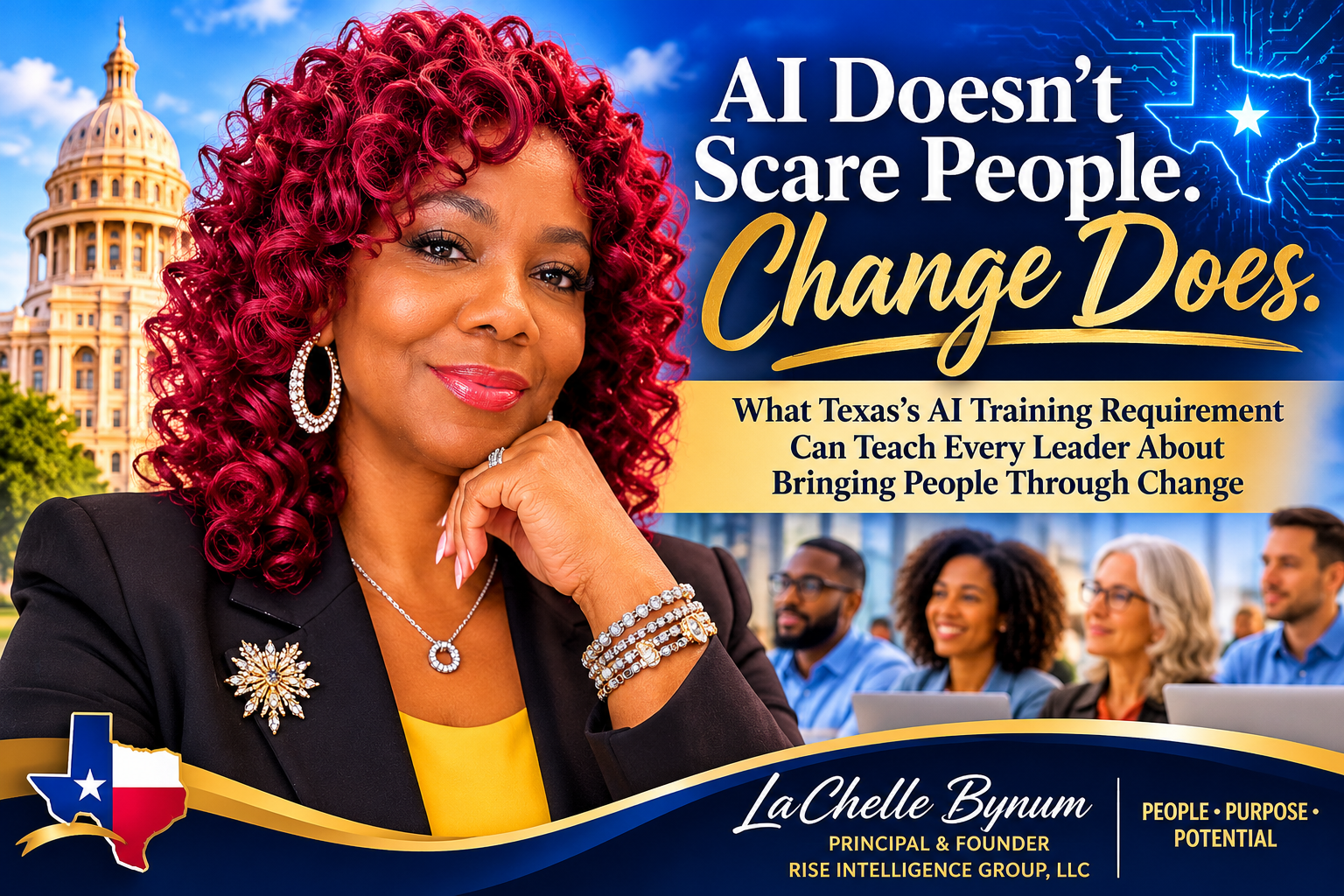
Texas has made AI awareness training an annual requirement for certain state and local government employees and officials. Many covered employees who use computers for at least a quarter of their work must complete a state-certified training program. School districts have additional provisions, and government entities must report their compliance by August 31 each year.
Across Texas, public employees will sit down in front of screens, work through training materials, and learn about artificial intelligence. Some will be curious. Some will be skeptical. Others will quietly wonder what all of this means for their jobs.
And plenty of small business owners feel the same pressure to "figure out AI," with no mandate, no training budget, and no one to ask.
The requirement is a good thing, and the state's standards are sound. Employees learn what AI is, how it can help in public-sector work, where it falls short, which uses the law prohibits, and five principles for using it responsibly: human oversight, privacy and security, transparency, accuracy, and accountability.
But I've spent enough years inside government, and enough years walking beside people through loss and reinvention, to know what checkbox training can't reach.
People don't resist technology. They resist losing their footing.
When I was a federal Program Analyst, I watched new systems roll out more times than I can count. The ones that struggled rarely failed because of the software. They failed because nobody addressed the quiet questions in the room.
Will I still be good at my job? Will this replace me? What happens if I make a mistake with it and it's my name on the decision?
Those aren't technical questions. They're human ones.
And even a well-designed training module may not answer them.
I learned the same lesson a second time, in a very different season. After my husband passed, and later, when I went through a period of housing instability, I discovered that the hardest part of change isn't learning the new thing. It's letting go of the version of yourself who knew exactly how things worked.
That's why I built the S.T.A.R.T. Framework™, and it's why I teach AI the way I do.
Fear makes people careless, too.
This is the part leaders miss.
An employee who is anxious about AI doesn't simply avoid it. Sometimes they use it quietly, without asking questions and without exercising the judgment the training was meant to build.
Imagine an employee pasting a constituent's personal information into a public chatbot because they were too embarrassed to ask whether it was allowed. Or trusting an AI-generated summary without verifying it because they were afraid of looking slow.
These are exactly the kinds of risks that responsible training is intended to prevent.
The state's five principles are exactly right. But principles only hold when people feel safe enough to practice them out loud.
What actually works
If you lead a team, a congregation, a school, or an agency, here is what I've seen make the difference:
1. Name the fear before you teach the tool.
Give people room to say what they're worried about. You'll learn more about your real risks in ten minutes of honest conversation than in a month of usage reports.
2. Practice with your own work.
Generic examples don't stick. Have people practice with the kinds of memos, reports, and constituent questions they handle every day. Use authorized AI tools and information that is appropriate to share. Give them someone who can answer questions, catch mistakes, and help build their confidence.
3. Make "check your work" a habit, not a rule.
Verifying AI output should feel as normal as proofreading an email. Model it yourself.
4. Be clear about what's authorized.
Not every mistake comes from bad intent. Sometimes people simply don't understand the boundaries. Tell them exactly which tools they can use, what information they can share, and when they need to stop and ask.
5. Remember who's accountable.
AI can draft, sort, and summarize. People still make the decisions, and people still answer for them.
A requirement is a starting line, not a finish line.
Texas has given public employers a clear responsibility.
The organizations that treat this requirement as an opportunity to build genuine confidence will accomplish something more valuable than compliance alone. They'll begin building a workforce that understands not only how to use AI, but when to question it, when to verify its output, and when human judgment must lead.
The ones that focus only on training completion may check the box and leave the underlying fear untouched.
And this applies far beyond government.
Every nonprofit, ministry, school, and small business is facing the same moment, with or without a mandate.
AI is becoming part of how we work, communicate, and make decisions. But no technology can replace the responsibility leaders have to prepare their people for change.
The question isn't simply whether your people will learn to use AI.
The question is whether they'll walk through that change alone, or with someone who understands both the technology and the human heart behind it.
Inspiration fades. Systems carry you home.
LaChelle Bynum is the Principal & Founder of RISE Intelligence Group, LLC, in Arlington, Texas, where she helps people and organizations move through AI and life change. She is an AI Consultant Strategist, a Certified AI Agent Builder, a former federal Program Analyst, a Certified Master Life Coach, creator of the S.T.A.R.T. Framework™, and the author of three books, including The Bridge Home. Learn more at lachellebempowers.info.
Sources
Join Influential Women and start making an impact. Register now.