AI Doesn’t Scare People. Change Does.
Moving beyond compliance: How leaders can build genuine confidence in AI adoption

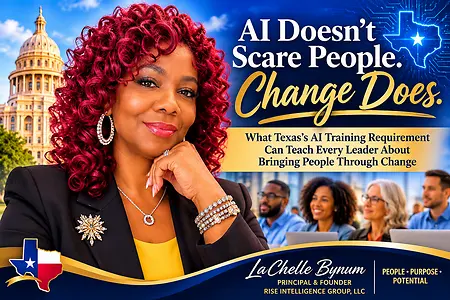
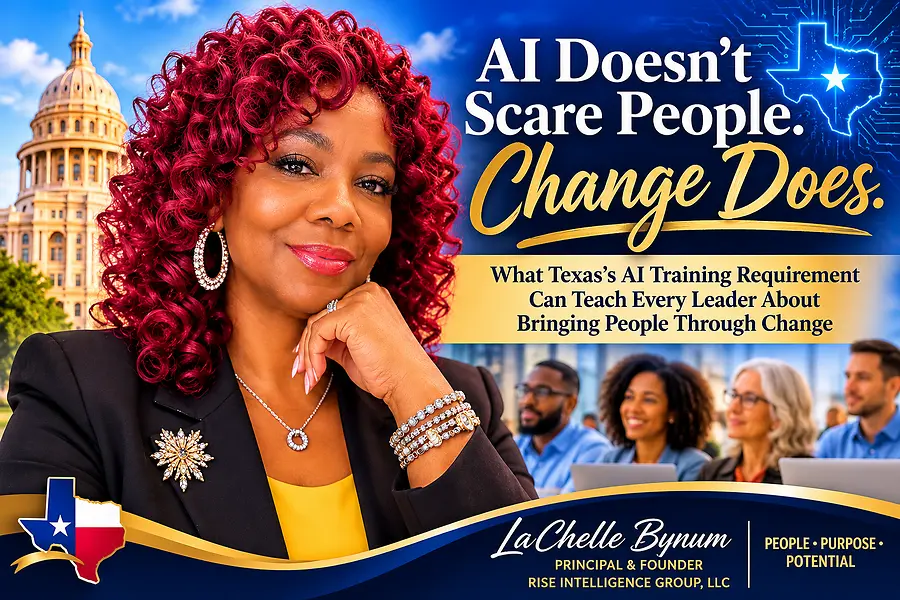
Texas has made AI awareness training an annual requirement for certain state and local government employees and officials. Many covered employees who use computers for at least a quarter of their work must complete a state-certified training program. School districts have additional provisions, and government entities must report their compliance by August 31 each year.
Across Texas, public employees will sit down in front of screens, work through training materials, and learn about artificial intelligence. Some will be curious. Some will be skeptical. Others will quietly wonder what all of this means for their jobs.
And plenty of small business owners feel the same pressure to "figure out AI," with no mandate, no training budget, and no one to ask.
The requirement is a good thing, and the state's standards are sound. Employees learn what AI is, how it can help in public-sector work, where it falls short, which uses the law prohibits, and five principles for using it responsibly: human oversight, privacy and security, transparency, accuracy, and accountability.
But I've spent enough years inside government, and enough years walking beside people through loss and reinvention, to know what checkbox training can't reach.
People don't resist technology. They resist losing their footing.
When I was a federal Program Analyst, I watched new systems roll out more times than I can count. The ones that struggled rarely failed because of the software. They failed because nobody addressed the quiet questions in the room.
Will I still be good at my job? Will this replace me? What happens if I make a mistake with it and it's my name on the decision?
Those aren't technical questions. They're human ones.
And even a well-designed training module may not answer them.
I learned the same lesson a second time, in a very different season. After my husband passed, and later, when I went through a period of housing instability, I discovered that the hardest part of change isn't learning the new thing. It's letting go of the version of yourself who knew exactly how things worked.
That's why I built the S.T.A.R.T. Framework™, and it's why I teach AI the way I do.
Fear makes people careless, too.
This is the part leaders miss.
An employee who is anxious about AI doesn't simply avoid it. Sometimes they use it quietly, without asking questions and without exercising the judgment the training was meant to build.
Imagine an employee pasting a constituent's personal information into a public chatbot because they were too embarrassed to ask whether it was allowed. Or trusting an AI-generated summary without verifying it because they were afraid of looking slow.
These are exactly the kinds of risks that responsible training is intended to prevent.
The state's five principles are exactly right. But principles only hold when people feel safe enough to practice them out loud.
What actually works
If you lead a team, a congregation, a school, or an agency, here is what I've seen make the difference:
1. Name the fear before you teach the tool.
Give people room to say what they're worried about. You'll learn more about your real risks in ten minutes of honest conversation than in a month of usage reports.
2. Practice with your own work.
Generic examples don't stick. Have people practice with the kinds of memos, reports, and constituent questions they handle every day. Use authorized AI tools and information that is appropriate to share. Give them someone who can answer questions, catch mistakes, and help build their confidence.
3. Make "check your work" a habit, not a rule.
Verifying AI output should feel as normal as proofreading an email. Model it yourself.
4. Be clear about what's authorized.
Not every mistake comes from bad intent. Sometimes people simply don't understand the boundaries. Tell them exactly which tools they can use, what information they can share, and when they need to stop and ask.
5. Remember who's accountable.
AI can draft, sort, and summarize. People still make the decisions, and people still answer for them.
A requirement is a starting line, not a finish line.
Texas has given public employers a clear responsibility.
The organizations that treat this requirement as an opportunity to build genuine confidence will accomplish something more valuable than compliance alone. They'll begin building a workforce that understands not only how to use AI, but when to question it, when to verify its output, and when human judgment must lead.
The ones that focus only on training completion may check the box and leave the underlying fear untouched.
And this applies far beyond government.
Every nonprofit, ministry, school, and small business is facing the same moment, with or without a mandate.
AI is becoming part of how we work, communicate, and make decisions. But no technology can replace the responsibility leaders have to prepare their people for change.
The question isn't simply whether your people will learn to use AI.
The question is whether they'll walk through that change alone, or with someone who understands both the technology and the human heart behind it.
Inspiration fades. Systems carry you home.
LaChelle Bynum is the Principal & Founder of RISE Intelligence Group, LLC, in Arlington, Texas, where she helps people and organizations move through AI and life change. She is an AI Consultant Strategist, a Certified AI Agent Builder, a former federal Program Analyst, a Certified Master Life Coach, creator of the S.T.A.R.T. Framework™, and the author of three books, including The Bridge Home. Learn more at lachellebempowers.info.
Sources

LaChelle Bynum is the Founder and CEO of RISE Intelligence Group, LLC, specializing in organizational AI readiness, responsible AI governance, and workforce transformation. Drawing on more than 30 years of federal government experience, she brings strategic leadership, organizational insight, and a people-centered approach to emerging technology. A Certified AI Agent Builder, Certified Master Transformation Life…