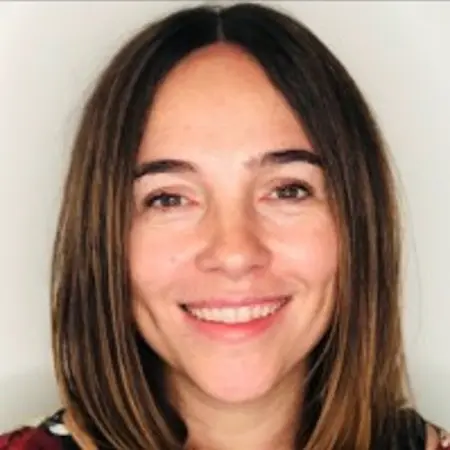
Her Story
About Leire
I have been in my field since 2003 when I graduated with my master's degree, though I also have a BA of 4 years and a master's degree of 2 in translation and interpretation, specifically in conference interpretation. What inspired me to get into this field is first of all the intellectual challenge. In interpretation, when you're at a big conference with different countries and delegations, whenever somebody speaks, you say the same into whatever language you are interpreting to almost at the same time. It's a real intellectual challenge because whatever I hear in English, I almost simultaneously say the same into Spanish. We work in soundproof booths with colleagues in other languages like Chinese, French, Korean, and Japanese. But I also felt a call for service to help other human beings. When you are in an immigration interview, in the courts, in the hospital, or working for a human rights association or the UN, you really feel that call that I am helping someone because these people cannot understand each other and I'm facilitating that connection. Intellectually, you learn a lot because you're constantly interpreting about different topics, and it's almost like you become an expert of that topic every week. This week I might work on private sector business, and next week I'll be working on health for the World Health Organization and the Food and Agriculture Organization of the United Nations, so constantly you are learning about new things, which is absolutely wonderful.
Her Interview
Ten minutes with Leire
01What do you attribute your success to?
I attribute my success to my students, of course. They make me a better teacher, a better professor. Every time I have the pleasure to be with them in the classroom, they challenge me. They come from different backgrounds, they share their stories, we interpret in class, we criticize their interpretation and performance, and we're always trying to improve. They are always very humble and they always teach me and motivate me. I also attribute it to my colleagues. Every time I'm in a high-level meeting interpreting for ministers, very high-level diplomats and CEOs, I hear very difficult, dense discourse and speech at a very high speed because countries have limited time to take the floor, and we always work in pairs. Whenever I hear a colleague and I'm like, oh my god, they are making this really look easy, something that is a very hard speech, they always motivate me to become better. I would say that without colleagues, and without my students, and without mentors and others that opened the way for me, I couldn't be here, that's for sure.
02What’s the best career advice you’ve ever received?
I think the best career advice is to always try, to never hold back. Many times I've been hired to interpret at conferences that I thought, what am I doing here? Because it was very high level. I had the pleasure to interpret for First Lady Michelle Obama and UN former Secretary General Ban Ki-moon. I always thought, like, oh, is it me? I'm like this girl from Spain, now I became American, how am I here? How is this happening to me? But the best advice that anybody could have ever given me is just, you know what? Go there, prepare, and try your best, and you have it. You've been working hard. Somebody has to do it, that person better be you. I also interpreted for President Biden in his campaign and for Vice President Harris. I think it's good to doubt yourself, and I think as women, we have the tendency to doubt ourselves all the time, but just to be able to overcome that fear, to say, I've trained for this, I prepare, I can do it. I've been years in the making.
03What advice would you give to young women entering your industry?
I would say exactly the same advice. Especially in this country, my language barriers are English into Spanish. Everything that I teach is out of English into Spanish, or out of French into Spanish. In this country, it's important because all the conferences take place in English, so if we invite leaders or any delegation from abroad that they don't really speak the language, or maybe they have basic English skills, that interpretation into Spanish, into the foreign language, is very important. I would say to any young woman who has the language skills, who wants to help others, who thinks, oh, I have what it takes, and I can learn the technique, to trust themselves and to always try. We need people like that. We need people who master Spanish and that are able to join and do the work and help people communicate. That's what we do - help people understand each other.
04What are the biggest challenges or opportunities in your field right now?
I think the biggest challenge is that first of all, you have to know the languages very well. You have to be exposed to culture, you have to live in the country, you have to know the language. In this day and age, the fact that we have all the internet and you can connect to any country in the world and listen to any language is absolutely wonderful, because really, you have to master the languages, and not only the language, you have to master the culture. You have to understand the culture to be able to interpret with such granularity and attention to detail and nuance. To become a top-level interpreter, you need that kind of cultural exposure and language knowledge, and that's not easy. I've been in the U.S. since 2001, so it's 25 years here, and before I grew up in Spain, so you have to be exposed to both cultures. A lot of people say AI might be a challenge that we are facing. Within AI and the new technologies, they're able to do a pretty decent translation, but we don't think the systems are there at the oral communication yet. Anyway, you always need that human touch in the communication, that human filter that can really control the machine. I feel people really rely on humans when it depends on communication at a very high and important level. At least for now, we don't know what's gonna happen in the future, but we're trying to adapt as we go.
05What values are most important to you in your work and personal life?
I think the values in the profession are always to stay true to the message, and that's very important. You are just the voice of that person in a different language, so whatever is said, you have to say it. You don't change the message or say something different. You always say whatever is being said. I feel that's an important value, that you always have integrity. We have a code of ethics as conference interpreters. We are part of the International Association of Conference Interpreters, AIIC, so we always go by that code of ethics. That's being true to the message, being faithful, then having integrity, being professional as well. And I would say, of course, being a good colleague. Whenever you can help a colleague, we always work in pairs, so we are always there supporting each other. And then as well, be professional to the client. If someone hires you, you have to prepare for that conference, you have to review the materials, you have to be there, to be professional, be there on time. You have to be intellectually curious, you have to like to read, to learn new things, to learn about new fields, to talk to people, to learn about what other people do. When you interpret, you're always working with concepts. You want to know about any field. That's always important as well, to have intellectual curiosity. A value that I think should be common to all of us is to be a good person. One mentor of mine always said, oh, you can be the best interviewer, but at the end of the day, what you have is always being a good person, whatever that is, but I feel that's also a good value to have.
Join Influential Women and start making an impact. Register now.