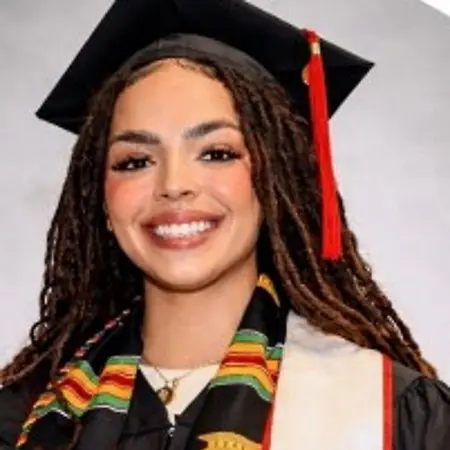
Her Story
About Micah
My journey in sports has been anything but traditional. I played Division I volleyball at the University of Alabama, where volleyball had been my everything since I was young. I came from a difficult background - my mom passed when I was young, and I was raised by a single parent - so volleyball became my escape and where I found myself. After two seasons, I had to medically retire due to endless injuries, including five knee surgeries and a lower body fracture. This was devastating because I had trained at the national team level and was a high school All-American. For about two years, I cut ties from all sports because it was too painful to watch. But during that time, I discovered my passion for the academic side of sports, particularly sociocultural issues involving race, gender, and politics. As Secretary of Black Athletes Built by Bama and now a graduate research assistant, I focus my research on how name, image, and likeness policies affect Black male athletes. I chose this focus because I wanted to work on something that would have immediate, actionable impact. My presentation at the College Sport Research Institute was my proudest achievement - I was nervous being the youngest person there with my long dreadlocks and tattoos, but I was able to give voice to athlete experiences and challenge the negative stereotypes that still persist. What made me unique was that I had played at the highest level and experienced some of the worst-case scenarios an athlete can face, yet came out on the academic side. I'm using what was once a source of shame - my medical retirement - to advocate for athletes and shed light on issues like mental health, suicide attempts, and self-harm that are so prevalent but rarely discussed.
Her Interview
Ten minutes with Micah
01What do you attribute your success to?
I really feel like my whole life I've relied on myself, sometimes to a fault. But deeper than that, I attribute my success to embracing even the difficult parts of me - digging deep, finding out who I am, how I became this way, and unpacking my life. When you really lay it all out there and look in the mirror at the good, bad, and ugly, that's what makes you who you are. I've used all of those things, even the negative, even the ugly and the gross, to inform my path. I stopped looking at my experiences as negatives, flaws, shame, or trauma, but as something that would push me forward because they're unique experiences. And I'm probably not the only one that's gone through it. So using what I have to connect with other people, above all, is what I would say has driven my success.
02What advice would you give to young women entering your industry?
I would say embrace yourself. Embrace being a woman, a woman of color, if you're part of the LGBTQ community. Whatever you are, don't shy away from it, because I feel like in this industry, it's so male-dominated, it's easy to almost think you have to become one of them in order to be accepted. There's that connotation of maybe the other women might be your competition, or maybe I shouldn't bring up this topic because it's touchy. But someone has to talk about the difficult issues in sports - gender, power dynamics, identity - and as a young woman, I'm 22, and I feel like I'm already kind of making some contributions to my field. Do not underestimate yourself as a young woman, because I came into that conference scared and nervous, and to see that my voice carries, I feel like every young woman can break into this field and have their voice carried.
03What are the biggest challenges or opportunities in your field right now?
I would say the biggest challenges are the lack of education amongst people that are willing to critique athletes, and also a lack of athlete voice. At the conference, I had people raising their hands to critique athletes for name, image, and likeness, but when I asked them to explain NIL to me, they didn't give me the correct answer. They didn't know the difference between NIL and revenue share. People are picking their strong yes or no side, but they still don't know what they're arguing for. There is still such a strong and negative athlete stereotype, especially within Black male athletes in high-revenue generating sports. I was hearing people say student athletes should be called athlete-athletes because they're not even students, making assumptions that they never go to class. And I'm hearing that as someone who is Secretary of Black Athletes Built by Bama and surrounds myself with Black athletes at our school that are active in the community, extremely intelligent people with great heads on their shoulders who want to make a difference. That negativity comes from the lack of education.
04What values are most important to you in your work and personal life?
The first things that come to my brain are like come as you are. I really don't see the point in my field or in my life trying to pigeonhole anyone, or trying to only take the good and ignore the bad. I feel like that happens a lot in athletics with that intensified athlete persona, and in my research I wanted to highlight the upbringings of athletes, the interests of athletes, who they are outside of their sport, because that often gets so neglected and we don't embrace the whole athlete, and that can cause a plethora of issues. With that, I also encourage myself to show people all of me, not just the parts I think they're gonna like, because at the end of the day, all of those experiences are what shaped me to who I am. I've had a lot of crazy experiences in my life as a young woman with my upbringing, a lot of untraditional things going on. For a long time, that was the root of shame, depression, and anxiety, and while that's still stuff that I battle to this day, I got to the point where I realized that there's kind of no point in trying to hide, because this is what made you who you are. If people are willing to accept you for your on-court performance, they're just gonna have to accept all of you, and that's nothing to be ashamed about.
Join Influential Women and start making an impact. Register now.