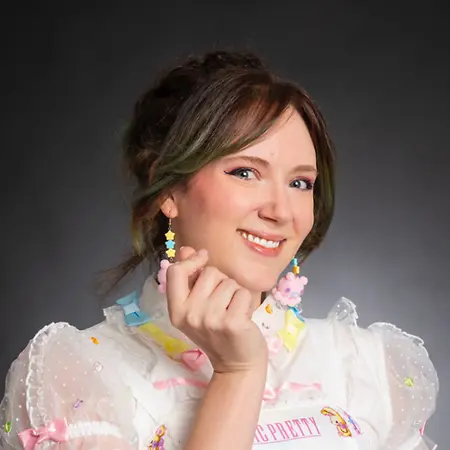
Her Story
About Rachel
I started out, like most folks, in IT roles, really just looking for a side job to put me through school. Originally, I was going to school for science, for physics specifically. I wanted to be a physics teacher. I was really interested in the idea of teaching students a hard concept that seemed so out of touch, and when it finally clicked for me, I was really passionate about this concept of, like, hey, hard things to learn, hard things to understand are actually easy if you have the right teacher. As I started working in IT and doing more of the kind of grunt-level support work, I realized that I actually enjoyed helping people figure problems out. I started to get more into the space of project management, which I like to describe as the meta of how we did the IT support, so focusing on operations within a company. I started to learn this concept of the user experience, and particularly my area is internal-facing, so with employees in the company, the employee experience, and how if you make it just 1% better to be an employee at a company, you actually are able to give that company a little bit of a competitive edge. Through a couple of career moves, I entered that world of project management, I started more in-depth with IT projects, looking at infrastructure, software development, internal custom applications, all the different ins and outs of the way that a company manages the tooling, the technology, and the data insights that it uses to actually do business. I was exposed to the concept of agile methodologies and agile project management, which at the time, you know, about 10 years ago or so, was kind of the new hotness. I really resonated with the concepts of doing things more iteratively, having that feedback loop, and how that actually improves not just the product that you deliver, but the way people feel about the work that you're doing to deliver it. That is what led me into my particular application suite that I'm an expert in, in the world of agile coaching and being a certified scrum master.
Her Interview
Ten minutes with Rachel
01What do you attribute your success to?
I attribute my success to a couple of things. First, I was given some really cool opportunities, just by nature of having a good family behind me. I wouldn't say that we were well off, I had to put myself through school, I didn't really have an opportunity to lean on my parents for support or funding in that way, but they did give me a roof over my head while I was trying to figure all of my school stuff out, and I know a lot of people didn't and do not have that leg up. I think that allowed me the time to really explore and figure out what actually makes sense for me. I also attribute a lot of my success to my father, who had an incredible work ethic. It was something that he demonstrated to me every single day, showing up, doing what matters, thinking about the way that you talk to different people. He taught me a lot about the art of communication and understanding. Some people want very detailed communication, some people don't. If you can identify who your audience is and kind of tailor the information that you give, you can be really successful and talk to a lot of different levels of people. He modeled that resiliency and the ability to just kind of think positively about all of the opportunity that you might have, instead of getting lost in your current circumstances or being upset about a bad project. And then I think last, I attribute my success to what my boss still jokingly refers to as the racial difference, or the ability to predict the future. It's not just a wealth of experience that I bring with me. It's that pattern recognition mindset. I think a lot of that has to do with the fact that I am a woman, I am neurodivergent, I have a different way of thinking about the world around me. I think more in whole systems, and how things interact, and all of the different places where that shows up, instead of just narrow, focused on input-output of one single thing. And I think this has given me that ability to see the bigger picture, to think about the bigger strategy of everything that's involved, and how it's gonna have that long-term impact.
02What advice would you give to young women entering your industry?
For young women entering the technology industry, I think the number one piece of advice that I'm gonna give everyone is to find your people. As a woman in tech especially, there is still a really strong adversarial culture that you have to go up against. It is baked into the organizations, into the systems, into the opportunities that we have, even if you have good managers who have a diverse mindset and try to honor and represent diversity. A lot of these organizations still really suffer from the old-school mentality that is not welcoming at all to women and non-binary folks. A lot of people will say that the answer to that is just resiliency, is just, you know, don't let it discourage you, and, you know, don't get hung up on that stuff, and just be confident, walk into that director's office anyways, and just say what you have to say with your chest, but I disagree. I think even the most confident among us feel shaken and fall victim to kind of that imposter mindset when we are always constantly in the out group, when we're always constantly looking at the communication style, the types of people that we see in the room, the words that are being used, the way that the systems are designed, and we just feel othered. And you're going to continue to feel that way, and I think that is something that is going to take a really long time to change. We need women in the industry to change that. And so, instead of just trying to be super resilient all the time and not let that bother you, I think the best thing that you can do is to find your people, find the people that make you feel supported, that make you feel like the in group, whether that's other women in the industry, whether that's just people that have a diverse mindset and make you feel seen and heard, and really center, craft your job, craft your responsibilities, craft your projects, and the things that you do, and the people that you have to interact with on a day-to-day basis around those people as much as possible.
03What are the biggest challenges or opportunities in your field right now?
The biggest challenge and the biggest opportunity is the same: AI. Specifically, generative AI and AI chatbots are exploding onto the scene. This is frontier technology. We are now in a world where AI as a chatbot is impacting every corner of everything that we do. I think we have a lot of really loud voices in the world of AI, and they tend to represent one perspective, a very single, not super diverse slice of way of thinking and way of viewing the world. And that is going to be a really big challenge. Everyone is trying to adopt it, trying to figure out this is a transformative technology that is literally going to change all of our jobs. It's like when the computer hit the scene. There is real grief around that, too. There is real grief and loss of people who are decades of expertise in their field that their job is now fundamentally changing to look completely different, and that's real, and we have to acknowledge that. We are, in most companies, being given directives to find a way to integrate this stuff into our day-to-day workflows without any real training or actual strategic plan of how we're supposed to achieve any sort of benefit by using this tool. On the flip side, there is a lot of opportunity in that space. Everybody wants AI experts on their team, so if you can become an AI expert, you're gonna have an invaluable skill set, and not just an expert at writing prompts and getting it to do the thing, but an expert at large language models and understanding how they actually function. I also think there is a lot of opportunity to be the voice of reason in the room, to be that strategic execution expert, and understand that we have to have a plan. We can't just throw it at the wall and see what sticks.
Join Influential Women and start making an impact. Register now.