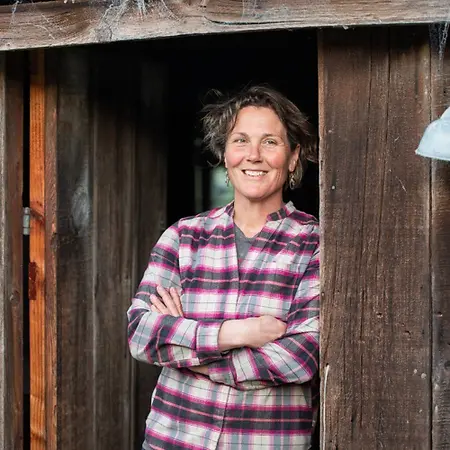
Her Story
About Sarah
Sarah Keiser is an innovative program developer, community builder, and land stewardship leader who has spent more than a decade creating and managing groundbreaking initiatives that strengthen wildfire resilience, ecological health, and regenerative agriculture throughout California. As the founder and CEO of Wild Oat Hollow, she has pioneered community grazing cooperatives and sustainable land management programs that empower landowners, municipalities, and public agencies to use livestock grazing, prescribed fire, and community education as effective tools for ecosystem restoration and wildfire mitigation. Her work has helped establish grazing as a recognized and funded strategy for landscape management, influencing policy and advancing practical solutions for fire-prone communities across the western United States.
Throughout her career, Sarah has built strong partnerships with Resource Conservation Districts, Cal Fire, University of California Cooperative Extension, policymakers, Indigenous fire practitioners, and community organizations to develop collaborative approaches to land stewardship. She has successfully secured and managed significant grants supporting forest health, wildfire risk reduction, and environmental restoration while leading large-scale initiatives such as the City of Petaluma Master Grazing Plan. Her expertise spans program development, strategic planning, stakeholder engagement, grant management, and community education, enabling her to transform innovative ideas into scalable, measurable programs that deliver lasting environmental and community benefits.
In addition to her leadership in conservation and wildfire resilience, Sarah remains deeply connected to the agricultural communities she serves. As a ranch owner and regenerative agriculture advocate, she combines practical, on-the-ground experience with strategic vision to advance sustainable land-use practices. Recognized with honors including the California Park & Recreation Society Community Service Award and the Gold Ridge Resource Conservation District Certificate of Appreciation, Sarah continues to lead efforts that strengthen ecosystems, support rural livelihoods, and create replicable models for resilient communities throughout the West.
Her Interview
Ten minutes with Sarah
01What’s the best career advice you’ve ever received?
The best career advice I ever received was from an entrepreneur when I was in my 20s. They told me to never undervalue myself and never undercharge for my services, because it is so much harder to raise your rates than to start high and know your value. If you're charging for services or products, don't underbid yourself thinking you're going to raise your rates, because you lose a lot of clientele by rising your rates. Start high, hold your value, and stick to your guns. You're worth it. Us women do have a tendency to undervalue ourselves, and we need to stop doing that. You might think you're going to get more clients or jobs by offering lower rates, but then you just get stuck in your low-rate market and have big trouble raising rates. If you start high, or at what you're valued at, it might take you a little longer, but you're going to get the right clientele, and they're going to be willing for you to raise your rates as they need to be raised. You don't want to be the cheap woman out there.
02What advice would you give to young women entering your industry?
Be fearless. Know you're going to have to work really hard, and that's okay. Know there are days you're going to want to quit, and that's okay too. You just don't quit, you take a break. Find some women mentors because they're out there. Get some connection and have some people to talk with, because this work is hard and it can feel very isolating. Define your network, because people are what is going to keep you in this work. It's hard work, but it's awesome, and it's a privilege to be able to work the land the way we are with our livestock. Don't just buy all your livestock right away. Maybe lease livestock the first couple of summers, get your feet wet, and try it out. Be nuanced and see the gaps, the niches, the holes. Find your niche in the work that you excel at and that gives you that feeling of success. Don't try to kill yourself doing something that is a burden for you, because you can be in this work and not do one specific leg of it. There are so many different pieces you can be doing. You can be a contract grazer, but you can also see the different pieces and the work that needs to be done. If you know you aren't going to want to be working livestock, think about going into the policy and advocacy. Think big and start small.
03What are the biggest challenges or opportunities in your field right now?
It's a tremendous upfront cost if you're going to be a contract grazer, for a very slow gain. You've got to be careful. Young women and people getting into this need to be a little more strategic. Don't just buy all your livestock, maybe lease livestock the first couple of summers, get your feet wet, and try it out. Be nuanced and see the gaps, the niches, the holes. That's what I did. I saw where there needed to be somebody out there paving the path and engaging the funders and public land managers to be able to pay for this work and be deeply invested in it, and then bring in those grazers that can do the work. You can be a contract grazer, but you can also see the different pieces and the work that needs to be done. If you know you aren't going to want to be working livestock, think about going into the policy and advocacy. We passed SB675, a policy in California that states that grazing is an effective tool for vegetation management for fire fuel load reduction, and now CAL FIRE has to fund it. Find your niche in the work that you excel at and that gives you that feeling of success. Don't try to kill yourself doing something that is a burden for you. There are so many different pieces you can be doing. Think big and start small.
04What values are most important to you in your work and personal life?
Ethics, honesty, and showing up are most important to me. I have no problem admitting that I make more mistakes than anybody else on the planet. I always tell people when we're starting to work together that I make mistakes, but when we own them and are honest about it, we can move through those mistakes and be better. Integrity, kindness, and generosity are huge for me. Collaboration is absolutely essential because so much of my work cannot be done alone, but as soon as you're in collaboration, it's all feasible and viable and almost easy. Those things are really important to me and show up a lot in this world, in how we are with each other and how we are with our work.
Join Influential Women and start making an impact. Register now.