

A reflective journey on unlearning, curiosity, and the power of community in building authenticity and leadership as a founder.
Her Story
About Stacie
Stacie Spragins is the Founder and Principal Consultant of leadRpoint, a consulting firm in the nonprofit and public sector consulting industry. With nearly 20 years of professional experience spanning consulting, nonprofit organizations, and public education, she is dedicated to helping organizations and communities navigate complex challenges and create meaningful, lasting change. Her work centers on what she calls Front Porch Thinking, an approach that brings people together, encourages thoughtful dialogue, and transforms diverse perspectives into practical solutions. She partners with state and local government agencies, financial services organizations, and professional associations, specializing in community outreach, stakeholder engagement, strategic planning, organizational transformation, and leadership development. Her key areas of focus include facilitating constructive city council meetings, applying restorative practices, strengthening community relationships, and fostering a greater sense of belonging.
Throughout her career, Spragins has held leadership positions in consulting, education, and program management. Before founding leadRpoint in August 2024, she served as Deputy Director of Leadership Development and Strategic Initiatives at the Maryland Municipal League, where she advanced leadership development, organizational engagement, and diversity, equity, inclusion, and accessibility initiatives. She also spent nearly seven years with Anne Arundel County Public Schools in various roles, including Special Education Teacher, Department Chair, and Special Education Resource Teacher, supporting professional development and instructional improvement. Earlier, she served as a Special Education Instructor with Baltimore City Public Schools and Program Manager at The Fund for American Studies, overseeing educational programs, curriculum development, internship placements, and a $1.1 million budget. Academically, she earned a B.A. in International Studies and a B.A. in Political Science from California Lutheran University, followed by an M.A. in Political Science from California State University, Fullerton. She has also completed the Maryland Equity, Inclusion, and Leadership program at the University of Baltimore, along with additional professional development in project management and leadership.
Beyond her professional responsibilities, Spragins is deeply committed to community service, women's advocacy, and mentoring. She served on the Anne Arundel County Commission for Women, supporting legislative and advocacy efforts that advance opportunities and improve outcomes for women and families throughout Maryland. She also contributes to the Junior League of Annapolis, where she has held leadership roles focused on member engagement, volunteer development, and strengthening community connections. Her service reflects her passion for mentoring women and educators, promoting inclusive leadership, and creating environments where individuals feel heard, valued, and empowered. Through leadRpoint, she continues to bring people together, strengthen public and nonprofit organizations, and help communities turn meaningful conversations into purposeful action.
Her Interview
Ten minutes with Stacie
01What do you attribute your success to?
I don’t believe success is built alone. Every room I have access to today is, in some way, connected to a woman who pulled out a chair, made an introduction, said my name, or simply made space for me to belong.
I’ve learned to embrace my own version of weird, keep moving forward, and bring other women into the rooms I’m fortunate enough to enter. Because I don’t measure success by workplace accolades. I measure it by what I can do with the access I’ve been given.
Sitting at tables with powerful people is a privilege, but it is also a responsibility. If I have a seat, I have an obligation to be a steward for the people who aren’t sitting there yet.
My success is not just a reflection of what I have done. It is a reflection of the women who made space for me. And the best way I know to honor that is to make space for the women coming behind and beside me.
02What’s the best career advice you’ve ever received?
One hundred percent, it’s steady movement. My mentor from Women’s Executive Alliance embodied that for me. What something looks like in one exact moment can morph into something entirely different months or years later.
As a mother and a businesswoman, my life has moved through seasons, and my career has reflected the highs and lows of those seasons. I’ve failed more times than I can count. Doors have closed that I thought surely should have been open to me. But instead of quitting, I just keep moving forward.
My dad used to joke that I was like a dog with a bone. Once I set my sights on something, there was no prying the bone from my teeth. I think he was right.
For me, resilience isn’t always about making some giant leap forward. Sometimes it’s simply refusing to stop. Steady movement.
03What advice would you give to young women entering your industry?
Embrace your freak and figure out what your specialty is and chase it. Live your why with authenticity. Negotiate your salary and don't undersell yourself. Have a mentor. The sky's the limit.
04What are the biggest challenges or opportunities in your field right now?
AI, for sure. You have to embrace it, but you also have to protect the humanity in what you do. A machine can give you information, ideas, and efficiency, but it can’t bring your lived experience, judgment, or perspective to the table. No one, and no machine, critically thinks exactly the way you do.
In the public and nonprofit sectors, that matters even more. The people you serve don’t want a machine telling them what their community needs. Community needs are far more nuanced than that. Data can help us understand where needs exist and where resources may have the greatest impact, but the community should help set the direction. The best decisions happen when data informs the work, but people remain at the center of it.
05What values are most important to you in your work and personal life?
For the last three years, I’ve had the same three values written on a sticky note in my office, in no particular order: autonomy, relationships, and authenticity.
For me, it goes back to embracing your freak, your weird, whatever makes you uniquely you. There is literally only one you. If you can’t show up as yourself, that’s stifling.
I want those values reflected both in my workplace and at home. If I’m living them well, I hope my kids and the people I work with feel safe enough to be fully themselves around me.
I actually think team success is driven, in part, by individuality. I think of it like a water polo team. Every player brings a different set of strengths and skills to their position. You don’t need everyone playing the same role or playing it the same way. You need each person bringing what they do best, trusting one another, and executing the play together. That’s how you score the goal.
Her Content Hub
Articles by Stacie
Unlearning, Curiosity, and the Warrior Within
From fog to clarity: how unlearning and curiosity became my compass to authentic leadership.

Last year, I taped a quote to my computer screen that read: "She who conquers herself is the mightiest warrior." At the time, I rolled my eyes. It felt dramatic. But I left it there.
Now, over a year later, I understand why it stayed with me.
When I decided to start my company, I was in a fog. Not the kind that lifts with a good night's sleep, but the kind that makes you question everything. I didn't feel like I was living authentically. I was exhausted, unsure, and one motivational sticky note away from a full-blown identity crisis.
But that fog? It was the catalyst.
It forced me to stop waiting for clarity and start creating it. And that's when the real transformation began.
Why Unlearning Matters Right Now
We're living in a time when everything is being redefined: how we work, how we lead, and how we connect. Starting a business in this climate meant unlearning a lot:
- Unlearning the idea that I had to have it all figured out.
- Unlearning the belief that leadership had to look a certain way.
- Unlearning the voices that told me I was too much or not enough.
And in that process, I found something powerful: a community of women who didn't just cheer me on; they challenged me, nurtured me, and reminded me that I wasn't alone.
Curiosity as a Compass
One quote that's been living rent-free in my head lately is from Monica Guzman: "Curiosity is big and it is badass. At its weakest, it keeps our minds open so they don't shrink. At its strongest, it whips us into a frenzy of unstoppable learning."
That's the energy I want to carry forward. Not just as a founder, but as a human.
Curiosity isn't just a personality trait. It's a survival skill.
- It's how we unlearn.
- It's how we discover what's next.
- It's how we lead with vision instead of fear.
And in a time when misinformation spreads faster than facts, curiosity is also how we protect the truth.
A Community That Lifts
What made this journey possible wasn't just grit; it was grace. It was the women who showed up for me, who reminded me that leadership isn't about having all the answers; it's about asking better questions. It's about staying open. It's about rising together.
This is the kind of leadership I believe in: one rooted in curiosity, courage, and collective growth.
The Invitation
So here's my ask: Don't just stay curious. Be relentless in your curiosity. Let it lead you. Let it teach you. Let it transform you. And hold me to that same standard. Because when one of us rises, we all rise.
Discover practical strategies for fostering civility and constructive dialogue among municipal leaders through actionable techniques that promote civic harmony and inclusive community engagement.
Civility Defined or Something Like It
Building Civility in Municipal Leadership Through Actionable Dialogue Strategies
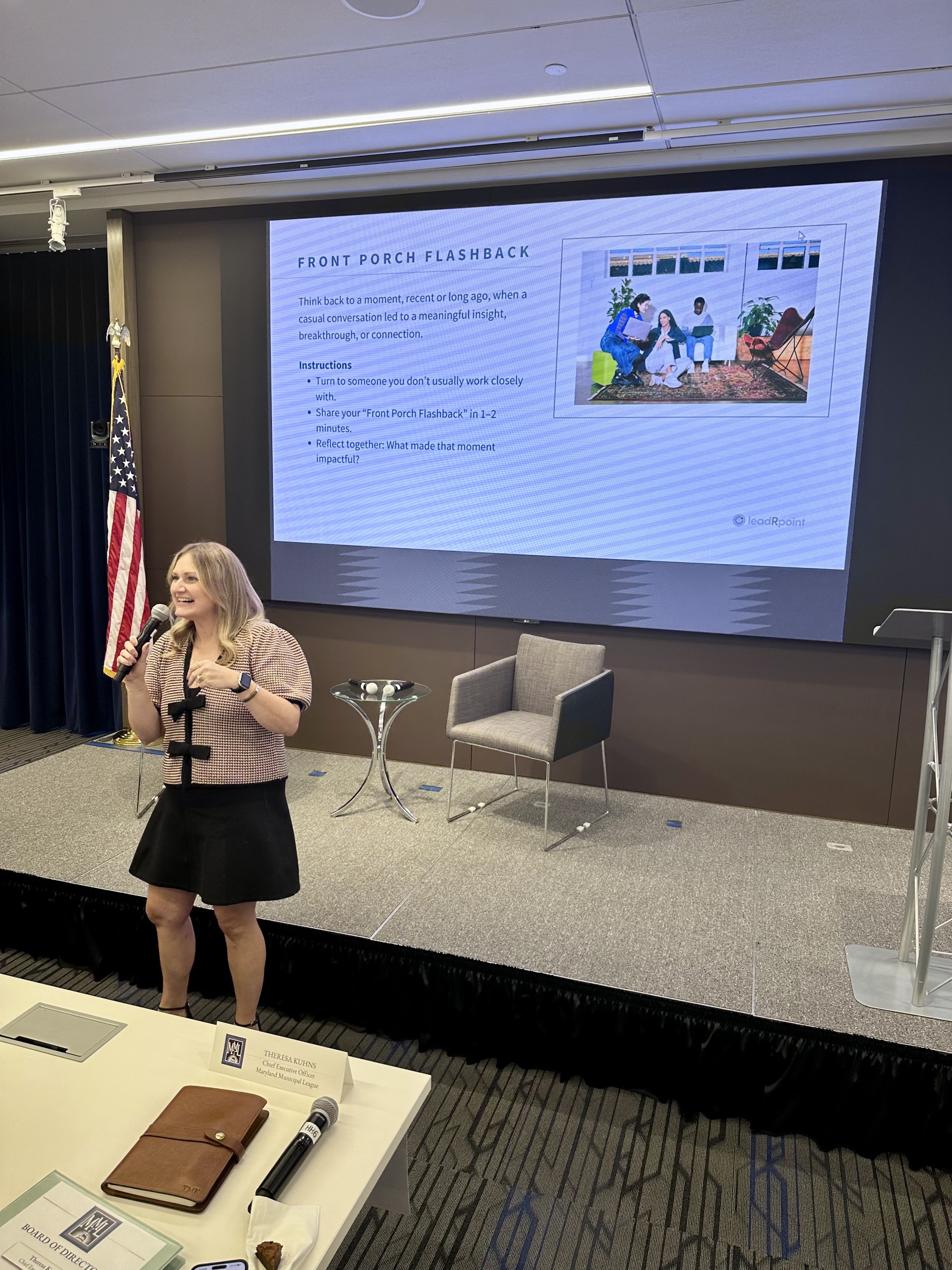
According to Merriam-Webster, civility is defined as "formal politeness in courtesy and speech." When I was given the opportunity to provide training on civility to a group of municipal leaders in Maryland, I felt a moment of hesitation. This hesitation did not stem from the topic's importance, which is highly relevant in today's workplace and political climate, but from the abstract nature of the concept and its varied interpretations among individuals.
Moreover, delivering insights on civility just days after an election, when attendees were likely experiencing a range of emotions, posed a significant challenge. The National League of Cities released its 2024 Incivility Survey results, revealing that nearly three in four respondents had experienced harassment. Encouraging a room full of leaders, who were dealing with post-election fatigue, to maintain an open mind and believe in the possibility of achieving civic harmony through engaging in difficult conversations required careful consideration and a strategic approach.
A nod to Atomic Habits by James Clear: Identifying myself as a civic-minded member of society, I pondered what consistent actions I could take to pave the way toward civic harmony. My solution was to create safe spaces for difficult conversations and equip attendees with the necessary tools to do the same. As the saying goes, "Go forth and multiply."
At the beginning of the presentation, I shared a quote by Jeffrey Alexander: "The discourse of civil society can be as repressive as liberating, legitimating not only inclusion but exclusion." I emphasized that understanding and addressing these challenging discussions is crucial for fostering an inclusive environment. This approach requires recognizing that the civil discourse we aim to cultivate can sometimes inadvertently validate exclusionary practices. Thus, it becomes essential to navigate these conversations with both sensitivity and firmness.
Upon presenting the quote, a participant raised their hand and said, "I am not sure I believe that statement." As the participant spoke further, they identified fringe conversations, specifically those involving hate speech, that should not be given breath. The participant had a valid concern. Progress, however, lies in the ability to engage in difficult conversations. You are not likely to change a person's mind in just one meeting, but over time, small actions can lead to more harmonious council meetings and other positive outcomes.
As the discussion continued, it became evident that truly fostering civil discourse required concrete actions and practical strategies. The aim was not only to acknowledge the validity of diverse perspectives but also to implement actionable steps that would lead to more harmonious civic engagement. This collaboration led to the development of several practices designed to cultivate civility and encourage constructive dialogue among municipal leaders and community members alike.
- Model the behavior you want to see and consider how you engage with people who do not share your views. Let the public see you getting along.
- During a meeting where someone is presenting an unpopular idea, give that person space by implementing the "like this idea for five minutes" rule.
- Redirect difficult conversations using "I" statements, such as "I think," "I feel," or "I believe."
- Tell stories to personalize your perspective, explain why you feel a certain way, and remain open-minded and curious about others' viewpoints while avoiding assumptions.
- Establish clear and consistent meeting norms tailored to various scenarios. This should involve setting expectations for participation, communication, and follow-up actions to ensure productive and efficient meetings.
Although these actions are minor, when implemented consistently, they can promote civility. This list is not exhaustive, so I encourage you to consider additional small actions you can take to contribute to the collective effort to create more harmonious communities.
Resources
Books
- Boatright, Robert, et al., editors. A Crisis of Civility? Political Discourse and Its Discontents. Routledge, 2019.
- Clear, James. Atomic Habits: An Easy & Proven Way to Build Good Habits & Break Bad Ones. Avery, 2018.
- Forni, P. M. The Civility Solution: What to Do When People Are Rude. St. Martin's Press, 2008.
Websites
- SHRM. "Promoting Civility in the Workplace." Society for Human Resource Management, 2024. https://www.shrm.org/topics-tools/tools/express-requests/promoting-civility-in-the-workplace
- NLC. "How the Upcoming Election Is an Opportunity to Improve Local Civil Discourse." National League of Cities, 2024. https://www.nlc.org/article/2024/10/30/how-the-upcoming-election-is-an-opportunity-to-improve-local-civil-discourse/
Join Influential Women and start making an impact. Register now.