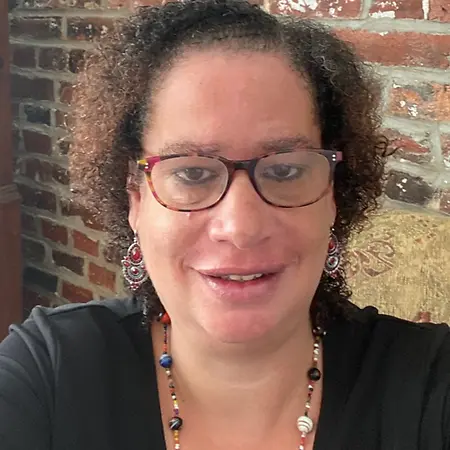
Her Story
About Teresa
Teresa Leslie is a research associate at University of Maryland and the Northeast regional coordinator for a national sustainable agriculture research program funded by the United States Department of Agriculture National Institute of Food and Agriculture. With more than 30 years of interdisciplinary experience, Leslie has built a career that bridges anthropology, public health, agriculture, and food systems. Trained originally as an anthropologist, she developed a systems-thinking approach early in her career, recognizing the importance of understanding how social, environmental, and scientific factors intersect to influence human health and sustainability.
Leslie began her professional journey in public health, focusing on infectious and vector-borne diseases, which led her to work internationally and gain firsthand experience in global health challenges. Determined to understand every aspect of the work, she expanded her expertise beyond anthropology by developing laboratory and technical research skills to complement her field experience. While living on a small island overseas, she became increasingly aware of the vulnerabilities of imported food systems and the direct relationship between food access, agriculture, and public health. That realization guided her transition into sustainable agriculture and food systems research, where she found a natural extension of her public health background rather than a departure from it.
Today, Leslie oversees a multi-million-dollar regional program that supports research and innovation in sustainable agriculture throughout the Northeast United States. In her leadership role, she manages a staff of approximately 14 people while collaborating with researchers, farmers, policymakers, and international partners to advance resilient food systems. She remains actively engaged in research and professional collaboration to stay current in the field, frequently participating in conferences and global discussions on sustainability. In addition to her professional work, Leslie serves as president of the Ivy Creek Foundation board in Virginia, reflecting her longstanding commitment to environmental stewardship, community engagement, and practical solutions that connect human and ecological health.
Her Interview
Ten minutes with Teresa
01What do you attribute your success to?
I attribute my success to my ability to change gears and shift focus, especially when I see a need. It's hard for me to say there's one notable experience because they all add up. It's cumulative, so sometimes you realize what am I doing, where am I going, and then all of a sudden you realize that the skills you got from something you did, you can apply to something else. When I made a decision that I really wanted to focus on sustainable agriculture and its relationship to health, the fact that I'm actually working in that now, I think, is a notable achievement. It means that you can shift gears if you put in the time and you do the work. I come across a lot of younger people who just want to say they have a role, and I have to say, you have to do the work. You can't just say you have the role and not do the work. You have to learn, you have to make mistakes, and sometimes you will fail, but you learn from that. I also have a great education that I received at Howard University, University of South Carolina, and University of Massachusetts Amherst. I absolutely love what I do and have a great team. I'm also writing books, which allows me to explore topics I'm passionate about, like history.
02What’s the best career advice you’ve ever received?
You can have a successful career and be able to make a difference.
03What advice would you give to young women entering your industry?
You have to do the work. You can't just say you have the role and not do the work. You have to learn, you have to make mistakes, and sometimes you will fail, but you learn from that. I come across a lot of younger people who just want to say they have a role, but you have to put in the time and do the work. Your achievements add up over time, and it's cumulative. Sometimes you realize what am I doing, where am I going, and then all of a sudden you realize that the skills you got from something you did, you can apply to something else. You can shift gears if you put in the time and effort.
04What are the biggest challenges or opportunities in your field right now?
It's a very difficult time right now. Generally, when a new administration comes in, you expect changes, but these days, the pendulum just swings so far in directions that it gets difficult to find grounding or footing. However, we have a great program, and because we are funded by USDA NIFA, which is National Institute of Food and Agriculture, we have support from our NIFA colleagues as well. The work we do in sustainable agriculture is important because we facilitate people to do research, and you really stay current with a lot of the important things that are going on in sustainable agriculture.
05What values are most important to you in your work and personal life?
Family is very important to me. I have 3 sons, and I just love spending time with them, even though they're adults now and have their own lives. When the family does get together, we enjoy each other, even if it's for a shorter amount of time. In my work, I'm very much a systems thinker, so I need to think about all parts and understand the full breadth of what's going on. I believe in doing the work, putting in the time, learning from mistakes, and being able to shift gears when you see a need. I also value my writing, which allows me to explore topics I'm passionate about, like history. I'm currently writing a book about the land that was purchased by my great-great-grandfather 20 years after he was emancipated, which is now the Ivy Creek Foundation nature preserve. I also like walking my dog.
Join Influential Women and start making an impact. Register now.