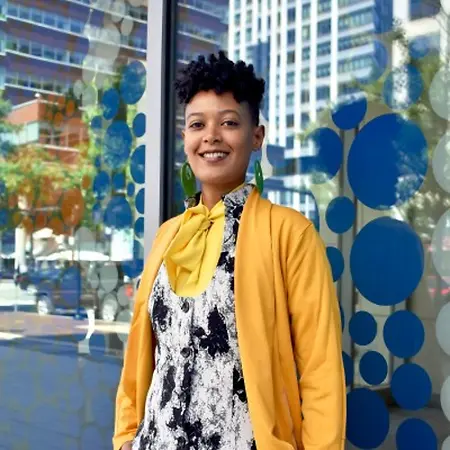
Her Story
About Tigist
I have always been interested in science and mathematics, though I just didn't know exactly what scientists did. When I started my undergraduate work, I actually met a grad student named Gretchen McConnell who was doing research in biology, and I was super fascinated by it. She saw that I was super interested and that I actually had a knack for the research side of science, so I got an internship position, and after that, it was just a match made in heaven. I've been doing that ever since. I did my grad school in pharmacology for like 6 years, and then I did a postdoc for another 5 years, and now I'm currently faculty. I specifically focus on studying how metabolism is regulated, using a lot of biochemistry and computational biology approaches and systems biology. My focus is especially understanding how metabolism is altered or corrupted in different types of diseases, like obesity and cancer, trying to understand the molecular events that could be informative for treatment. I've had phenomenal mentors that have made my journey much more successful than if it was on my own, including Gretchen McConnell who gave me the opportunity to do research early in my training, and my postdoctoral advisor, Dr. Forrest White, who believes in not letting yourself get bogged down by limits and really thinking outside of the box and doing the right thing and the right science.
Her Interview
Ten minutes with Tigist
01What do you attribute your success to?
Outside of excellent mentorship and people being in my corner, I think tenacity and being able to persevere is a big part of my success. I think there are moments, and there still will be and are moments where I find it challenging to continue the work and face the everyday versus the long-term complications of just being in this career, and I feel like finding ways to persevere has really made a big dent in how I view myself in the future, how I ensure that my trainees and my peers persevere and still make it through the current challenge. So I think perseverance is like a key part of my success. With that perseverance comes forgiving yourself, because I think most of the time when people say you persevere through, it doesn't mean that you're powering through the whole time, but recognizing that I'm having a very hard time right now, I'm gonna give myself a moment to recognize the challenge and find the way out, because I feel like sometimes we feel like we're not supposed to recognize that something is difficult. I think recognizing that helps you persevere.
02What are the biggest challenges or opportunities in your field right now?
In the next 5 years, I'm hoping to make an impactful contribution in metabolism research and identify ways we can incorporate diet-based treatments for things like obesity and diabetes, but also find ways to tackle resistance to therapy in cancer. There's a huge link between obesity and cancer now, and my goal is to try and find ways that we can outsmart nature, because our bodies, usually when in cancer or diseases, our body's processes are a little bit used against us. I'm trying to figure out how nature does that, and to try and tackle that before patients become resistant to therapy.
03What values are most important to you in your work and personal life?
I think, for me, community is like a big part of success. I kind of seek that and establish that in every aspect of my life. So in my professional environment, I make sure that me and other junior faculty get to interact and help each other out, because we're all just learning this job. And then in my personal life, same thing. I always want to make sure that I have a community supporting me, and that I support them, and that we're there for each other, because I think that is what makes us unique. That's what helps us succeed in life.
Join Influential Women and start making an impact. Register now.