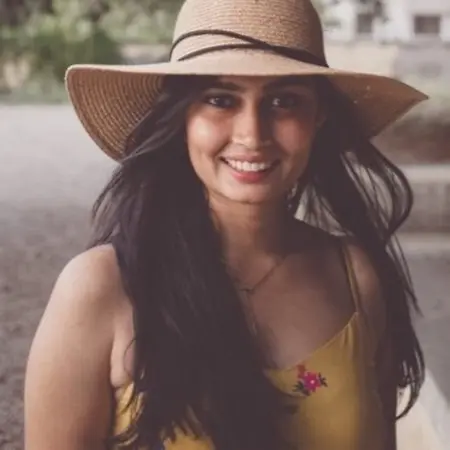
Her Story
About Vrunda
Multifaceted and motivated UX/ Visual Designer with 5 years of experience defining product experiences, increasing user engagement, and optimizing product usability, across multiple business verticals. A highly versatile and creative leader with expertise in visual design, layout, and information architecture. Skilled in user-centered design methodologies, designing for scale, and delivering high-quality concepts. Ability to continuously develop innovative designs to meet project deliverables, evolve product strategies, and deliver outstanding user experiences.
Her Interview
Ten minutes with Vrunda
01What do you attribute your success to?
I attribute my success to a combination of resilience, curiosity, and a strong commitment to continuous learning. Navigating different countries, roles, and constraints has taught me to adapt quickly and turn setbacks—such as visa challenges—into opportunities to upgrade my skills and broaden my perspective. I’m deeply curious by nature, which drives me to stay current with evolving design practices, invest in formal certifications, and experiment with new tools and technologies. At the same time, I bring a disciplined, user-centered mindset to every project, balancing creativity with structure so that my work not only looks good but genuinely solves problems. Above all, I credit the mentors, colleagues, and teams I’ve worked with, who have challenged me, trusted me with responsibility, and helped me grow as both a designer and a leader.
02What’s the best career advice you’ve ever received?
The best career advice I’ve ever received is to treat every transition—planned or unplanned—as a design problem, not a dead end.
That advice has shaped how I navigate my path. When I moved between countries, shifted from visual design to UX, or faced visa-related setbacks, I was encouraged to step back, understand the constraints, and “redesign” my next step instead of seeing it as failure. It taught me to ask: Who are the users here (my future self, employers, customers)? What are the real needs and constraints? What small prototype can I try next—whether that’s a new certification, a freelance project, or a different role?
Alongside that, another piece of advice that’s stayed with me is to keep investing in your skills even when no one is watching. That mindset is what led me to pursue a Master’s degree, add UX certifications, explore new tools, and keep refining my craft through volunteer work and side projects. It’s a reminder that careers aren’t linear; they’re built through continuous learning, curiosity, and the willingness to keep designing your own path forward.
03What advice would you give to young women entering your industry?
Own your perspective
Your background, culture, and lived experiences are a strength, not something to “tone down.”
Design is about seeing the world differently, and your unique point of view will help you notice problems others overlook and create more inclusive solutions.
Invest in your skills, not just titles
Focus on building a strong foundation in visual design, UX principles, and research methods rather than chasing the “perfect” job title right away.
Take courses, seek feedback, ship real projects (even small ones), and keep a record of your work—your skills and portfolio will open doors, even when your path is non-linear.
Advocate for yourself and your boundaries
Don’t be afraid to ask questions, negotiate, or say “I don’t know yet, but I’ll find out.”
Set clear boundaries around your time and energy, seek mentors who respect you, and surround yourself with communities—especially other women in design—who will amplify your voice rather than minimize it.
04What are the biggest challenges or opportunities in your field right now?
Challenge: AI and automation
AI is reshaping how products are designed, tested, and shipped, and a lot of decisions are increasingly driven by algorithms, templates, and growth metrics rather than thoughtful UX. Designers risk being pushed into “pixel pushing” or oversight roles if they don’t stay close to strategy and learn how to design responsibly with (and around) AI tools.
Opportunity: Human-centered design in fintech and AI
In areas like fintech, there’s a growing need for UX designers who can make complex systems—like lending, credit, or savings—feel transparent, fair, and humane. Designers who understand users’ real constraints, can communicate clearly, and can collaborate with engineers and business teams are in a strong position to shape how AI and financial products impact people’s lives.
Challenge: Keeping experiences inclusive and ethical
As products scale globally, expectations around accessibility, inclusivity, privacy, and trust are much higher. Women and other underrepresented groups in UX still face bias, wage gaps, and underrepresentation in leadership, which affects whose perspectives shape the final products.
Opportunity: Deep craft plus continuous learning
Because the field is evolving so quickly, designers who keep building their skills—through certifications, new tools, and diverse projects—have a real edge. There’s room for people who are versatile across visual design, UX, and research to lead end‑to‑end experiences rather than just one narrow slice of the process.
05What values are most important to you in your work and personal life?
The values that matter most to me—both in my work and my personal life—are curiosity, integrity, empathy, and resilience.
In my work, curiosity shows up as a constant desire to learn, experiment, and improve, whether that’s exploring new design tools, understanding emerging technologies like AI, or learning from users and teammates. Integrity means doing what’s right even when it’s not the easiest path—being honest about constraints, advocating for ethical and inclusive design decisions, and following through on commitments. Empathy is at the heart of UX and visual design: listening carefully, understanding people’s contexts, and creating experiences that feel respectful, intuitive, and human. Resilience ties it all together; careers and life paths are rarely linear, so I value the ability to adapt, turn setbacks into opportunities for growth, and keep moving forward with purpose and optimism.
Join Influential Women and start making an impact. Register now.