30 Years Later, Google Knows Her Name
How a Decades-Long Career Finally Became Visible: The Story Behind the Google Knowledge Panel

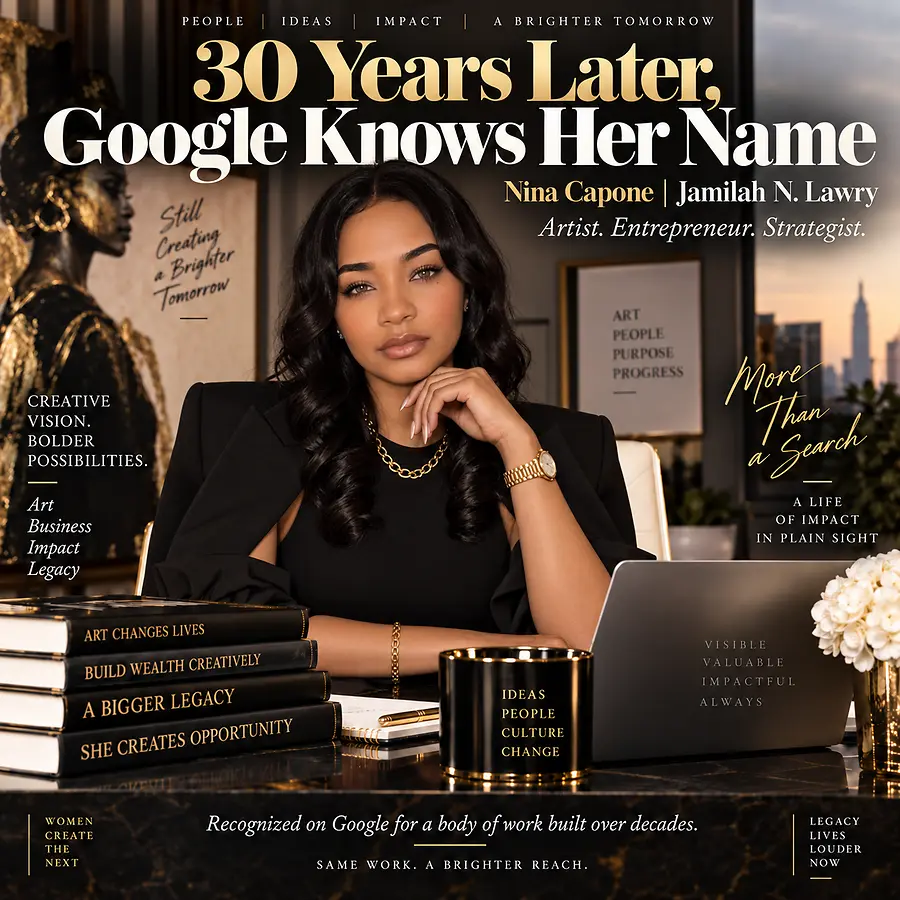
For years, Nina Capone was the name I carried into rooms before people ever knew Jamilah N. Lawry. It was the name attached to music, interviews, radio, performances, conversations, ideas, risks, mistakes, reinvention, and more than three decades of work. So when Google recognized Nina Capone with a Knowledge Panel, I understood immediately that this was bigger than seeing my name on a screen. It was a digital acknowledgment that the body of work had become identifiable.
There is something interesting about building a name before the internet fully understood how to document people. Artists from my generation did not begin with algorithms, blue checks, streaming dashboards, and perfectly optimized biographies. We built reputations in real rooms. We passed CDs hand to hand. We worked radio. We performed. We networked. We created relationships. We kept going even when there was no digital system keeping score.
Then the World Changed.
Suddenly, everything became searchable. Your history became data. Your relevance became links. Your credibility became something search engines attempted to understand through websites, interviews, music platforms, databases, press mentions, social profiles, and consistent information spread across the internet.
That is what makes this moment meaningful to me.
A Google Knowledge Panel is not an award, and it does not magically validate every decision I have ever made. What it does represent is recognition of an entity. Google has gathered enough information from across the web to understand that Nina Capone is not simply a username, random stage name, or temporary social media identity. It connects the name to a real person and an established body of work.
For an independent artist, that matters.
Independent artists spend years building without the infrastructure major entertainers often have behind them. There may be no massive public relations department cleaning up your search results, no corporate label feeding information into databases, and no team making sure every website tells the same story. A lot of us have had to learn how to become the artist, marketer, archivist, strategist, publisher, and business owner at the same time.
My journey became even more complicated because Nina Capone and Jamilah N. Lawry eventually grew into two powerful professional identities. Nina Capone became the artist and media personality. Jamilah N. Lawry became the entrepreneur, consultant, strategist, and businesswoman. For a long time, I kept those worlds separated. I thought professionalism required me to put one identity away whenever I stepped into the other.
I No Longer Believe That.
They are not competing identities. They are chapters of the same story.
The creativity that built Nina Capone helped build the strategist. The business lessons I learned navigating entertainment strengthened the consultant. The technology, branding, marketing, and operational knowledge I developed as Jamilah made me better at understanding the business behind Nina Capone. One did not distract from the other. They developed together.
That is why seeing Google begin to connect and understand the Nina Capone identity feels different at this stage of my life. It represents something I believe many creators eventually learn: visibility is cumulative.
People often look at a moment of recognition and assume something happened overnight. They see the panel, article, interview, award, viral moment, or opportunity. What they do not see are the years when almost nobody was watching. They do not see the projects that did not work, the websites that had to be rebuilt, the music released before streaming became dominant, the relationships that disappeared, the industries that changed, or the decision to continue creating when walking away would have been easier.
Digital Authority Works Much the Same Way.
Google does not know your sacrifices. It understands signals.
Consistent names. Reliable sources. Structured information. Official websites. Music catalogs. Profiles. Articles. Interviews. Credits. Databases. Connections between entities. Over time, those signals create a digital footprint strong enough for technology to recognize that a person has an established presence.
There is a lesson in that for every entrepreneur, artist, author, consultant, and creator building a personal brand today: document your work.
Do not assume people will remember everything you have done. Do not allow your entire career to exist only on social media platforms you do not own. Build your website. Publish your biography. Archive your accomplishments. Connect your professional identities. Make sure your name, work, and history are represented accurately across credible platforms.
Your digital footprint eventually becomes part of your legacy.
For me, the Nina Capone Knowledge Panel is not the finish line. If anything, it feels like Google finally caught up to a story that was already being written.
And maybe that is the part I appreciate most.
I did not create Nina Capone hoping a search engine would recognize her one day. I created her because I had something to say. I kept developing her because music and media became part of how I expressed myself. Years later, technology simply found enough evidence to confirm that she had been here all along.
There is something powerful about that.
Sometimes recognition does not arrive when you first deserve it. Sometimes it arrives after the work has had enough time to leave receipts.
Nina Capone has receipts.
And now, apparently, Google does too.