5 Public Speaking Mistakes That Make People Stop Listening
How to Stop Being the Smartest Person in the Room and Start Getting Results

Here is the corrected version. I've preserved the author's conversational style, humor, emphasis, and overall structure while making minor grammar, punctuation, and sentence-structure corrections.
You can be the smartest person in the room and still lose the room.
I've seen it happen to startup founders convinced they've created the next billion-dollar idea. I've watched newly promoted leaders become so focused on proving they deserve their titles that they forget about the people they're supposed to lead. And I've sat through presentations delivered by brilliant experts who somehow managed to make fascinating subjects painfully boring.
And it's not just inexperienced entrepreneurs. I've watched seasoned consultants, trainers, and facilitators fall into the same trap. They assume that if they deliver an exceptional lecture packed with expertise, the audience will naturally be impressed.
Except that's not always what happens.
People disengage. Eyes glaze over. Someone starts checking their phone. The energy slowly drains out of the room.
The presenter keeps going, convinced they're delivering tremendous value.
Meanwhile, the audience is mentally planning dinner.
Now, fair warning. This article might come with a little more attitude than you're used to hearing from me.
I'm generally the person who looks for the good, celebrates people's strengths, and finds ways to encourage them. And I still believe in all of that.
But after years of coaching, speaking, facilitating, and watching some of the same mistakes play out over and over again, I've developed a few pet peeves.
And I've reached a point where I think we could all benefit from a little less sugarcoating.
I've always believed that clarity is kindness. Sometimes that means saying the thing people need to hear, even when it's not wrapped in a pretty bow.
So let's stop beating around the bush and talk about what actually matters when you're standing in front of an audience.
Here's the uncomfortable truth.
Nobody owes you their attention just because you know your stuff.
And before you think I'm pointing fingers, let me tell you about the time I needed that exact reminder myself.
A Reality Check. Literally.
I recently competed on Season 25 of The Blox, an entrepreneurial reality competition, alongside my MenoPalz co-founders.
I walked in feeling pretty damn confident.
Two TEDx talks. Speaking at Harvard. Years of coaching executives and teaching leaders how to communicate. I knew how to pitch. I knew my material.
And frankly, I expected to win.
I even had my poker face ready. I was going to be cool, collected, and strategic.
Then Day 2 happened.
No red jersey. No top-performer recognition.
And a pretty uncomfortable realization.
I was spending too much energy trying to look like the person who should win instead of showing up as the person who could actually connect with the audience.
I hate to admit that my ego had gotten in the way.
The irony? I've spent years teaching people that presence matters more than polish.
And there I was, polishing the hell out of my presence.
So I made a shift.
I stopped worrying about looking impressive and started focusing on what the judges needed to understand, what would make our message memorable, and how to bring my own personality into the room.
On Day 3, we took first place in our pod and first place overall for the day. I earned that red jersey.
We were ultimately named the Season 25 winners.
Was the change in my approach the only reason for those results? Of course not. My co-founders and I worked hard, made strategic decisions, and learned from the experience.
But I know what changed for me.
I stopped performing confidence and started communicating with purpose.
And it reinforced five mistakes I see people make all the time.
Mistake #1: Making It About Yourself
Let's talk about ego.
And no, I'm not just talking about arrogance.
Ego also shows up when you're terrified of public speaking. It can sound like this:
What if I forget my words? What if I look nervous? What if they think I'm stupid? What if I mess up?
Notice anything about these questions?
Every question is about you.
Now, I'm not dismissing speaking anxiety. It's real, and I've coached plenty of people through it.
But when you're so consumed with how you're being perceived that you forget why you're speaking, you've made yourself the center of a conversation that should be about your audience.
The same thing happens when you're overly confident.
You spend your time demonstrating how knowledgeable you are instead of figuring out what people need from you.
Two very different behaviors. Same underlying problem.
You're focused on yourself instead of the people you're trying to reach.
Here's the fix: Before you prepare your presentation, answer three questions.
Who am I speaking to? What do they care about? What do I want them to think, feel, or do differently?
If you can't answer those questions, you're not ready to build your presentation.
And yes, sometimes getting over yourself is the best speaking advice you'll ever receive.
Mistake #2: Confusing Expertise With Value
I've seen entrepreneurs fall completely in love with their own ideas.
They know every feature. Every detail. Every reason their business is brilliant.
And they can't understand why customers aren't lining up.
Here's why.
Your passion for your idea doesn't automatically make it valuable to someone else.
The same goes for public speaking.
Your audience doesn't need a complete download of everything you've learned over the past 20 years.
They need the part that's relevant to them.
I learned something about this long before I ever stepped onto a professional stage.
My father was a federal judge, and growing up around him taught me a great deal about the importance of clarity, precision, and getting to the point.
When you're trying to make a compelling argument, more words don't necessarily make it stronger. In fact, unnecessary information can bury the very point you're trying to make.
The strongest argument isn't always the longest or most elaborate. It's the one people can understand, follow, and evaluate.
That lesson has stayed with me throughout my career.
Clarity isn't about dumbing down your message. It's about respecting your audience enough to make it understandable.
I've watched speakers spend the first ten minutes establishing their credibility through an endless parade of credentials, accomplishments, and professional milestones.
I get it. Credibility matters.
But your résumé and your life story aren't the presentation.
Give people enough context to trust you, then get to the good stuff.
Here's the fix: For every major point you plan to make, ask yourself, "So what?"
Why should the audience care?
What does this help them understand, solve, or accomplish?
If you can't answer that, either make the connection or cut the content.
Your expertise earns you the opportunity to contribute.
Your ability to make that expertise useful earns you the audience's attention.
Mistake #3: Being Informative but Painfully Boring
Can we please stop pretending that delivering information is the same thing as delivering a good presentation?
It's not.
You can have impeccable research, beautiful slides, and a perfectly organized message.
And still bore the hell out of everyone.
I've seen this repeatedly throughout my career, particularly with experienced consultants and facilitators who are incredibly knowledgeable about their subjects.
They walk into a room with a wealth of information and genuinely believe that delivering a brilliant lecture is enough.
And to be fair, the information may be excellent.
But there's a difference between delivering content and creating an experience where people actually learn.
I've watched presenters continue talking while the room slowly loses energy. Participants stop engaging. The questions disappear. People shift in their seats, glance at the clock, and start counting down until the next break.
And sometimes the facilitator doesn't even notice.
They're so focused on delivering everything they've prepared that they've forgotten to pay attention to the people sitting in front of them.
That's not a content problem.
That's a connection problem.
One of my favorite concepts in speaking is edutainment.
Education plus entertainment.
And no, that doesn't mean you need to become a stand-up comedian or perform a choreographed dance across the stage.
It means understanding that people need a reason to stay engaged.
They want stories. Humor. Relatable examples. A little surprise. Something that makes them think, laugh, or see an idea differently.
They want to feel like they're part of the experience, not trapped in a lecture.
I use humor and storytelling when it makes sense because they both help me connect with people. Not because I need to be the entertainment, but because I want the message to stick.
And that's an important distinction.
Edutainment isn't about making yourself the show. It's about making the learning experience worth showing up for.
Here's the fix: Look at your next presentation and identify where you can create a moment of engagement.
Can you replace a data-heavy slide with a story?
Can you ask a provocative question?
Can you use an unexpected comparison to make a complicated idea easier to understand?
Can you make people laugh at something they recognize in themselves?
And most importantly, can you read the room well enough to know when something isn't landing?
Because great facilitators don't just deliver content.
They pay attention to what's happening with the people receiving it.
You don't need to entertain every second.
But you do need to earn the next few minutes of their attention.
Mistake #4: Practicing Perfection Instead of Connection
This one hits close to home.
Because it's exactly what I caught myself doing on The Blox.
I was trying to look composed. Strategic. Confident.
I was managing how I wanted to be perceived.
And it was getting in the way of how I naturally communicate.
Here's something I've learned after years of speaking and coaching others.
People don't need you to be perfect.
They need you to be present.
Yet I still see speakers memorizing every word, obsessing over every gesture, and rehearsing their presentations until they sound like they're reading from an invisible teleprompter.
Then they get in front of an audience, forget one sentence, and panic.
Why?
Because they practiced a script instead of learning how to communicate a message.
Here's the fix: Know your opening. Know your key points. Know your transitions. And know exactly where you want the audience to land.
Then practice delivering those ideas naturally.
Record yourself. Get feedback. Practice recovering when something doesn't go as planned.
And leave enough room for your personality to show up.
A little imperfection can make you more relatable.
Presence over polish. Every time.
Mistake #5: Forgetting That Speaking Is Supposed to Accomplish Something
This might be the most expensive mistake of all.
People spend weeks preparing presentations without ever getting clear about what they want the presentation to accomplish.
They want to sound confident.
They want to look professional.
They want people to like them.
Okay.
But what do you want the audience to do?
Think about it.
An entrepreneur pitches a business because they want someone to invest, buy, partner, or believe in the opportunity.
A leader communicates a vision because they want people to understand it and move in the same direction.
A professional presents an idea because they want someone to consider it, support it, or make a decision.
Even an inspirational keynote should leave people with something worth thinking about or acting on.
That's the point.
Speaking isn't about how well you perform. It's about what happens because you spoke.
Here's the fix: Before you prepare anything, finish this sentence:
"When I'm done speaking, I want my audience to ______."
Be specific.
Then build your message backward from that outcome.
What do they need to understand?
What objections or questions might they have?
What examples will help them connect the dots?
What will make the message memorable?
And what clear next step should they take?
If your presentation doesn't support that outcome, you're probably spending time on the wrong things.
The Best Speaking Advice I Can Give You? Get Over Yourself.
I say that with love.
And apparently, I needed to hear it myself.
My experience on The Blox was a pretty humbling reminder that knowing something and consistently practicing it are two different things.
I've spent years teaching people to communicate with authenticity, connect with their audiences, and stop confusing polish with presence.
Then I walked into a competition, put on my best poker face, and briefly forgot my own advice.
Go figure.
But that's also what I love about learning.
Sometimes the lesson isn't something new.
Sometimes it's something you already know that you need to start doing again.
So whether you're an entrepreneur pitching your next big idea, a leader trying to inspire your team, or a professional preparing for an important presentation, remember this:
Stop trying to prove you're the smartest person in the room.
Stop making your nerves the center of the universe.
Stop hiding behind your credentials.
And please, stop making people sit through presentations that exist solely to demonstrate how much you know.
Instead, understand your audience. Give them something valuable. Make the experience engaging. And communicate with a purpose.
Because nobody cares how impressive you are if they can't figure out why it matters to them.
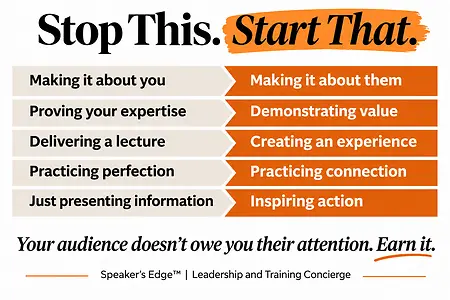
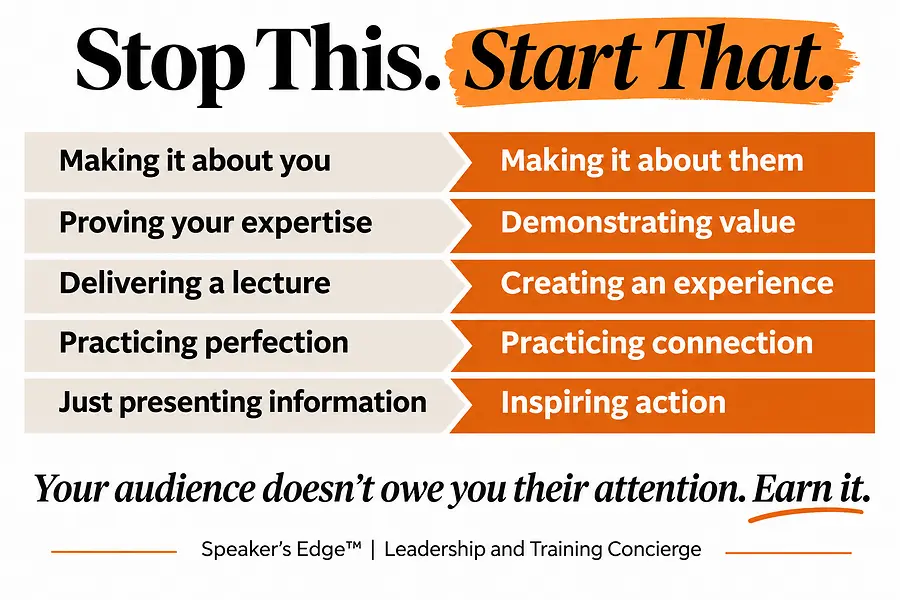
Your audience doesn't owe you their attention. You have to earn it.
And when you finally stop making it about yourself?
That's when people start listening.
Morgan Massie is the founder and CEO of Leadership and Training Concierge, a two-time TEDx speaker, executive coach, author, and co-founder of MenoPalz. Through her Speaker's Edge™ programs, she helps entrepreneurs, leaders, and professionals develop the skills to communicate with clarity, engage audiences, and inspire action. www.morganmassie.com

Morgan Massie is a leadership development strategist and CEO of Leadership and Training Concierge, serving organizations and entrepreneurs globally. With over 20 years of experience, she is a TEDx speaker, bestselling author, and Forbes contributor recognized for translating leadership challenges into actionable solutions. Morgan champions women's advancement through board service at She Means Business and as Chief…