AI Report, Inflation Provoke Rocky Week
Stock market declines amid AI concerns and rising wholesale inflation pressures.


 Stocks fell last week amid concerns about artificial intelligence (AI) and a warmer-than-expected reading of wholesale inflation.
The Standard & Poor’s 500 Index fell 0.44 percent, while the Nasdaq Composite Index declined 0.95 percent. The Dow Jones Industrial Average dropped 1.27 percent. The MSCI EAFE Index, which tracks developed overseas stock markets, rose 1.22 percent.1,2
AI Disruption
Markets began the week under pressure as investors’ fears of AI disruption spread to a wide variety of industries. On Monday, a new research report circulated across trading floors, suggesting that AI could influence the broader economy and affect the unemployment rate.3
Stocks bounced back over the next two sessions as investors saw opportunity in an oversold AI trade. The relief rally included software and cybersecurity stocks, as well as AI-related technology shares more broadly. The rally gained momentum, spurred on by a prominent AI chipmaker, as investors eagerly awaited its Q4 corporate report. Investors pushed all three major averages higher over both days.4
But markets resumed their decline over the final two trading days of the week. The Dow Industrials fell more than the other two major averages, both on Friday and for the week. The Dow’s weakness was notable given that it still leads the S&P 500 and Nasdaq year to date.5
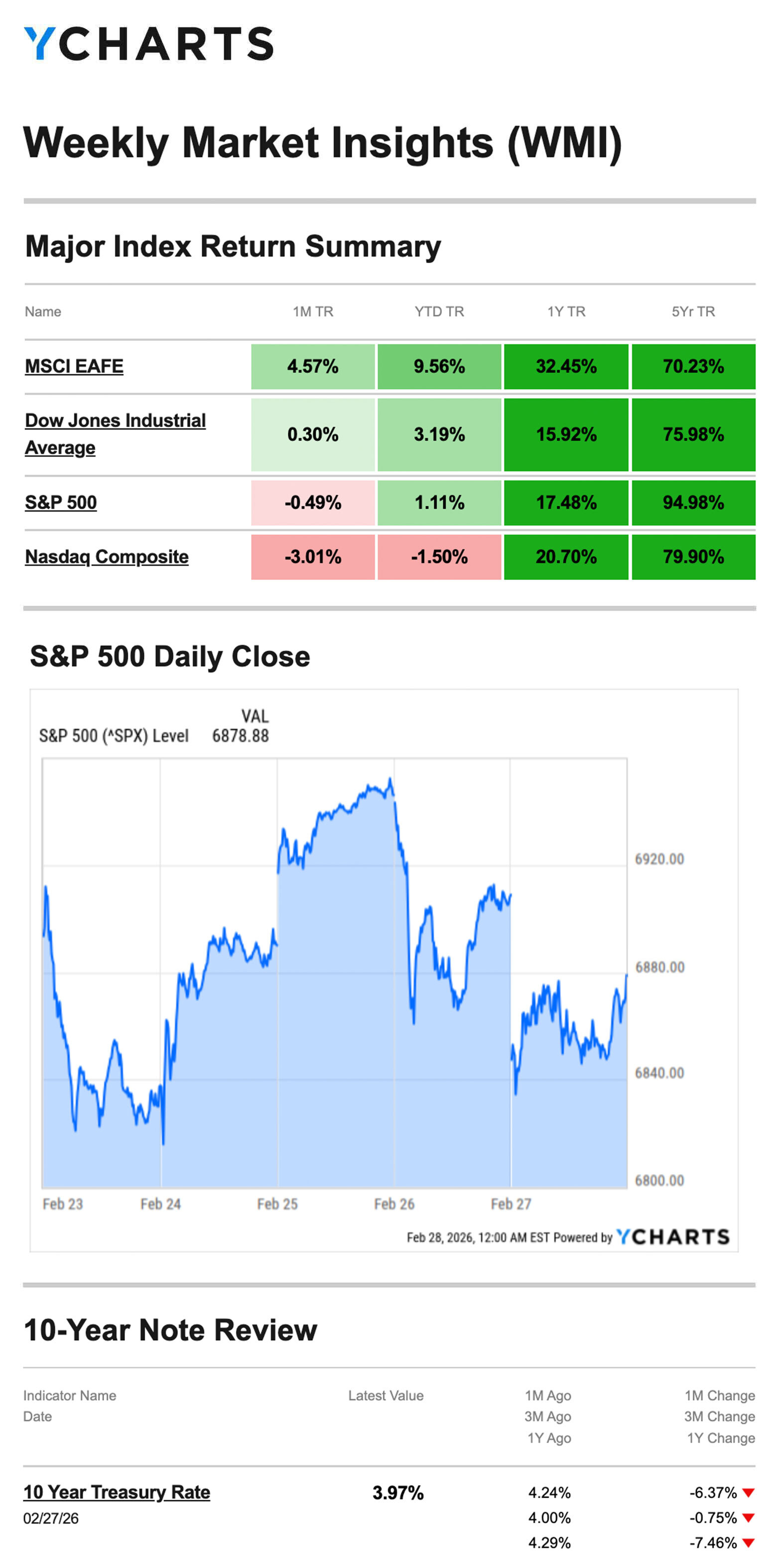
Source: YCharts.com, February 28, 2026. Weekly performance is measured from Monday, February 23, to Friday, February 27. TR = total return for the index, which includes any dividends as well as any other cash distributions during the period. Treasury note yield is expressed in basis points.
Wholesale Inflation Rises
Friday’s shutdown-delayed Producer Price Index (PPI) report showed that wholesale inflation rose 0.5 percent in January over the prior month. Economists expected prices to rise by 0.3 percent.6
PPI measures the costs for businesses, and some fear that if it costs businesses more to make a good or deliver a service, those costs might get passed on to consumers. Investor concerns often rise whenever an inflation report shows prices rising faster than the Fed’s 2 percent target.
This Week: Key Economic Data
Monday: PMI — Manufacturing. ISM Manufacturing. Auto Sales.
Tuesday: Fed Presidents John Williams (New York) and Neel Kashkari (Minneapolis) speak.
Wednesday: ADP Employment Report. PMI — Services. ISM Services. Fed Beige Book.
Thursday: Weekly Jobless Claims. Q4 Productivity. Import Prices.
Friday: Federal Employment Report. Cleveland Fed President Beth Hammack speaks.
Source: Investors Business Daily - Econoday economic calendar; February 27, 2026. The Econoday economic calendar lists upcoming U.S. economic data releases (including key economic indicators), Federal Reserve policy meetings and speaking engagements of Federal Reserve officials. The content is developed from sources believed to provide accurate information. The forecasts or forward-looking statements are based on assumptions and may not materialize. The forecasts are also subject to revision.
This Week: Companies Reporting Earnings
Tuesday: CrowdStrike (CRWD)
Wednesday: Broadcom Inc. (AVGO)
Thursday: Costco Wholesale Corporation (COST), Marvell Technology, Inc. (MRVL)
Source: Zacks, February 27, 2026. Companies mentioned are for informational purposes only. It should not be considered a solicitation for the purchase or sale of the securities. Investing involves risks, and investment decisions should be based on your goals, time horizon and risk tolerance. The return and principal value of investments will fluctuate as market conditions change. When sold, investments may be worth more or less than their original cost. Companies may reschedule their earnings reports without notice.
 "I don’t believe in being serious about anything. I think life is too serious to be taken seriously."
– Ray Bradbury
 A Beginner's Guide to Juicing
Juicing is a fantastic way to get some extra fruits and veggies into your diet, especially on those busy days when you can’t find time to make a nutritious meal. Plus, it’s easy to start and reap the many benefits.
First, decide what kind of juicer you want. The two most common types are masticating and centrifugal juicers. Masticating juicers “chew” the food and are slower than centrifugal juicers. Preparing the produce for these juicers takes longer because they can juice only small pieces, but you retain more nutrients. Centrifugal juicers are slightly more affordable and use a spinning disk to extract juice. You do less produce prep, but the juice has fewer nutrients.
Next, you need to decide what to juice. You’ll learn which fruits and veggies yield the most juice and which choices combine well with others, but here are two simple recipes to get you started:
Green Juice
- Celery
- Cucumber
- Apple/pineapple/orange/lemon
- Spinach/kale
Purple Juice
- Beets (you can juice the green tops as well)
- Kale
- Carrots
- You can add ginger, turmeric or even garlic to give your juice extra flavor and kick.
Tip adapted from Live Simply Natural7
 Bratan Lake
Bali, Indonesia
1. WSJ.com, February 27, 2026
2. Investing.com, February 27, 2026
3. CNBC.com, February 23, 2026
4. CNBC.com, February 25, 2026
5. WSJ.com, February 27, 2026
6. WSJ.com, February 27, 2026
7. Livesimplynatural.com, August 25, 2025

Cell: 201-707-3681
Schedule a time to meet by phone,

Investing involves risks, and investment decisions should be based on your own goals, time horizon, and tolerance for risk. The return and principal value of investments will fluctuate as market conditions change. When sold, investments may be worth more or less than their original cost.
The forecasts or forward-looking statements are based on assumptions, may not materialize, and are subject to revision without notice.
The market indexes discussed are unmanaged, and generally, considered representative of their respective markets. Index performance is not indicative of the past performance of a particular investment. Indexes do not incur management fees, costs, and expenses. Individuals cannot directly invest in unmanaged indexes. Past performance does not guarantee future results.
The Dow Jones Industrial Average is an unmanaged index that is generally considered representative of large-capitalization companies on the U.S. stock market. The Nasdaq Composite is an index of the common stocks and similar securities listed on the Nasdaq stock market and considered a broad indicator of the performance of stocks of technology and growth companies. The MSCI EAFE Index was created by Morgan Stanley Capital International (MSCI) and serves as a benchmark of the performance of major international equity markets, as represented by 21 major MSCI indexes from Europe, Australia, and Southeast Asia. The S&P 500 Composite Index is an unmanaged group of securities that are considered to be representative of the stock market in general.
U.S. Treasury Notes are guaranteed by the federal government as to the timely payment of principal and interest. However, if you sell a Treasury Note prior to maturity, it may be worth more or less than the original price paid. Fixed income investments are subject to various risks including changes in interest rates, credit quality, inflation risk, market valuations, prepayments, corporate events, tax ramifications and other factors.
International investments carry additional risks, which include differences in financial reporting standards, currency exchange rates, political risks unique to a specific country, foreign taxes and regulations, and the potential for illiquid markets. These factors may result in greater share price volatility.
© 2026 Primerica | 65349 | 5265759


