Competence Is Information, Not Instruction
How competence can mask what you actually want, and why your curiosity matters more than your success.

Why "you can handle it" is not a career plan, and what organizations lose when they treat curiosity as a detour.
By Lynn Cirillo
The Peter Principle, Laurence J. Peter's well-known observation from 1969, holds that people tend to be promoted until they land in a role they can't do well. Leaders love to quote it. But across more than three decades in corporate America and executive leadership, I saw a different failure far more often, and I lived it myself.
People get promoted into roles they do extremely well and never actually chose. They aren't failing. They're succeeding, steadily and visibly, at careers assembled by momentum. And because the work is good, nobody, including the person doing it, stops to ask whether it still fits. That is one of the most underdiagnosed talent problems in organizations, and my argument about it is simple: competence is information, not instruction. The fact that someone can do something well tells you very little about whether they should keep doing it, and almost nothing about where their best future contribution lies. The curiosity we dismiss as a distraction, and the "detours" we squint at on a résumé, are often the better data.
How Careers Get Built by Momentum
I did not grow up wanting a career in corporate America. I took a job to pay the bills while I went to school at night. I worked hard, people noticed, and responsibility followed. Then came another role, another problem someone trusted me to solve, and another promotion. Eventually, I was an Executive Vice President overseeing people, technology, data, research, systems, and organizational change.
Each decision made sense from where I stood. None felt dramatic. That's how most careers are built: one practical decision at a time, until you look back and realize something that once felt temporary has become an identity.
I don't regret that career. It taught me how organizations function, how trust is built and lost, and how systems either support people or make their work harder. What I loved most was understanding people: why one person thrived in a role while another struggled, and why the same leader could build confidence in one person and fear in another. But I also learned that making something work and choosing it are different things, and they can look identical from the outside for decades.
The Voice That Answers Questions Nobody Asked
Competence develops its own voice. It says, You can handle it.
That voice is valuable in a crisis. The trouble starts when it answers questions it was never asked. Should I take this role? You can handle it. Should I stay? You can handle it. Do I even want this? You can handle it.
That isn't an answer. The ability to endure something says almost nothing about whether you should choose it.
Organizations amplify that voice. Every time a capable person absorbs one more responsibility without dropping the others, the system gets confirmation that they can absorb the next one. Leaders read that as readiness. Often, it's simply adaptability, and adaptability can keep someone moving long after their real engagement has left the building.
What Leaders Get Wrong About Curiosity
They treat curiosity as a perk instead of a signal. Curiosity is where a person's attention goes when nobody is assigning it. That isn't trivia. It's one of the clearest indicators of where someone will do sustained, original thinking.
They demand a business case before exploration. Herminia Ibarra's work on career change, in her book Working Identity, argues that people rarely plan their way into a new direction. They learn by experimenting with possible versions of themselves and testing them in practice. Clarity often comes from movement, not before it. An organization that requires certainty before anyone tries something new is designing out the very process through which people find their best work.
They read nonlinear paths as noise. In talent reviews, the lateral move, the career break, the side passion, and the "unrelated" first career are treated as gaps to explain. Often, they're the throughline.
They confuse retention with engagement. Someone who stays because they're excellent at a role they never chose isn't necessarily committed. They may be enduring. The difference shows up later, in the leader who becomes reliable but no longer original, or the high performer who resigns "out of nowhere."
The Momentum Audit
This four-layer diagnostic grows out of the excavation questions in my book. You aren't hunting for mistakes. You're separating layers that have blended together over time, in your own career or in someone you lead.
1. Chosen. What did this person deliberately select? A field, a kind of problem, a way of working. These are the clearest signals of intent, and in long careers, they're often the thinnest layer.
2. Adapted. What did they make work because circumstances required it? A relocation, a reorganization, a role that happened to be vacant. Adaptation is a real strength. It just isn't the same as preference.
3. Accrued. What landed on them because they could carry it? This is competence momentum: the portfolio that grew because they were reliable, not because they asked for it. For high performers, it's often the thickest layer and the one most often mistaken for ambition.
4. Throughline. What shows up in every role, regardless of title? The instinct or curiosity that persists across jobs, industries, and decades. For me, it was always the urge to understand what's happening beneath the surface of an organization and the people in it. The titles changed. That instinct never did.
The insight is in the proportions. When the Accrued layer dwarfs the Chosen layer and the Throughline has no outlet, you're looking at someone succeeding on momentum. That person is a flight risk, a burnout risk, or a quietly diminishing asset—and often all three.
Practices for Leaders and HR
- Ask, "Do you want this, or are you good at it?" before every promotion or major assignment. Make it a normal question, not a loyalty test.
- Hold throughline conversations, not just career-path conversations. Ask people what they've been curious about in every job they've had. Then look for where that curiosity could do real work for the organization.
- Fund small experiments. Short rotations, stretch projects with a defined end, and time shadowing another function can all help. Low-stakes experiments let people generate the clarity that planning alone can't. Researchers Amy Wrzesniewski and Jane Dutton described employees reshaping their tasks, relationships, and view of their work as "job crafting." Leaders can encourage that instead of treating it as drift.
- Read résumés and talent profiles differently. Treat the nonlinear move as a question—"What did that teach you that you still use?"—rather than a gap to be defended.
- Watch the people who never ask for anything. The ones absorbing the most may be furthest from their own choices.
What a Year of Saying Yes Taught Me About Movement
In 2010, a close friend declared it the Year of Yes. We stopped automatically talking ourselves out of experiences. For my fortieth birthday, we played hooky and spent the day with a police bomb squad. Not one bit of it would have survived a cost-benefit analysis.
What I understand now is that the year didn't turn me into someone new. It gave room to parts of me that had been there all along and had simply stopped being invited to the meeting. That is what good leaders can do inside organizations: not reinvent people, but make room for what's already there.
Questions to Ask
- Which of my responsibilities did I choose, and which accrued because I could carry them?
- Where on my team is "they can handle it" standing in for "they want it"?
- What curiosity has followed my best people through every role, and does it have an outlet here?
- Are we requiring certainty before we allow exploration?
- Who on my team would I describe as reliable but no longer surprising?
The Detour Is Data
If you've built a career one practical decision at a time and lately wondered whether it still fits, that question deserves validation, not suspicion. It doesn't mean you made mistakes. It means you have more information now than you did when you started.
For leaders, the work is to stop treating competence as a set of instructions for someone's future. Competence tells you what a person can do. Curiosity tells you where they're headed. The detours were rarely detours. More often, they were the point.
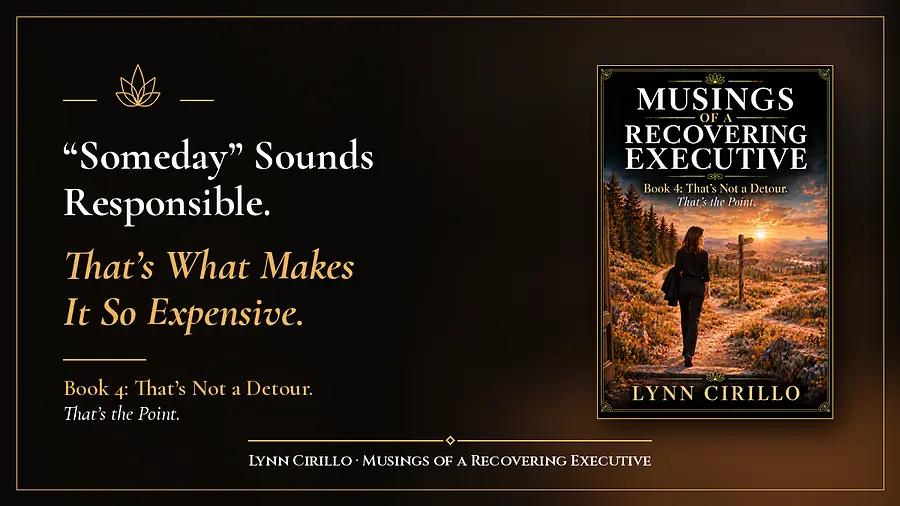
I follow the throughlines in my own life, from a career I never planned to the curiosity that traveled with me through all of it, in That's Not a Detour. That's the Point., Book 4 in my Musings of a Recovering Executive series. Each chapter ends with Excavation Questions to help you find the patterns in your own path. You can learn more at https://MusingsOfaRecoveringExecutive.com/books/thats-not-a-detour-thats-the-point/.
About the Author
Lynn Cirillo is an author, leadership mentor, and founder of Grounded Leadership LLC, based in Cheyenne, Wyoming. A former Executive Vice President who oversaw people, technology, data, research, systems, and organizational change, she spent more than three decades in corporate America and executive leadership. She writes the Musings of a Recovering Executive series about leadership, identity, boundaries, reinvention, and neurodiversity. Learn more at https://MusingsOfaRecoveringExecutive.com/.