Entity Optimization: Why the Business Structure You Started With May Not Be the One That Serves You Now
Why your business structure may no longer fit your growing company—and what to do about it.

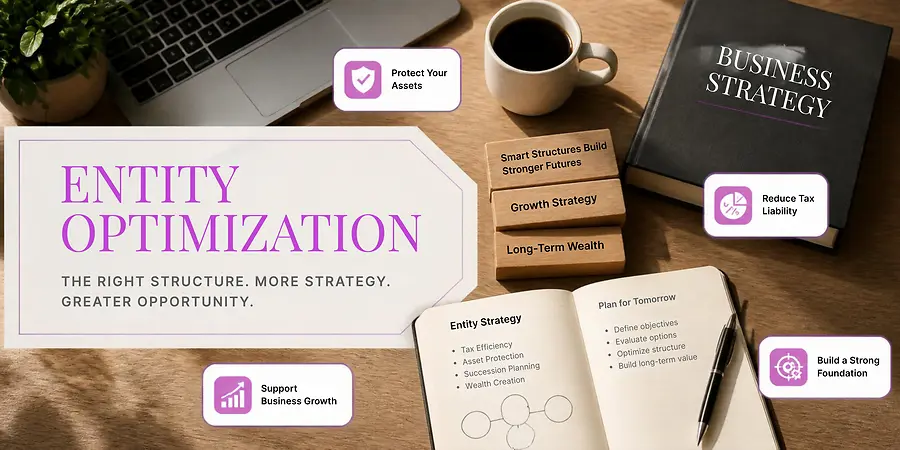
Most business owners choose their legal structure once—usually in the first year, often based on whatever felt simplest at the time—and never revisit it again. That decision made sense for the business you had then. It may not make sense for the business you have now.
This is the blind spot I see most often in my work with growing business owners: the business changes, the revenue changes, the risk changes, but the entity structure stays frozen in time. That gap has a name—entity optimization—and closing it is one of the most overlooked levers a business owner has.
What Entity Optimization Actually Means
Entity optimization is the process of evaluating whether your current business structure—sole proprietorship, single-member LLC, multi-member LLC, S corporation, C corporation, or a combination of entities—still fits your business today. It's not about chasing the "best" structure in the abstract. It's about matching the structure to the business: how much you're earning, how much risk you're carrying, how many people are involved, and where you're headed.
A structure that was efficient and protective at one stage of growth can quietly become a liability at the next. Owners rarely notice this happening in real time because nothing forces the review. There's no automatic alert that says, "Your structure is now working against you." It has to be looked at deliberately, and usually by someone outside the day-to-day operations of the business.
Why This Matters More As You Grow
As a business scales, three things tend to grow alongside it: tax exposure, personal liability exposure, and complexity. Each of these interacts directly with entity structure.
The right structure can help manage how income is taxed, create a clearer line between personal and business liability, and give a growing company more flexibility—to bring on a partner, raise capital, hire, or eventually sell. The wrong structure doesn't just fail to help with these things; it can actively work against them, often in ways that aren't visible until a tax season, a lawsuit, or a sale process forces the issue.
For women building and scaling businesses in particular, this matters because credibility and protection compound. A structure that signals seriousness to lenders, investors, and partners—and that genuinely protects personal assets from business risk—supports every other growth decision made downstream.
Signs It May Be Time to Revisit Your Structure
A few patterns tend to show up when a business has outgrown its original entity setup:
- Revenue has grown meaningfully since the structure was first put in place.
- The business has taken on more risk—new contracts, new locations, new liability exposure—without a corresponding review of how that risk is legally contained.
- There's more than one income stream running through the same entity.
- A partner, co-owner, or investor is entering the picture.
- There's a real possibility of selling the business, bringing on family members, or passing it on within the next several years.
None of these alone automatically means a change is needed. But together, they're a strong signal that the structure deserves a second look rather than an assumption that "it's fine because it's always been fine."
How the Process Works, in General Terms
A proper entity optimization review starts with an honest picture of where the business stands today—not just income, but how the business actually operates, who's involved, and what risks exist. From there, the available structures are evaluated against that reality, not against a generic best practice. Any recommended change is weighed against the cost and complexity of making it because a technically "better" structure isn't worth pursuing if the transition outweighs the benefit.
This isn't a one-time fix, either. The businesses that benefit most from entity optimization treat it as a recurring checkpoint—revisited as the business changes, not left in place indefinitely.
The Bottom Line
Your business structure should be working for you, not simply inherited from a decision made years ago. Reviewing it isn't about second-guessing your original choice—it's about making sure the business you've built today is protected and positioned by a structure that actually matches it.